
Free Safe Operating Procedure (Crop Thinning) Template
Download our free Safe Operating Procedure for crop thinning to formalise safety processes for this common agricultural task. Customise this template today.
Free Safe Operating Procedure (Crop Thinning) Template
DOCX • 126 KB + PDF
Updated Oct 2026
No signup required
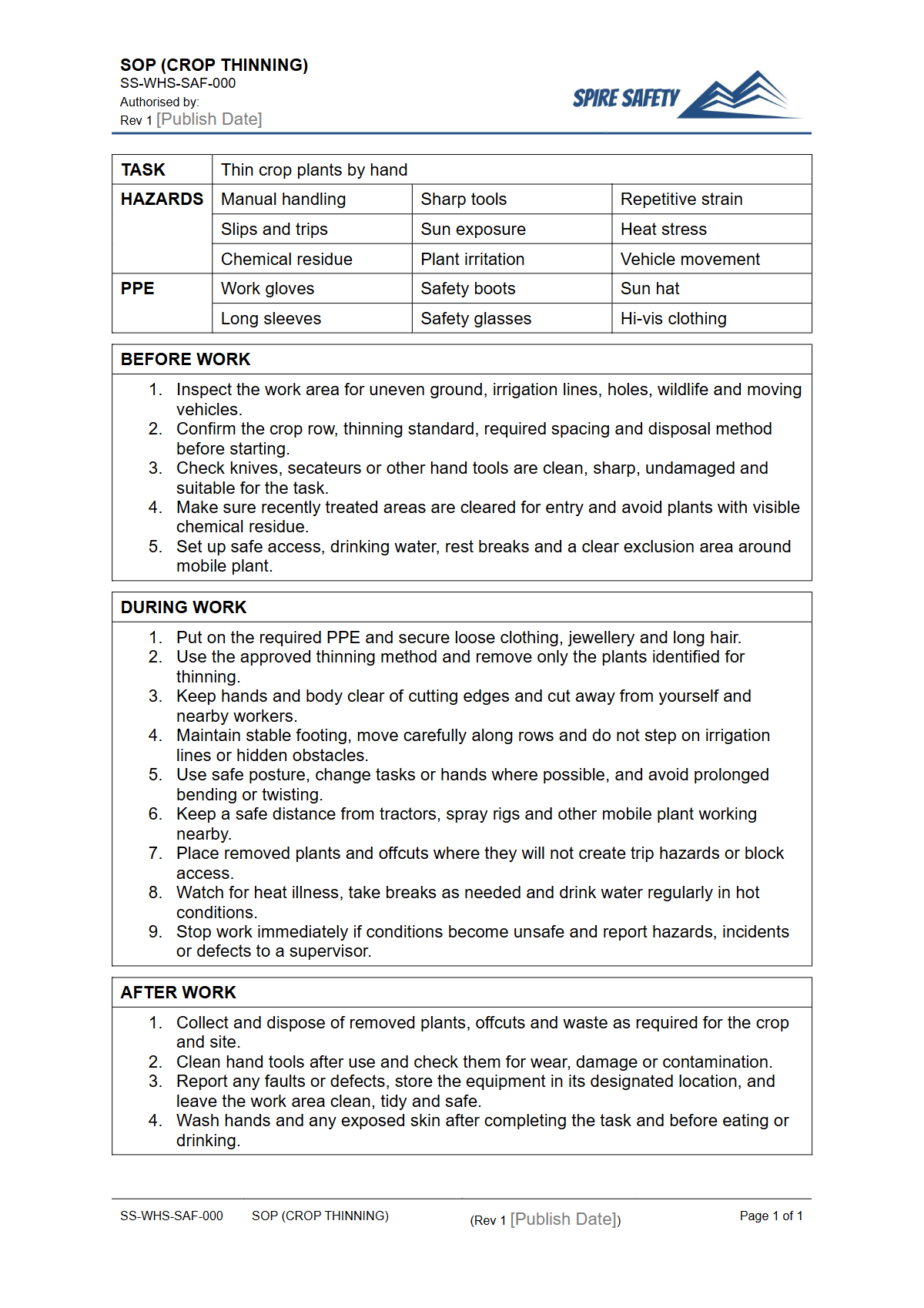
Purpose of the Free Safe Operating Procedure (Crop Thinning) Template
This Safe Operating Procedure (SOP) provides a structured framework for performing crop thinning tasks safely and efficiently. Crop thinning, a crucial process in many agricultural settings to improve crop quality and yield, involves repetitive manual tasks and exposure to various hazards.
A formal SOP helps standardise procedures, ensuring every worker understands the identified risks and the required control measures to mitigate them.
By documenting the process, you create a clear, consistent training resource that helps meet your duty of care obligations under Australian WHS legislation. It establishes a benchmark for expected safe work behaviour and provides a foundation for risk management. The principles in this document can be adapted to other agricultural processes, such as those covered in our FREE Planter SOP Template.
Video walkthrough
How to use the Free Safe Operating Procedure (Crop Thinning) Template
Our template is provided in both DOCX and PDF formats for your convenience. To use it effectively, download the DOCX file and adapt it to the specific conditions of your farm or horticultural business.
This involves adding details about your unique site, the specific crops being thinned, the tools used, and the personnel involved.
Important: It is essential to customise this document for your specific workplace. We have provided a comprehensive starting point, but you must add or remove information to reflect your unique site conditions, equipment, and personnel.
You should conduct a site-specific risk assessment and consult with your workers to ensure the final SOP is practical and effective.
When to use this Safe Operating Procedure
A Safe Operating Procedure for crop thinning should be used as a core part of your daily and long-term safety management. It is most effective when integrated into your processes at several key stages:
- Worker Induction: Use the SOP to train new workers and contractors before they begin any crop thinning tasks.
- Pre-start Meetings: Refer to the SOP during daily briefings or toolbox talks, especially at the start of the thinning season, to refresh workers' knowledge of hazards and controls.
- Refresher Training: Schedule periodic reviews of the SOP with experienced workers to reinforce safe practices and discuss any new hazards.
- Incident Investigation: Use the SOP as a benchmark to determine if procedures were followed correctly after an incident or near-miss occurs.
Who should use it
This template is designed for use by anyone responsible for workplace health and safety in an agricultural or horticultural setting. Key users include:
- Farm Owners and Managers: To establish and implement formal safety procedures across their operations.
- Supervisors and Team Leaders: To train, monitor, and guide workers in performing tasks safely.
- WHS Officers and Advisors: To develop and integrate task-specific procedures into the broader safety system.
- Workers: As a clear guide on how to perform their job without compromising their health and safety or that of their colleagues.
Key Hazards in Crop Thinning
Crop thinning activities present several significant hazards that must be managed. Your SOP should detail control measures for risks including:
- Musculoskeletal Disorders: From repetitive movements, awkward postures (bending, reaching, twisting), and forceful exertions.
- Slips, Trips, and Falls: On uneven, wet, or cluttered ground.
- Environmental Exposure: Risks from sun (UV exposure), heat stress, cold, rain, and wind.
- Manual Handling: Lifting and moving ladders, bags, or other equipment.
- Tools and Equipment: Cuts and lacerations from thinning shears or knives.
- Biological Hazards: Bites and stings from insects, spiders, or snakes.
Integrating SOPs into Your WHS System
A single SOP is a valuable tool, but its effectiveness is magnified when it's part of a comprehensive safety framework. Documented procedures like this one form the practical, on-the-ground component of your overall WHS management systems. An effective system ensures that procedures are developed through proper risk assessment, communicated through training, monitored for compliance, and regularly reviewed for continuous improvement.
Training and Consultation
Developing an SOP in isolation is a common mistake. WHS regulations require consultation with workers.
The people performing the task every day have invaluable insight into the real-world risks and the practicality of proposed controls. Involve your team in drafting and reviewing the SOP.
Once finalised, you must provide clear training to ensure everyone understands its contents. For organisations needing assistance with this process, our WHS consulting services can provide expert guidance on implementation and training.
Documenting procedures for all key tasks, including those outlined in resources like our FREE Spreader SOP Template, ensures consistency.
Find More Agricultural Safety Resources
This crop thinning SOP is one of many documents available to support safety in the agricultural industry. Standardising procedures for all high-risk tasks is essential for building a strong safety culture.
For example, you may also need a FREE Seed Drill SOP Template to manage planting operations. You can explore our complete free WHS resources library to find more templates, checklists, and guides to help you manage your workplace health and safety obligations effectively.
Common mistakes
Common mistakes to avoid
- Using a generic template without adding site-specific details, tools, and environmental conditions.
- Failing to consult with workers who perform the crop thinning task during the drafting and review process.
- Not providing practical training on the finalised SOP, assuming workers will read and understand it on their own.
- Treating the SOP as a document that is filed away, rather than a live document used for training and regular review.
Legal references
Legal considerations
The following legal requirements may be relevant to this type of work.
- Work Health and Safety Act (Harmonised) — Provides the primary duties for protecting workers and other people from work health and safety risks.
- Work Health and Safety Regulations (Harmonised) — Sets out requirements supporting the management of workplace hazards and risks.
The following codes may be relevant to this type of work.
- Managing WHS Risks Code of Practice — Provides practical guidance on identifying hazards, assessing risks and applying effective controls.
- Work Health and Safety Consultation, Cooperation and Coordination Code of Practice — Provides practical guidance on consulting workers and coordinating with other duty holders.
- Managing the Work Environment and Facilities Code of Practice — Provides practical guidance on safe work environments, workplace facilities and related controls.
Did you know
A High-Risk Industry
The agriculture, forestry, and fishing industry is consistently one of the highest-risk industries in Australia, with a serious injury claim rate significantly higher than the national average.
Manual Task Risks
Hazardous manual tasks, such as the repetitive movements common in crop thinning, are a leading cause of workplace injuries in the agricultural sector, resulting in costly musculoskeletal disorders.
FAQ
Frequently asked questions
01What should be included in a Safe Operating Procedure for crop thinning?
02How often should a crop thinning SOP be reviewed?
03Is a Safe Operating Procedure a legal requirement in Australia for crop thinning?
04Can this template be used for fruit thinning as well?
Share this resource
Free Safe Operating Procedure (Crop Thinning) Template
Browse Categories
How To Use It
- 1Download and open in Word or PDF.
- 2Replace the placeholders with your business details.
- 3Get it reviewed by a WHS specialist before rollout.
Need it customised?
Our WHS consultants can adapt this template to your site, run a gap analysis, or audit what you already have in place.
Book a Free Consultation WHS consulting servicesor call 1300 156 382
Related templates
- Free Safe Operating Procedure (Cross Dock Transfer) Template
- Free Safe Operating Procedure (Crowd Barrier Handling) Template
- Free Safe Operating Procedure (Crowd Entry Screening) Template
- Free Safe Operating Procedure (Crowd Queue Control) Template
- Free Safe Operating Procedure (Crusher Operation) Template
- Free Safe Operating Procedure (Cryogenic Dewar) Template