
Free Safe Operating Procedure (Cross Dock Transfer) Template
Formalise your cross docking process with our structured Safe Operating Procedure template. Download our free DOCX and PDF resource to get started today.
Free Safe Operating Procedure (Cross Dock Transfer) Template
DOCX • 126 KB + PDF
Updated Oct 2026
No signup required
Purpose of the Free Safe Operating Procedure (Cross Dock Transfer) Template
Cross docking is a high-paced logistics strategy that involves transferring goods directly from inbound to outbound transport with minimal to no storage time. While it boosts efficiency, it also introduces significant WHS risks.
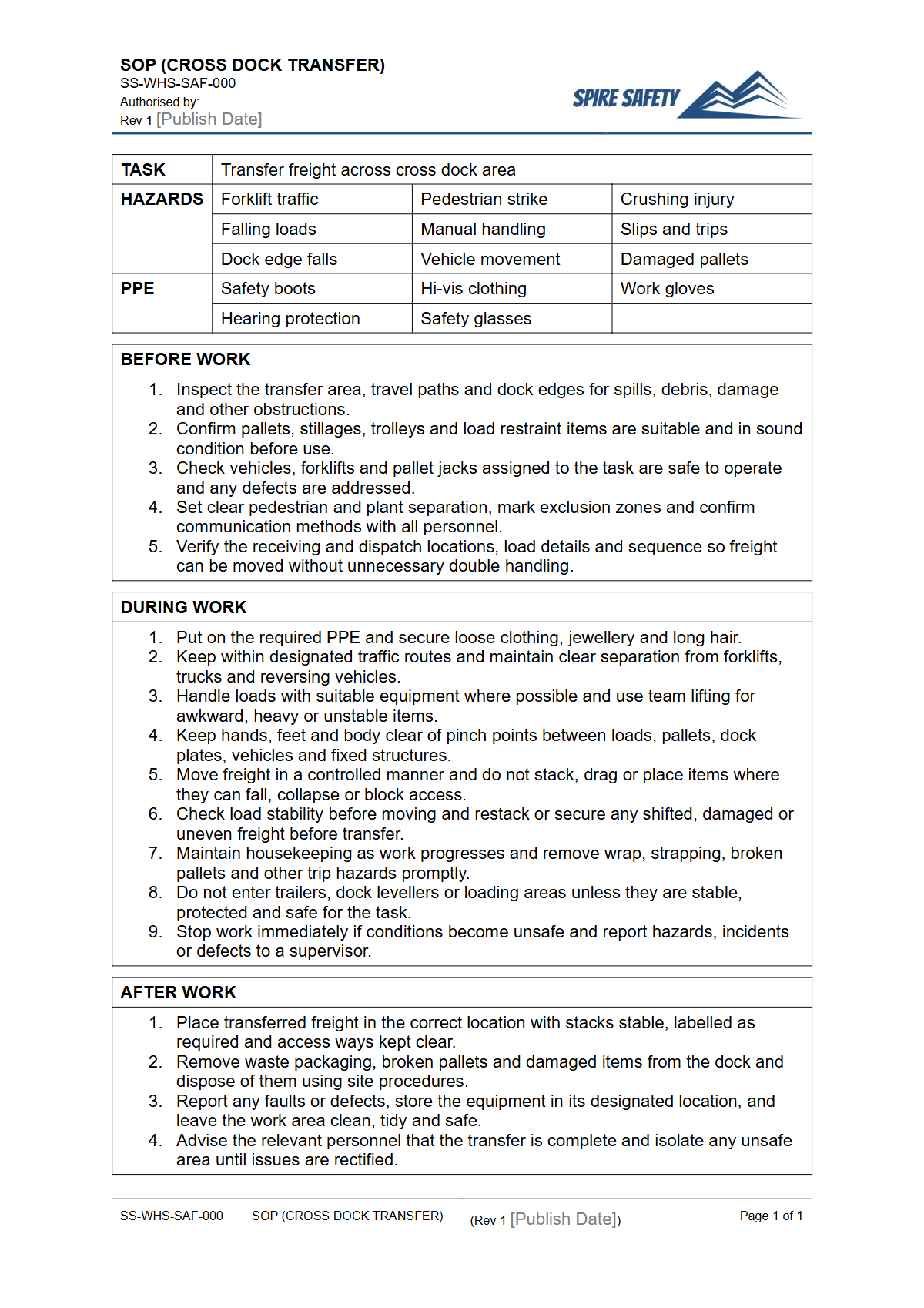
This Free Safe Operating Procedure (Cross Dock Transfer) Template provides a structured framework for documenting the safest way to perform this task. By clearly defining steps, responsibilities, and precautions, your organisation can minimise the risk of incidents involving mobile plant, manual handling, and vehicle movements.
A documented SOP helps standardise your process, ensuring every worker follows the same approved method. This consistency is vital for reducing errors, preventing injuries, and maintaining an efficient flow of goods.
It forms a key part of your overall safety management system, demonstrating a commitment to providing a safe work environment for all employees and contractors involved in your supply chain operations. A thorough procedure also aids in training new staff and serves as a benchmark for safety performance reviews and WHS compliance auditing.
Video walkthrough
How to use the Free Safe Operating Procedure (Cross Dock Transfer) Template
This template is a starting point designed to be adapted to your specific workplace. To make it effective, you must customise it with details relevant to your site's layout, equipment, personnel, and the types of freight being handled.
Download the DOCX file and begin by walking through the procedure on-site with the workers who actually perform the task.
Key areas for customisation include:
- Site-Specific Information: Add your company name, the specific location or dock number, and dates for review.
- Plant and Equipment: List all equipment used, such as forklifts, pallet jacks, or automated systems. Reference specific operator manuals or related procedures, like a Telehandler SOP template if these are used on your site.
- Risk Assessment: Detail the findings from your risk assessment, including identified hazards (e.g., collisions, falls, manual handling injuries) and the control measures you have implemented.
- Step-by-Step Instructions: Break down the entire cross docking process from the arrival of the inbound truck to the departure of the outbound vehicle. Be specific about communication protocols, load inspection, securing freight, and traffic management rules.
Important: This is a template only. We are not WHS consultants, and this document must be customised by a competent person to suit your specific business operations, plant, and equipment.
You must ensure it aligns with your existing WHS management systems and addresses all identified hazards.
When to use a Cross Dock Transfer SOP
A Safe Operating Procedure for cross docking should be a live document, used consistently throughout your operations. It is not a "set and forget" tool.
Its primary use is to provide clear, accessible instructions for workers performing the task, ensuring safety and efficiency every time. It should be readily available in the relevant work area, whether in a printed binder or on a digital device.
Beyond daily operational guidance, this SOP is essential during specific activities. Use it as a central document for worker induction and training, ensuring new team members understand the approved method from day one.
It is also a critical tool for conducting refresher training and for facilitating toolbox talks on specific hazards related to cross docking, such as pedestrian segregation or load stability. After any incident, near miss, or change in process, the SOP must be reviewed and updated to incorporate learnings and new control measures.
Who should use this Safe Operating Procedure
This Safe Operating Procedure is intended for a broad range of personnel within a logistics or warehousing environment. Primarily, it is for the workers and operators who physically carry out the cross docking tasks, including forklift operators, freight handlers, and truck drivers.
They need to understand and follow the procedure to ensure their own safety and the safety of their colleagues.
Supervisors, team leaders, and warehouse managers are responsible for implementing, enforcing, and reviewing the SOP. They use it to train staff, monitor work practices, and investigate any deviations from the established procedure.
Furthermore, WHS advisors and safety committees should be involved in the development and review process to ensure the SOP effectively controls risks and aligns with broader safety policies. For operations that use specific machinery, integrating this with other documents like a Conveyer System SOP ensures a holistic approach to safety in the loading area.
Our free WHS resources library has many other templates you can adapt for your workplace.
Common mistakes
Common mistakes to avoid
- Failing to customise the template for specific site layouts and traffic flow.
- Inadequate training for workers on the finalised procedure and emergency plans.
- Neglecting to clearly define and enforce pedestrian exclusion zones around vehicles and plant.
- Not reviewing and updating the SOP after an incident, near miss, or change in process.
Legal references
Legal considerations
The following legal requirements may be relevant to this type of work.
- Work Health and Safety Act (Harmonised) — Provides the primary duties for protecting workers and other people from work health and safety risks.
- Work Health and Safety Regulations (Harmonised) — Sets out requirements supporting the management of workplace hazards and risks.
The following codes may be relevant to this type of work.
- Managing WHS Risks Code of Practice — Provides practical guidance on identifying hazards, assessing risks and applying effective controls.
- Work Health and Safety Consultation, Cooperation and Coordination Code of Practice — Provides practical guidance on consulting workers and coordinating with other duty holders.
- Managing the Work Environment and Facilities Code of Practice — Provides practical guidance on safe work environments, workplace facilities and related controls.
Did you know
Efficiency Gains
Effective cross docking can reduce material handling by over 50% and decrease the time from production to customer, significantly lowering storage and inventory holding costs.
High-Risk Industry
The Transport, Postal & Warehousing industry consistently ranks among the highest for serious workers' compensation claims in Australia, with body stressing and falls, trips and slips being major causes.
FAQ
Frequently asked questions
01What is cross docking in a warehouse?
02What are the main hazards in cross docking operations?
03Does this Safe Operating Procedure template cover traffic management?
04How often should a Cross Dock Transfer SOP be reviewed?
Share this resource
Free Safe Operating Procedure (Cross Dock Transfer) Template
Browse Categories
How To Use It
- 1Download and open in Word or PDF.
- 2Replace the placeholders with your business details.
- 3Get it reviewed by a WHS specialist before rollout.
Need it customised?
Our WHS consultants can adapt this template to your site, run a gap analysis, or audit what you already have in place.
Book a Free Consultation WHS consulting servicesor call 1300 156 382
Related templates
- Free Safe Operating Procedure (Crowd Barrier Handling) Template
- Free Safe Operating Procedure (Crowd Entry Screening) Template
- Free Safe Operating Procedure (Crowd Queue Control) Template
- Free Safe Operating Procedure (Crusher Operation) Template
- Free Safe Operating Procedure (Cryogenic Dewar) Template
- Free Safe Operating Procedure (Culvert Clearing) Template