
Free Safe Operating Procedure (Creek Bank Cleanup) Template
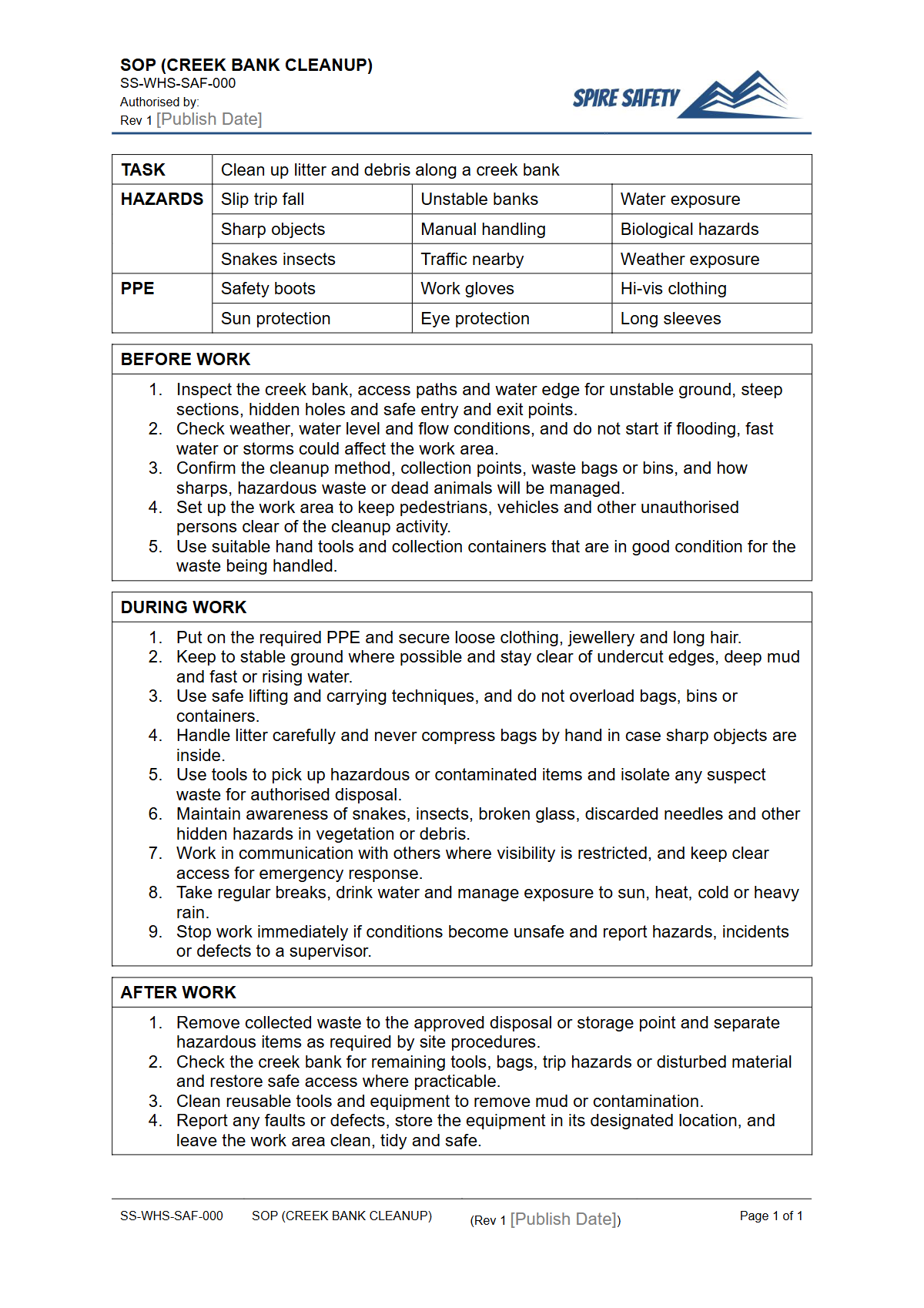
Download our free Safe Operating Procedure (Creek Bank Cleanup) Template. This document provides a structured starting point for outlining safe work practices.
Free Safe Operating Procedure (Creek Bank Cleanup) Template
DOCX • 126 KB + PDF
Updated Oct 2026
No signup required
Purpose of the Free Safe Operating Procedure (Creek Bank Cleanup) Template
This Safe Operating Procedure (SOP) template is designed to help organisations establish and document a safe system of work for creek bank cleanup activities. Environmental and community projects, while beneficial, introduce unique hazards that must be managed to ensure the health and safety of workers and volunteers.
Our Free Safe Operating Procedure (Creek Bank Cleanup) Template provides a structured foundation for identifying risks—from unstable ground and manual handling to biological hazards—and implementing effective control measures. It formalises step-by-step instructions, PPE requirements, and emergency protocols, serving as a critical tool for training, inductions, and ongoing risk management.
Video walkthrough
How to use the Free Safe Operating Procedure (Creek Bank Cleanup) Template
You can download this template in DOCX format for easy editing or as a PDF for straightforward printing and distribution. It is structured based on Australian WHS principles and common industry practice.
This document is a starting point, not a finished product. It is essential that you conduct a thorough risk assessment and customise the contents to reflect the specific conditions of your worksite, the equipment being used, the tasks being performed, and the competency of your personnel.
A generic SOP that doesn't account for site-specific variables is insufficient for managing your safety obligations.
Key Sections to Customise
To make the SOP effective, pay close attention to customising the following areas:
- Site-Specific Hazards and Risks: Detail all potential hazards unique to your location, such as steep banks, fast-flowing water, local venomous wildlife, or contaminated waste.
- Control Measures: List the specific controls you will implement to mitigate the identified risks. This could include exclusion zones, specific manual handling techniques, or water safety protocols.
- Personal Protective Equipment (PPE): Specify the exact PPE required, such as non-slip waterproof boots, gloves rated for biological or chemical hazards, high-visibility clothing, and sun protection.
- Step-by-Step Procedure: Break down the cleanup process into clear, sequential steps from pre-start checks to waste disposal and site pack-up.
- Emergency Procedures: Outline the response plan for incidents like injury, snake bite, or a person falling into the water, including contact details and the location of first aid kits.
Integrating tailored SOPs into your daily operations is a core component of a robust safety framework. Developing these procedures is a key part of building effective WHS management systems that protect your people and ensure operational consistency.
When to use it
This Safe Operating Procedure should be developed, finalised, and communicated before any creek bank cleanup work commences. It forms a crucial part of the planning phase, ensuring that risks are considered and controlled before anyone is exposed to them.
The SOP should be used during pre-start meetings to brief all participants on the day's tasks and safety requirements. It also serves as a primary training document for inducting new workers or volunteers and as a reference tool for supervisors to monitor that the agreed-upon safe work methods are being followed.
If you need assistance embedding these processes into your workflow, our WHS consulting services can provide expert guidance.
Who should use it
This template is intended for use by Persons Conducting a Business or Undertaking (PCBUs), managers, supervisors, and team leaders who are responsible for planning, organising, and overseeing cleanup activities. This includes leaders within local councils, environmental agencies, landcare groups, and community organisations.
They are responsible for ensuring the SOP is customised and implemented correctly. The final, approved SOP is a critical document for all workers and volunteers involved in the cleanup, as it clearly outlines their responsibilities and the procedures they must follow to work safely. For larger-scale creek bank rehabilitation projects that may involve earthmoving equipment, you should also develop specific procedures, such as those outlined in our free Dozer SOP template.
Common Hazards in Creek Bank Cleanups
Creek banks can be hazardous environments. A thorough risk assessment is essential to identify and control the specific risks at your site. Common hazards include:
- Slips, trips, and falls: Caused by wet, slippery, or uneven ground, rocks, and submerged objects.
- Manual handling injuries: From lifting, carrying, or dragging heavy or awkward items like bags of rubbish, logs, or tyres.
- Biological hazards: Exposure to bacteria in water, snakes, spiders, insects, and sharp vegetation like thorns.
- Hazardous materials: Contact with discarded chemical containers, broken glass, needles, or asbestos-containing materials.
- Working near water: Risk of falling into water and drowning, particularly in areas with strong currents or cold temperatures.
- Environmental hazards: Sunburn, dehydration, heat stress, or hypothermia from adverse weather conditions.
If the project involves mechanically stabilising the bank, procedures for specific plant are critical; you can use our free Trencher SOP Template as a guide for this associated task. You can find more templates to help manage various workplace hazards in our free WHS resources library.
Common mistakes
Common mistakes to avoid
- Using a generic template without customising it for site-specific hazards like water depth, current speed, and local wildlife.
- Failing to check weather forecasts and water level information before commencing work.
- Providing inadequate or incorrect PPE, such as gloves that don't protect against biological hazards or broken glass.
- Neglecting to induct all workers and volunteers on the finalised SOP before they start work.
Legal references
Legal considerations
The following legal requirements may be relevant to this type of work.
- Work Health and Safety Act (Harmonised) — Provides the primary duties for protecting workers and other people from work health and safety risks.
- Work Health and Safety Regulations (Harmonised) — Sets out requirements supporting the management of workplace hazards and risks.
The following codes may be relevant to this type of work.
- Managing WHS Risks Code of Practice — Provides practical guidance on identifying hazards, assessing risks and applying effective controls.
- Work Health and Safety Consultation, Cooperation and Coordination Code of Practice — Provides practical guidance on consulting workers and coordinating with other duty holders.
- Managing the Work Environment and Facilities Code of Practice — Provides practical guidance on safe work environments, workplace facilities and related controls.
Did you know
Manual Tasks are a Major Risk
According to Safe Work Australia, injuries resulting from hazardous manual tasks are the most common type of workplace injury in the country. A proper SOP helps mitigate this risk through planned work methods and team lifting.
The Importance of Consultation
Australian WHS laws mandate that PCBUs must consult with their workers on matters affecting their health and safety. Involving your team in the creation of an SOP makes it more practical and effective, increasing the likelihood it will be followed.
FAQ
Frequently asked questions
01What should be included in a Safe Operating Procedure for creek bank cleanup?
02Is this creek cleanup SOP template suitable for volunteer groups?
03How often should a Safe Operating Procedure be reviewed?
04Who is responsible for creating a creek bank cleanup SOP?
Share this resource
Free Safe Operating Procedure (Creek Bank Cleanup) Template
Browse Categories
How To Use It
- 1Download and open in Word or PDF.
- 2Replace the placeholders with your business details.
- 3Get it reviewed by a WHS specialist before rollout.
Need it customised?
Our WHS consultants can adapt this template to your site, run a gap analysis, or audit what you already have in place.
Book a Free Consultation WHS consulting servicesor call 1300 156 382
Related templates
- Free Safe Operating Procedure (Crematorium Ash Handling) Template
- Free Safe Operating Procedure (Crew Bus Cleaning) Template
- Free Safe Operating Procedure (Cricket Pitch Cover) Template
- Free Safe Operating Procedure (Cricket Pitch Repair) Template
- Free Safe Operating Procedure (Crimp Lug Press) Template
- Free Safe Operating Procedure (Crop Row Marking) Template