
Free Safe Operating Procedure (Crematorium Ash Handling) Template
Download our free Safe Operating Procedure for crematorium ash handling. This template provides a structured starting point for your WHS documents.
Free Safe Operating Procedure (Crematorium Ash Handling) Template
DOCX • 126 KB + PDF
Updated Oct 2026
No signup required
Purpose of the Free Safe Operating Procedure (Crematorium Ash Handling) Template
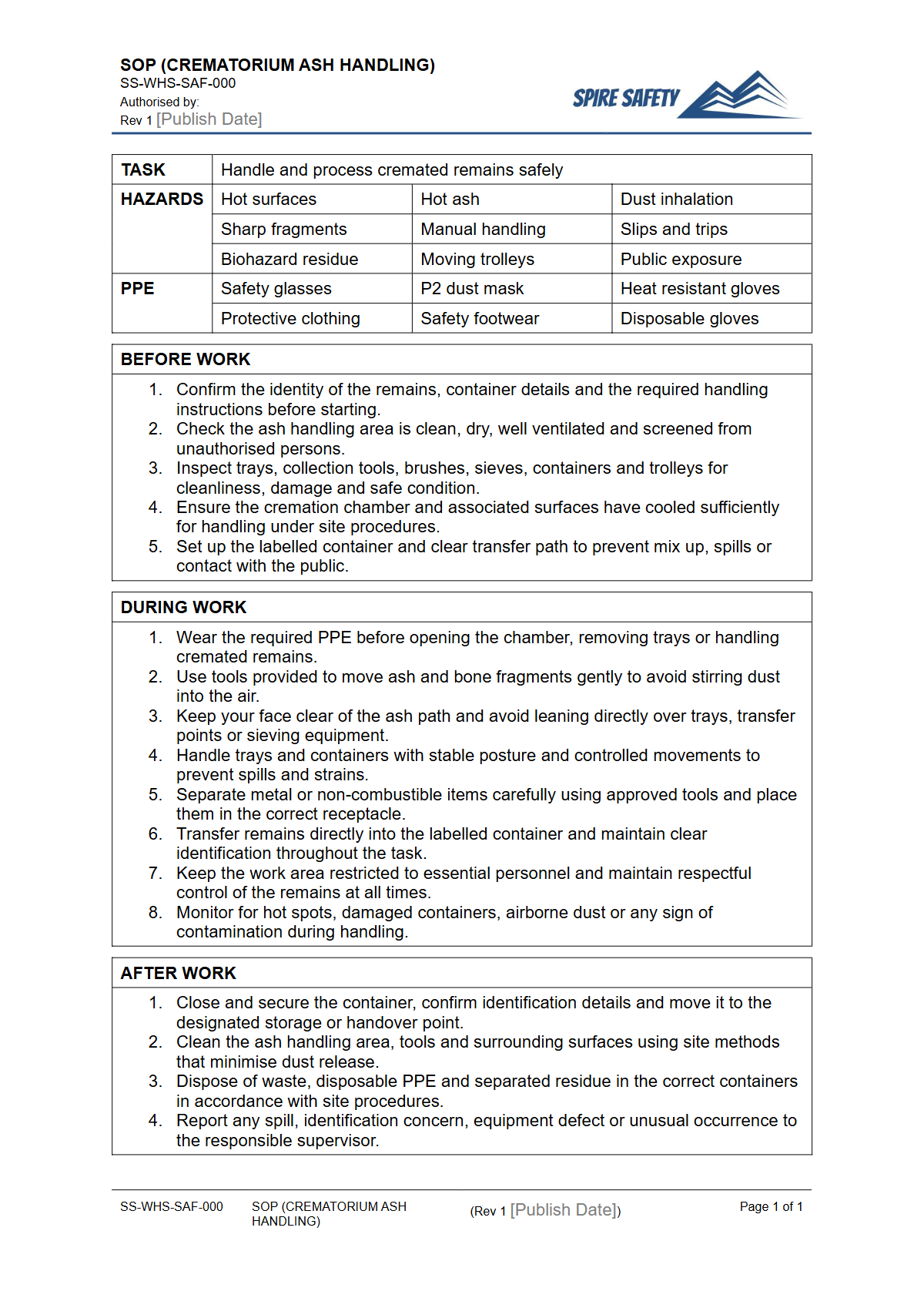
Handling cremated remains, or 'ash', is a sensitive and specialised task with significant work health and safety risks. This Free Safe Operating Procedure (Crematorium Ash Handling) Template provides a structured framework for organisations to document a safe system of work for this process.
A documented SOP is essential for managing hazards such as thermal burns from hot remains, musculoskeletal injuries from manual handling, and respiratory exposure to fine particulates. By implementing a clear and consistent procedure, you can protect your workers, ensure respectful handling of remains, and demonstrate a commitment to safety and diligence.
The primary goal is to minimise risk by outlining step-by-step instructions for tasks like opening the cremator, cooling remains, processing (pulverising), and transferring the ash into an urn or container. This document forms a critical part of an organisation’s broader WHS management systems, helping to standardise operations and provide a clear reference for training and supervision.
It encourages a proactive approach to safety, moving beyond assumptions to a clearly defined and agreed-upon process.
Video walkthrough
How to use the Free Safe Operating Procedure (Crematorium Ash Handling) Template
This document is a template, not a finished product. To be effective, you must customise it to reflect the specific circumstances of your workplace.
Generic procedures are a common point of failure in safety management. We have drafted this SOP as a starting point, but you are responsible for ensuring it is tailored to your unique environment, equipment, and legal obligations.
Customisation Steps:
- Consultation: Involve the workers who perform the task. Their direct experience is invaluable for identifying the real-world hazards and practical control measures. Consultation is a key requirement of WHS legislation.
- Risk Assessment: Before finalising the SOP, conduct a specific risk assessment for handling crematorium ash at your site. Identify all potential hazards, assess the level of risk, and determine the most effective control measures. This process will inform the details you include in the procedure.
- Site-Specific Details: Edit the template to include the specific make and model of your cremator and cremulator (processor), your chosen Personal Protective Equipment (PPE), emergency procedures, and contact details. Remove any steps or equipment mentioned in the template that are not relevant to your operation.
- Review and Approve: Once customised, the SOP should be reviewed and approved by a competent person, such as a manager or WHS officer.
- Training: All relevant workers must be trained on the final, approved SOP. Ensure they understand the steps, the reasons behind them, and what to do in an emergency. Keep records of this training.
If you require assistance in conducting risk assessments or tailoring safety documents to your operations, consider engaging professional WHS consulting services for expert guidance.
When to use this Safe Operating Procedure
This SOP should be used as the primary reference document every time cremated remains are handled. It is not a document to be filed away and forgotten.
It should be readily accessible to workers in the operational area. It is particularly important to refer to the SOP when training new employees, conducting refresher training for existing staff, investigating an incident or near miss, or when there are changes to equipment or procedures.
Regular use and review ensure that the safe work method remains current and effective.
Who should use this Safe Operating Procedure
This procedure is designed for all personnel directly involved in the crematorium process. This includes cremator operators, funeral home attendants, cemetery workers, and any other staff member whose duties involve the cooling, collection, processing, or packaging of cremated remains.
Supervisors and managers should also be thoroughly familiar with the SOP to ensure they can effectively oversee operations and enforce safety standards. WHS representatives will find it a useful tool for monitoring workplace safety and conducting inspections. Even maintenance staff can benefit from understanding the procedure, especially when servicing equipment like the cremulator or its dust extraction systems, which might use components similar to those covered in a free Air Compressor SOP.
This template is just one example of the many documents available. For more procedural templates and safety checklists, you can browse our complete free WHS resources library.
Common mistakes
Common mistakes to avoid
- Handling remains before they have cooled sufficiently, creating a significant burn risk.
- Neglecting to use or properly maintain appropriate respiratory protective equipment (RPE).
- Using a generic procedure without customising it for the site's specific cremator and processor.
- Poor housekeeping that allows ash dust to accumulate on surfaces, posing an ongoing inhalation hazard.
Legal references
Legal considerations
The following legal requirements may be relevant to this type of work.
- Work Health and Safety Act (Harmonised) — Provides the primary duties for protecting workers and other people from work health and safety risks.
- Work Health and Safety Regulations (Harmonised) — Sets out requirements supporting the management of workplace hazards and risks.
The following codes may be relevant to this type of work.
- Managing WHS Risks Code of Practice — Provides practical guidance on identifying hazards, assessing risks and applying effective controls.
- Work Health and Safety Consultation, Cooperation and Coordination Code of Practice — Provides practical guidance on consulting workers and coordinating with other duty holders.
- Managing the Work Environment and Facilities Code of Practice — Provides practical guidance on safe work environments, workplace facilities and related controls.
Did you know
The 'Cremulator'
The machine used to process bone fragments into fine, uniform ash after cremation is called a 'cremulator'. This step is crucial for preparing the remains for an urn and is a key focus of safety procedures due to the dust it can generate.
Cooling Times
Cremated remains can retain dangerously high temperatures for several hours after being removed from the cremator. Rushing this cooling period is a common cause of serious thermal burns, highlighting the need for a strict, time-based procedure.
FAQ
Frequently asked questions
01What are the main hazards involved in handling crematorium ash?
02Is specific PPE required for handling cremated remains?
03How often should an SOP for crematorium ash handling be reviewed?
04Can this SOP template be adapted for pet crematoriums?
Share this resource
Free Safe Operating Procedure (Crematorium Ash Handling) Template
Browse Categories
How To Use It
- 1Download and open in Word or PDF.
- 2Replace the placeholders with your business details.
- 3Get it reviewed by a WHS specialist before rollout.
Need it customised?
Our WHS consultants can adapt this template to your site, run a gap analysis, or audit what you already have in place.
Book a Free Consultation WHS consulting servicesor call 1300 156 382
Related templates
- Free Safe Operating Procedure (Crew Bus Cleaning) Template
- Free Safe Operating Procedure (Cricket Pitch Cover) Template
- Free Safe Operating Procedure (Cricket Pitch Repair) Template
- Free Safe Operating Procedure (Crimp Lug Press) Template
- Free Safe Operating Procedure (Crop Row Marking) Template
- Free Safe Operating Procedure (Crop Scouting) Template