
Free Safe Operating Procedure (Crew Bus Cleaning) Template
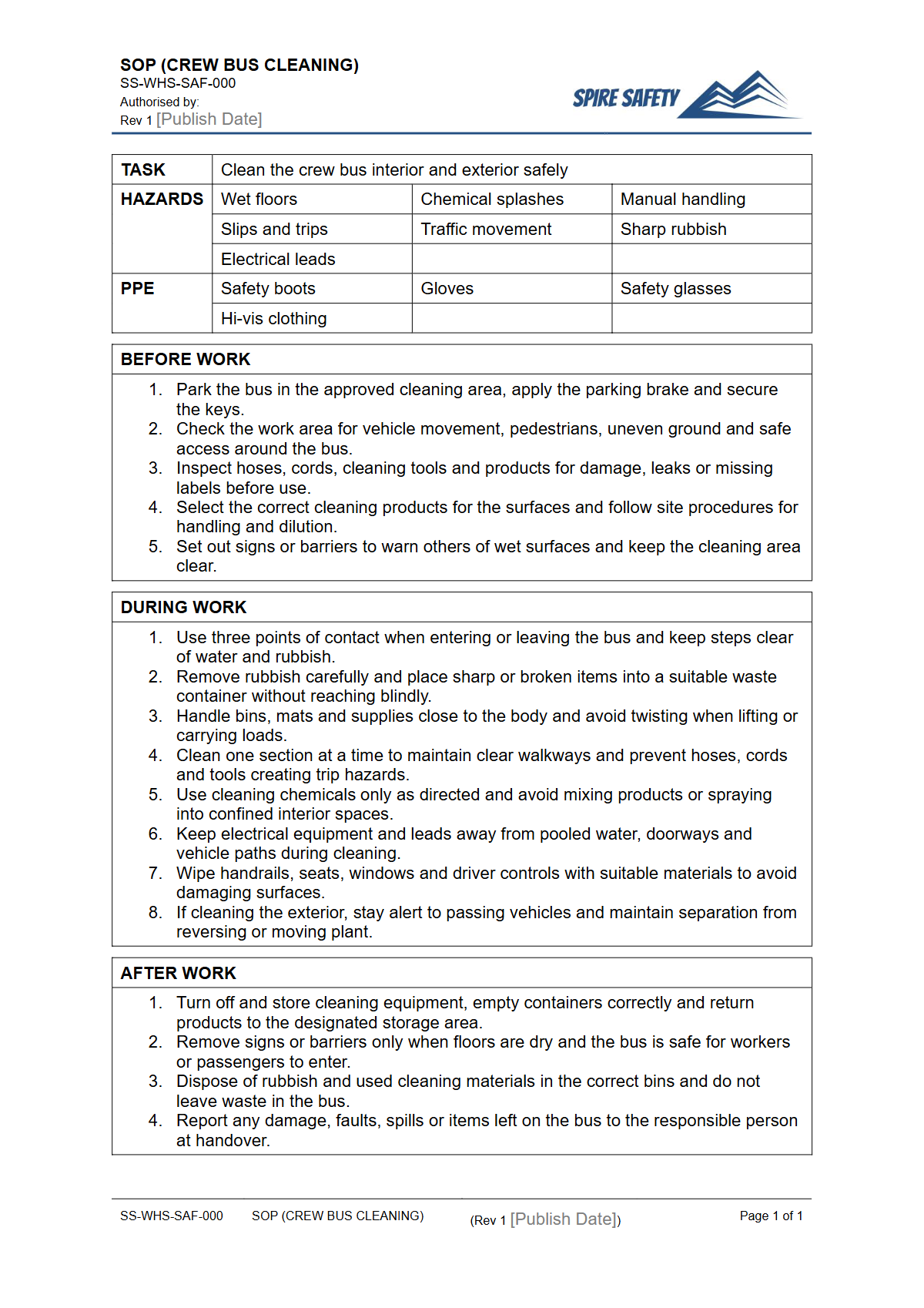
Download our free Safe Operating Procedure (Crew Bus Cleaning) Template to formalise your cleaning processes.
Free Safe Operating Procedure (Crew Bus Cleaning) Template
DOCX • 126 KB + PDF
Updated Oct 2026
No signup required
Purpose of the Free Safe Operating Procedure (Crew Bus Cleaning) Template
This Safe Operating Procedure (SOP) for crew bus cleaning provides a structured framework for documenting a safe system of work. Using this free template helps your organisation formalise the steps required to clean crew buses safely and effectively, minimising risks to workers.
The process of cleaning vehicles, especially those used to transport personnel in industries like mining and construction, involves significant hazards. These can include exposure to hazardous chemicals, ergonomic strains from manual tasks, slips and trips in wet environments, and potential contact with biological hazards.
A documented SOP ensures all tasks are performed consistently and safely, providing a clear reference for workers and supervisors. Implementing robust procedures like this is a fundamental part of developing comprehensive WHS management systems that protect your team and support your operational requirements.
Video walkthrough
How to use the Free Safe Operating Procedure (Crew Bus Cleaning) Template
This document is a starting point, not a finished solution. It is provided in DOCX format for easy editing and customisation, as well as a PDF for quick reference.
To use it effectively, you must adapt it to the specific context of your workplace. This involves conducting a thorough risk assessment for your crew bus cleaning tasks and incorporating the findings into the SOP.
Key Sections to Customise
- Hazard Identification: Detail the specific hazards present in your cleaning area and process, such as poor ventilation, electrical equipment, or specific chemical properties.
- Personal Protective Equipment (PPE): Specify the exact PPE required for each task, such as chemical-resistant gloves, eye protection, and non-slip footwear. Be specific about standards (e.g., AS/NZS standards).
- Chemicals and Equipment: List all cleaning chemicals used by name. You must cross-reference this section with the Safety Data Sheet (SDS) for each product and include key safety information. Similarly, list all equipment used, from pressure washers to vacuums. For complex machinery, you may need a separate SOP, like our Free Air Compressor SOP Template.
- Step-by-Step Procedure: Detail the exact sequence of tasks, from pre-cleaning checks and preparation of cleaning solutions to the final inspection of the bus. Make the instructions clear, concise, and unambiguous.
- Emergency Procedures: Outline the response for foreseeable emergencies, including first aid for chemical exposure, spill containment procedures, and fire response.
Important: We have developed this template as a guide. You must customise this Safe Operating Procedure to reflect the unique hazards, equipment, and environment of your workplace.
A generic document cannot address your specific WHS obligations. If you require assistance in this process, our WHS consulting services can provide expert support tailored to your needs.
When to use it
A Safe Operating Procedure for crew bus cleaning should be used consistently whenever the task is performed. It serves as a vital tool for ensuring procedural discipline and safety across different scenarios.
Use this SOP for routine daily or weekly cleaning to maintain hygiene standards and for periodic deep cleaning sessions. It is also essential for post-incident cleaning, such as after a biological spill or contamination event, to ensure the area is sanitised correctly and safely.
Furthermore, the SOP can be integrated into pre-hire and post-hire vehicle inspections to ensure cleanliness standards are met. Regularly reviewing procedural adherence through observation can be a valuable input for your safety audits, which is an area our WHS compliance auditing team specialises in.
Who should use it
This SOP is intended for use by all personnel involved in the cleaning and maintenance of crew buses. This includes dedicated cleaning staff, vehicle detailers, maintenance workers, and any operator responsible for vehicle upkeep.
Supervisors and team leaders should use the document to guide training, conduct competency assessments, and supervise work to ensure it is being performed according to the established safe procedure. WHS managers and safety representatives will find the template useful for establishing a baseline standard and integrating it into the broader workplace safety framework. A robust safety system often includes dozens of such documents, covering everything from cleaning to the operation of heavy equipment detailed in resources like a FREE Telehandler SOP Template. For more guides and checklists, you can explore our complete free WHS resources library.
Common mistakes
Common mistakes to avoid
- Using the template without customising it for specific site conditions and bus models.
- Failing to read and incorporate crucial safety information from the Safety Data Sheets (SDS) for all chemicals.
- Not providing workers with adequate training on the finalised SOP and the specific hazards involved.
- Neglecting to provide, maintain, or enforce the use of the required Personal Protective Equipment (PPE).
Legal references
Legal considerations
The following legal requirements may be relevant to this type of work.
- Work Health and Safety Act (Harmonised) — Provides the primary duties for protecting workers and other people from work health and safety risks.
- Work Health and Safety Regulations (Harmonised) — Sets out requirements supporting the management of workplace hazards and risks.
The following codes may be relevant to this type of work.
- Managing WHS Risks Code of Practice — Provides practical guidance on identifying hazards, assessing risks and applying effective controls.
- Work Health and Safety Consultation, Cooperation and Coordination Code of Practice — Provides practical guidance on consulting workers and coordinating with other duty holders.
- Managing the Work Environment and Facilities Code of Practice — Provides practical guidance on safe work environments, workplace facilities and related controls.
Did you know
Slips, Trips and Falls
Slips, trips and falls are a leading cause of workplace injuries in Australia. Maintaining a dry, uncluttered work area during and after cleaning is a critical control measure.
Chemical Safety
The Globally Harmonized System (GHS) of Classification and Labelling of Chemicals provides standardised pictograms and information, making it easier to quickly understand hazards listed on a Safety Data Sheet (SDS).
FAQ
Frequently asked questions
01What are the main hazards when cleaning a crew bus?
02How often should a Crew Bus Cleaning SOP be reviewed?
03Is this template suitable for all types of cleaning chemicals?
04Can this SOP be used for training new cleaners?
Share this resource
Free Safe Operating Procedure (Crew Bus Cleaning) Template
Browse Categories
How To Use It
- 1Download and open in Word or PDF.
- 2Replace the placeholders with your business details.
- 3Get it reviewed by a WHS specialist before rollout.
Need it customised?
Our WHS consultants can adapt this template to your site, run a gap analysis, or audit what you already have in place.
Book a Free Consultation WHS consulting servicesor call 1300 156 382
Related templates
- Free Safe Operating Procedure (Cricket Pitch Cover) Template
- Free Safe Operating Procedure (Cricket Pitch Repair) Template
- Free Safe Operating Procedure (Crimp Lug Press) Template
- Free Safe Operating Procedure (Crop Row Marking) Template
- Free Safe Operating Procedure (Crop Scouting) Template
- Free Safe Operating Procedure (Crop Thinning) Template