
Free Safe Operating Procedure (Crawler Crane Setup) Template
Download our free Safe Operating Procedure (Crawler Crane Setup) Template. This user-friendly document helps you outline key safety steps. Get your DOCX now.
Free Safe Operating Procedure (Crawler Crane Setup) Template
DOCX • 126 KB + PDF
Updated Oct 2026
No signup required
Purpose of the Free Safe Operating Procedure (Crawler Crane Setup) Template
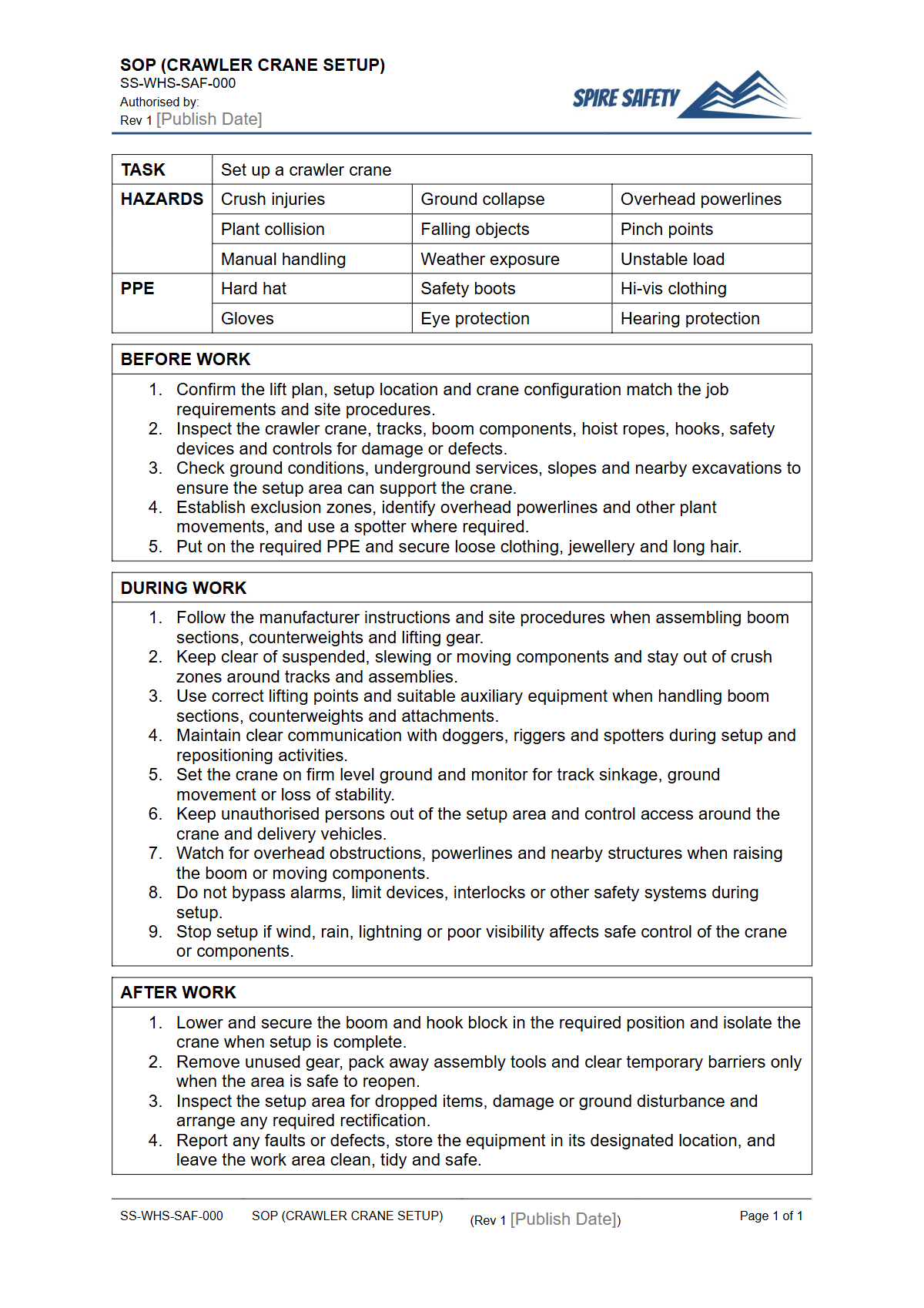
Establishing a safe work environment is paramount for any high-risk task, and crawler crane operations are no exception. This free Safe Operating Procedure (Crawler Crane Setup) Template provides a structured framework for documenting the essential steps to safely assemble and prepare a crawler crane for lifting operations.
A comprehensive SOP is a critical tool for ensuring tasks are performed consistently and safely by all personnel, minimising the risk of incidents. It serves as a step-by-step guide covering pre-start checks, site assessment, equipment assembly, and establishing exclusion zones.
By implementing a clear SOP, you formalise safe work practices, support operator training, and demonstrate a commitment to workplace safety. This document is a fundamental part of robust WHS management systems, helping your organisation manage risks effectively.
Video walkthrough
How to use the Free Safe Operating Procedure (Crawler Crane Setup) Template
Our downloadable template is designed as a foundational document that you can adapt for your specific operational needs. To use it effectively, begin by downloading the DOCX file and reviewing its contents alongside the crane manufacturer's instructions and relevant technical specifications.
It is crucial to gather a team, including experienced crane operators, riggers, doggers, and safety supervisors, to provide input. Walk through each step of the procedure, modifying the content to match the specific model of crawler crane in use, the unique conditions of your worksite, and your company's existing safety protocols.
Similar to customising our free Dozer SOP template, this process ensures the final document is practical, relevant, and fully integrated into your workflow.
Important: This is a template only. We have developed it as a general guide, but you must customise it to reflect the specific equipment, ground conditions, personnel, and risks at your workplace.
A generic procedure is not sufficient to control site-specific hazards.
When to Use this Safe Operating Procedure
A Safe Operating Procedure for crawler crane setup should be a living document used throughout the lifecycle of the task. It is essential during the induction and training of new operators or riggers, providing them with a clear, authoritative guide to follow.
It also serves as a valuable pre-start tool for experienced crews to reference before beginning assembly, ensuring no critical steps are missed. Furthermore, the SOP is an invaluable resource during incident investigations, helping to determine if procedures were followed correctly.
Regular use in toolbox talks and for refresher training reinforces safe behaviour and maintains a high level of safety awareness on site. For other heavy equipment, a similar approach applies, such as when using our FREE Telehandler SOP Template.
Who Should Use this SOP?
This SOP is intended for a range of personnel involved in crane operations. Primarily, crane operators, riggers, and doggers must be thoroughly familiar with the procedure and trained in its application.
Site supervisors and project managers should also use the document to oversee operations and verify that safety protocols are being adhered to. WHS advisors and safety officers will use the SOP as a benchmark for workplace inspections and safety observations.
Its development and review process should involve all these roles to ensure it is comprehensive and practical. The existence and proper use of such documents are often reviewed during a formal WHS compliance auditing process, demonstrating proactive risk management.
Key Sections of the Crawler Crane Setup SOP
A well-structured SOP should guide the user logically from initial planning to final pre-lift checks. Our template includes placeholders for critical information that you must populate:
- Personal Protective Equipment (PPE): Specifies the required PPE for all personnel involved in the setup, such as hard hats, steel-capped boots, high-visibility clothing, and gloves.
- Pre-Operational Checks: A detailed checklist for inspecting the crane's components, including tracks, superstructure, ropes, and safety devices, before assembly begins.
- Site Assessment: Critical steps for evaluating ground bearing capacity, identifying overhead powerlines or underground services, and planning access and egress routes.
- Assembly/Disassembly Sequence: The step-by-step process for assembling the boom, counterweights, and other components, as specified by the manufacturer.
- Exclusion Zones: Instructions for establishing and communicating controlled areas to prevent unauthorised personnel from entering the work zone.
- Communication: Defines the signals (hand or radio) and protocols to be used between the operator, riggers, and spotters. Procedures for other machinery, such as those found in our FREE Grader SOP (Safe Operating Procedure) Template, also emphasise clear communication.
Integrating with Other Safety Documents
This Safe Operating Procedure does not exist in isolation. For crawler crane operations, which are defined as high-risk construction work, a Safe Work Method Statement (SWMS) is also mandatory.
The SOP complements the SWMS; the SWMS identifies the high-risk hazards and outlines control measures, while the SOP provides the detailed, sequential instructions for performing the task itself. This SOP should also align with specific lift plans, risk assessments, and plant hazard checklists.
Integrating these documents creates a comprehensive safety system for your lifting operations. To discover more templates that can support your safety framework, explore our complete free WHS resources library for a wide range of documents.
Common mistakes
Common mistakes to avoid
- Failing to adequately assess ground conditions and confirm bearing capacity, leading to instability.
- Neglecting to establish and maintain clear, enforced exclusion zones during assembly and lifting.
- Using a generic SOP from another site without customising it for the specific crane model and work area.
- Inadequate or unclear communication between the operator, riggers, and spotters during setup.
Legal references
Legal considerations
The following legal requirements may be relevant to this type of work.
- Work Health and Safety Act (Harmonised) — Provides the primary duties for protecting workers and other people from work health and safety risks.
- Work Health and Safety Regulations (Harmonised) — Sets out requirements supporting the management of workplace hazards and risks.
The following codes may be relevant to this type of work.
- Managing WHS Risks Code of Practice — Provides practical guidance on identifying hazards, assessing risks and applying effective controls.
- Work Health and Safety Consultation, Cooperation and Coordination Code of Practice — Provides practical guidance on consulting workers and coordinating with other duty holders.
- Managing the Work Environment and Facilities Code of Practice — Provides practical guidance on safe work environments, workplace facilities and related controls.
Did you know
Ground Pressure Advantage
Crawler cranes distribute their immense weight over their long, wide tracks, resulting in significantly lower ground pressure compared to wheeled cranes. This key feature allows them to operate effectively on softer or less-prepared ground where other cranes cannot.
FAQ
Frequently asked questions
01Is a Safe Operating Procedure the same as a SWMS for a crawler crane?
02Who is responsible for developing a crawler crane SOP?
03How often should we review our crawler crane setup SOP?
04What should the site assessment section of the SOP cover?
Share this resource
Free Safe Operating Procedure (Crawler Crane Setup) Template
Browse Categories
How To Use It
- 1Download and open in Word or PDF.
- 2Replace the placeholders with your business details.
- 3Get it reviewed by a WHS specialist before rollout.
Need it customised?
Our WHS consultants can adapt this template to your site, run a gap analysis, or audit what you already have in place.
Book a Free Consultation WHS consulting servicesor call 1300 156 382
Related templates
- Free Safe Operating Procedure (Creek Bank Cleanup) Template
- Free Safe Operating Procedure (Crematorium Ash Handling) Template
- Free Safe Operating Procedure (Crew Bus Cleaning) Template
- Free Safe Operating Procedure (Cricket Pitch Cover) Template
- Free Safe Operating Procedure (Cricket Pitch Repair) Template
- Free Safe Operating Procedure (Crimp Lug Press) Template