
Free Safe Operating Procedure (Crane Limit Switch Test) Template
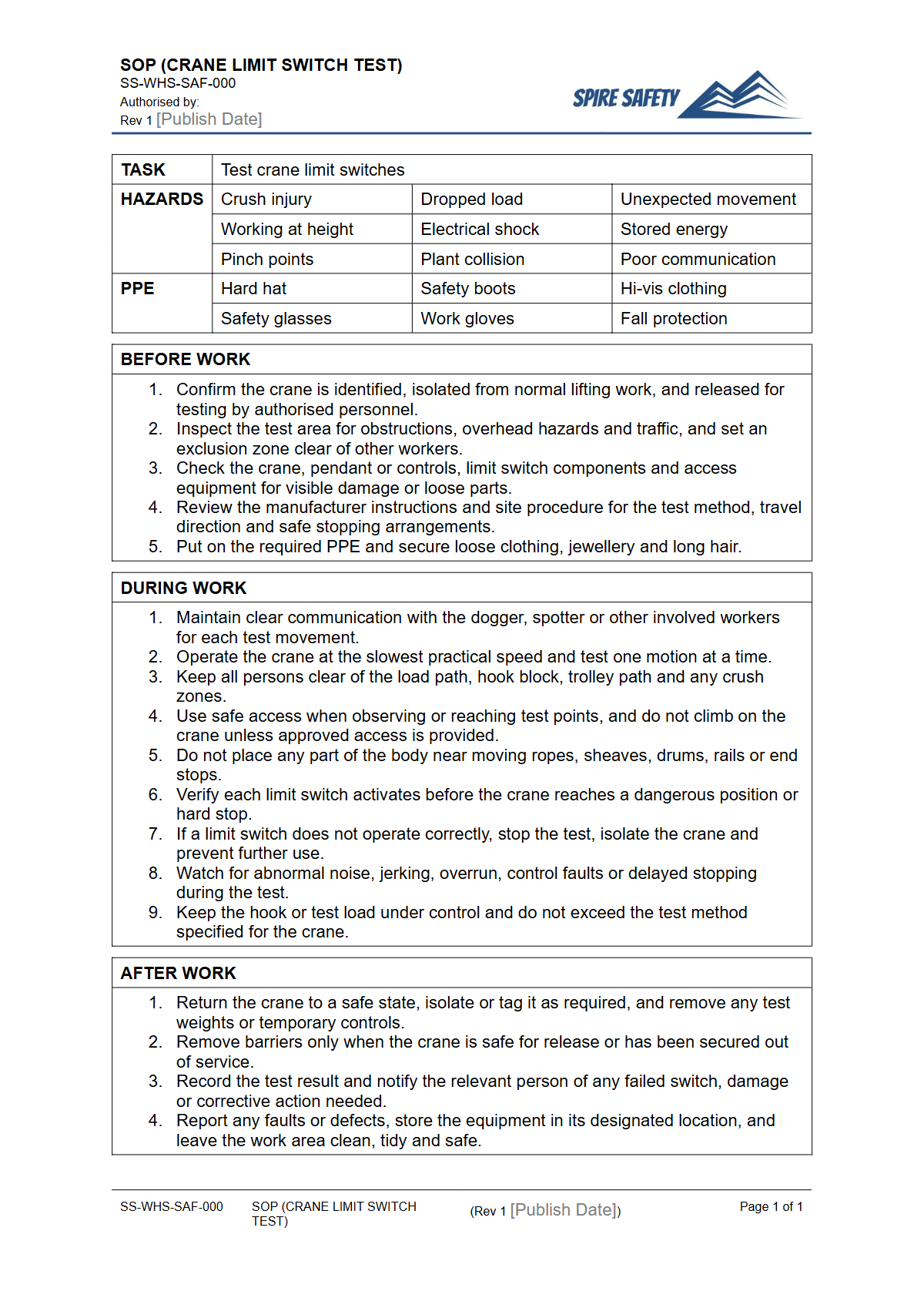
Formalise your crane safety checks with our free Safe Operating Procedure (Crane Limit Switch Test) Template.
Free Safe Operating Procedure (Crane Limit Switch Test) Template
DOCX • 126 KB + PDF
Updated Oct 2026
No signup required
Purpose of the Free Safe Operating Procedure (Crane Limit Switch Test) Template
Operating cranes presents significant risks, and functional safety devices are non-negotiable. This Free Safe Operating Procedure (Crane Limit Switch Test) Template provides a structured starting point for documenting the process of testing a crane's limit switches.
Limit switches are critical safety mechanisms that prevent over-hoisting, over-lowering, and over-travel, protecting both the equipment and personnel from catastrophic failure. Formalising this test procedure ensures it is conducted consistently and correctly every time.
Using a documented SOP helps your organisation meet its duties under Australian WHS law to provide and maintain safe plant. It forms a key part of your overall safety framework, demonstrating that you have clear, repeatable processes for verifying critical safety functions.
Integrating this procedure into your broader WHS management systems ensures that crane safety is managed proactively, not reactively after an incident occurs.
Video walkthrough
How to use the Free Safe Operating Procedure (Crane Limit Switch Test) Template
This template is designed for easy customisation. To make it effective for your workplace, you must adapt it to your specific operational context.
It is not a complete, ready-to-use document as-is. We have included prompts and sections that you need to populate with your site-specific information.
Key customisation steps include:
- Identifying the specific make, model, and ID of the crane(s) it applies to.
- Listing the names or roles of personnel authorised to perform the test.
- Specifying the exact Personal Protective Equipment (PPE) required.
- Detailing the step-by-step actions for testing each limit switch (e.g., upper hoist, lower hoist, trolley, travel).
- Outlining your workplace's specific emergency and communication procedures.
Once customised, the SOP should be reviewed, approved, and used to train all relevant personnel. Regular reviews are also essential to ensure the procedure remains current, especially after any modifications to the crane or changes in legislation.
A thorough review of your safety documents can be a core part of a WHS compliance auditing program.
When to conduct a Crane Limit Switch Test
A limit switch test is not a one-off event. It should be performed at regular, defined intervals as part of a comprehensive crane maintenance and inspection program. The procedure outlined in this SOP should be triggered:
- Before the start of each shift: As part of the operator's pre-operational checks.
- After scheduled maintenance: To verify that safety systems are correctly reinstated.
- Following any repairs or adjustments to the hoisting mechanism, travel drives, or control system.
- During periodic inspections as mandated by Australian Standards (e.g., AS 2550) and the crane manufacturer's guidelines.
Documenting procedures for high-risk plant is a fundamental safety practice. For example, sites that operate cranes may also use other specialised equipment that requires its own set of checks, such as those detailed in our FREE Telehandler SOP Template.
Who should use this Safe Operating Procedure
This SOP should be used by personnel who are deemed competent to operate or maintain the specific crane. This typically includes:
- Trained Crane Operators: As part of their daily pre-start inspection routine.
- Qualified Maintenance Technicians: During servicing, repairs, and periodic inspections.
- Riggers and Doggers: Who may need to understand the function and testing of limit switches as part of their role in ensuring safe lifts.
- WHS Managers and Supervisors: To train workers, verify compliance, and conduct workplace inspections.
Competency is key; workers must have received specific training on the crane model and understand the serious hazards associated with incorrect testing. This principle applies to all equipment on site, which is why having procedures like a Free Air Compressor SOP (Safe Operating Procedure) Template is just as important for ancillary plant.
What's included in this Safe Operating Procedure Template?
Our template is provided as a DOCX file for easy editing and a PDF for reference. It is structured to align with established safety management principles and includes sections for:
- Risk Assessment: Prompts to identify hazards (e.g., electrical, falls, dropped objects) and list control measures.
- Personnel & PPE: Clearly define who can perform the task and what protective equipment they must wear.
- Step-by-Step Procedure: A logical sequence for preparing the area, testing each switch at slow speed, and verifying correct operation.
- Documentation: A sign-off section to record the date, time, personnel involved, and test outcome (Pass/Fail).
A well-defined SOP removes ambiguity and ensures every critical step is followed. This structured approach is valuable for all material handling equipment, including those covered in our FREE Conveyer System SOP (Safe Operating Procedure) Template. For more guidance and templates, explore our complete free WHS resources library.
Common mistakes
Common mistakes to avoid
- Failing to isolate the area and ensure no load is attached during the test.
- Activating the switch at high speed, causing unnecessary wear and shock to components.
- Neglecting to document the test results, creating a gap in maintenance and compliance records.
- Assuming a passed test means the crane is safe, without completing all other required pre-operational checks.
Legal references
Legal considerations
The following legal requirements may be relevant to this type of work.
- Work Health and Safety Act (Harmonised) — Provides the primary duties for protecting workers and other people from work health and safety risks.
- Work Health and Safety Regulations (Harmonised) — Sets out requirements supporting the management of workplace hazards and risks.
The following codes may be relevant to this type of work.
- Managing WHS Risks Code of Practice — Provides practical guidance on identifying hazards, assessing risks and applying effective controls.
- Work Health and Safety Consultation, Cooperation and Coordination Code of Practice — Provides practical guidance on consulting workers and coordinating with other duty holders.
- Managing the Work Environment and Facilities Code of Practice — Provides practical guidance on safe work environments, workplace facilities and related controls.
Did you know
Over-Hoisting Risk
A failed upper hoist limit switch is a leading cause of 'two-blocking', a dangerous event where the hook block contacts the upper sheave block, potentially causing the hoist rope to snap and the load to fall.
More Than One Switch
Modern cranes have multiple limit switches, not just for the main hoist. They can also control trolley travel, bridge travel, and slew (rotation), preventing collisions with other structures or equipment.
FAQ
Frequently asked questions
01What is a crane limit switch and why is it important?
02How often should a crane limit switch test be performed?
03Who is considered a 'competent person' to conduct a crane limit switch test?
04Does this SOP template cover all types of cranes?
Share this resource
Free Safe Operating Procedure (Crane Limit Switch Test) Template
Browse Categories
How To Use It
- 1Download and open in Word or PDF.
- 2Replace the placeholders with your business details.
- 3Get it reviewed by a WHS specialist before rollout.
Need it customised?
Our WHS consultants can adapt this template to your site, run a gap analysis, or audit what you already have in place.
Book a Free Consultation WHS consulting servicesor call 1300 156 382
Related templates
- Free Safe Operating Procedure (Crane Outrigger Setup) Template
- Free Safe Operating Procedure (Crane Pendant Control) Template
- Free Safe Operating Procedure (Crane Radio Controls) Template
- Free Safe Operating Procedure (Crane Scale) Template
- Free Safe Operating Procedure (Crash Cart Restocking) Template
- Free Safe Operating Procedure (Crawler Crane Setup) Template