
Free Safe Operating Procedure (Crane Pendant Control) Template
Effectively manage crane pendant control risks with our customisable Safe Operating Procedure template. Download this free DOCX and PDF to start today.
Free Safe Operating Procedure (Crane Pendant Control) Template
DOCX • 126 KB + PDF
Updated Oct 2026
No signup required
Purpose of the Free Safe Operating Procedure (Crane Pendant Control) Template
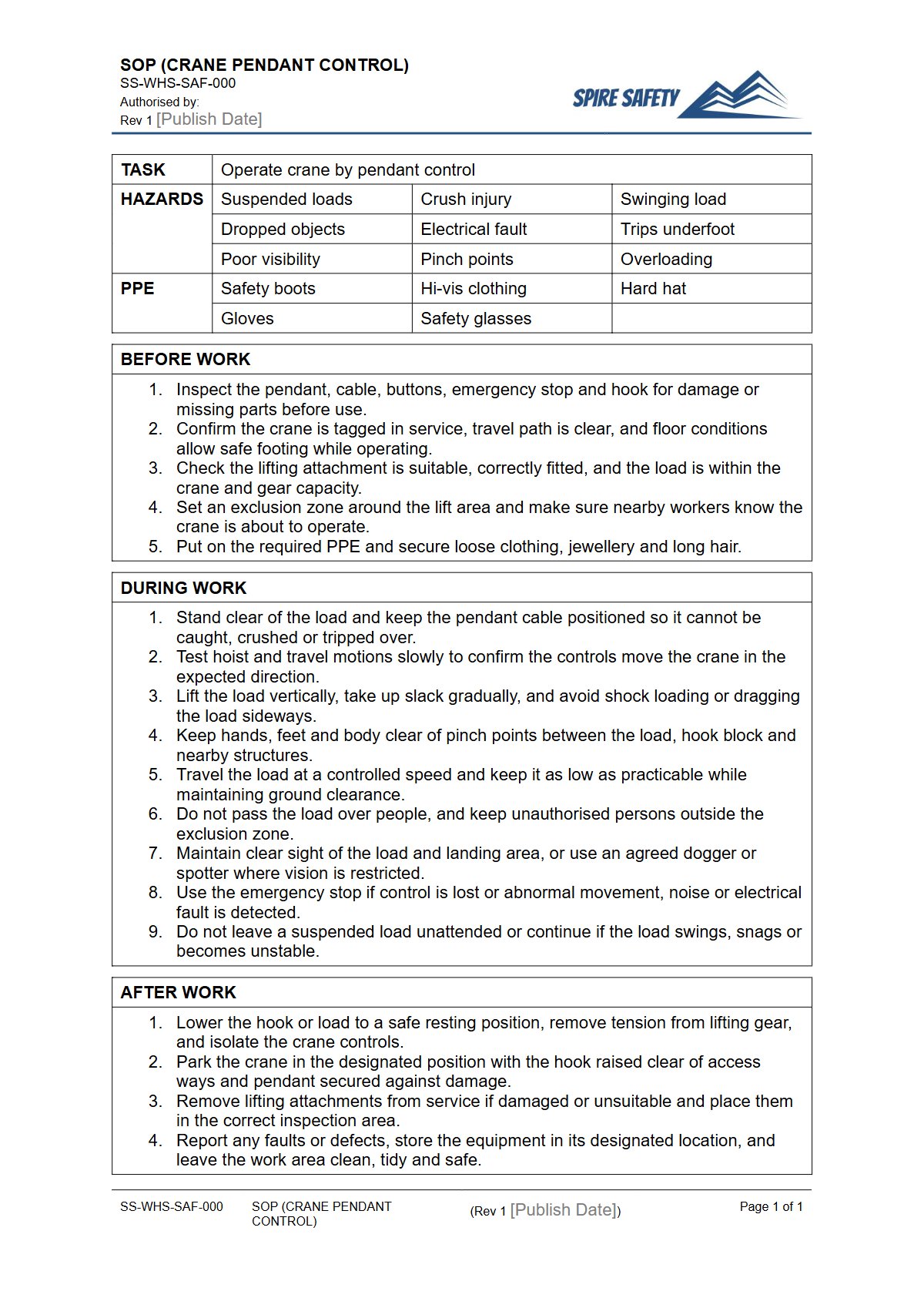
Operating any type of crane involves significant risks, and using a pendant control requires specific safety protocols to protect the operator and others in the vicinity. This Free Safe Operating Procedure (Crane Pendant Control) Template provides a structured framework for documenting the required steps to operate this equipment safely.
A well-defined SOP helps standardise your processes, minimise the risk of incidents such as collisions or dropped loads, and ensures workers are aware of their responsibilities. It is a critical component for managing high-risk plant and equipment within your broader safety framework.
Implementing robust procedures like this one is a fundamental part of comprehensive WHS management systems. By clearly outlining pre-start checks, operational steps, and shutdown procedures, you create a verifiable record of your organisation's commitment to safety. This template is designed to align with the principles of the Australian model WHS framework, providing a solid foundation for your site-specific document.
Using standardised procedures across all plant and equipment, including a FREE Telehandler SOP Template for other lifting machinery, helps create a consistent safety culture.
Video walkthrough
How to use the Free Safe Operating Procedure (Crane Pendant Control) Template
This template is designed for easy adaptation to your specific operational needs. To use it effectively, download the DOCX file and begin by consulting with the crane operators, doggers, and supervisors who will be using the equipment.
Their direct experience is invaluable for identifying practical hazards and effective control measures that are relevant to your site. This collaborative approach ensures the final SOP is both practical and more likely to be adopted by the team.
You must fill in the specific details related to your crane model, workplace environment, types of loads handled, and emergency contacts. The document includes sections for PPE, pre-operational checks, step-by-step operating instructions, and post-operational procedures.
Before finalising the SOP, it's beneficial to conduct a risk assessment specific to crane pendant control tasks to ensure all identified hazards are addressed. Regular reviews of your processes through WHS compliance auditing can help identify any gaps between your documented procedures and actual work practices.
Important Note: This document is a template and must be customised to suit the specific equipment, environment, and tasks at your workplace. As the Person Conducting a Business or Undertaking (PCBU), you are responsible for ensuring your procedures are safe and adequate for your needs.
We are not liable for any incidents that may occur from the use of this document. For more templates and safety resources, you can browse our complete free WHS resources library.
When to use a Safe Operating Procedure for Crane Pendant Control
An SOP for crane pendant control should be integrated into your daily operations. It is not a document to be filed away; it is an active tool for risk management.
It should be used as the primary training document for new operators and as a basis for refresher training for existing staff. Supervisors should use the SOP as a checklist to monitor work practices and ensure tasks are performed as required.
It should also be readily available in the work area for easy reference.
The procedure is particularly critical during pre-start inspections, where operators must verify the functionality of the pendant controls, emergency stop, and hoist limits before commencing any lift. It also guides the operator through the entire lifting cycle, from planning the lift path to safely setting down the load.
An SOP is a living document that should be reviewed and updated after any incident, when new hazards are recognised, or when the crane or work environment changes. For sites with multiple types of fixed plant, it's good practice to have similar documents, such as an Air Compressor SOP Template, to ensure consistency.
Who should use this Safe Operating Procedure
This SOP template is intended for use by several key roles within an organisation. WHS managers, safety officers, and site supervisors are the primary authors and custodians of the document.
They are responsible for adapting the template to their workplace, consulting with workers, and implementing the final procedure. They must also ensure that all relevant personnel are trained in its contents and that the procedure is regularly reviewed and updated as needed.
The end-users are the crane operators themselves. They must understand and strictly follow the outlined steps to ensure their own safety and the safety of those around them.
Doggers and riggers who work with the crane operator also need to be familiar with the SOP to ensure effective communication and coordination during lifting operations. For complex operational environments or for organisations needing to develop a suite of safety documents, engaging external WHS consulting can provide expert guidance and support.
For example, a consultant can help develop procedures for all major plant, including a Conveyer System SOP if one is present on your site.
Common mistakes
Common mistakes to avoid
- Failing to conduct and document daily pre-start checks on the pendant control and crane.
- Walking backwards while operating the crane, creating a serious trip and fall hazard.
- Not maintaining a clear line of sight with the load and the entire travel path.
- Using the pendant cable to pull or drag the crane or hoist, which can damage the cable and control unit.
Legal references
Legal considerations
The following legal requirements may be relevant to this type of work.
- Work Health and Safety Act (Harmonised) — Provides the primary duties for protecting workers and other people from work health and safety risks.
- Work Health and Safety Regulations (Harmonised) — Sets out requirements supporting the management of workplace hazards and risks.
The following codes may be relevant to this type of work.
- Managing WHS Risks Code of Practice — Provides practical guidance on identifying hazards, assessing risks and applying effective controls.
- Work Health and Safety Consultation, Cooperation and Coordination Code of Practice — Provides practical guidance on consulting workers and coordinating with other duty holders.
- Managing the Work Environment and Facilities Code of Practice — Provides practical guidance on safe work environments, workplace facilities and related controls.
Did you know
Ergonomic Design
Modern pendant controls are increasingly designed with ergonomics in mind to reduce operator fatigue and the risk of musculoskeletal disorders from repetitive use.
The Wireless Future
While cabled pendants are common, many new crane installations now use wireless radio remote controls to improve operator mobility and positioning, reducing entanglement hazards and improving line of sight.
FAQ
Frequently asked questions
01What is a crane pendant control?
02Is training required to use a crane with a pendant control?
03How often should a Safe Operating Procedure for a crane be reviewed?
04What are the main hazards of using a crane pendant control?
Share this resource
Free Safe Operating Procedure (Crane Pendant Control) Template
Browse Categories
How To Use It
- 1Download and open in Word or PDF.
- 2Replace the placeholders with your business details.
- 3Get it reviewed by a WHS specialist before rollout.
Need it customised?
Our WHS consultants can adapt this template to your site, run a gap analysis, or audit what you already have in place.
Book a Free Consultation WHS consulting servicesor call 1300 156 382
Related templates
- Free Safe Operating Procedure (Crane Radio Controls) Template
- Free Safe Operating Procedure (Crane Scale) Template
- Free Safe Operating Procedure (Crash Cart Restocking) Template
- Free Safe Operating Procedure (Crawler Crane Setup) Template
- Free Safe Operating Procedure (Creek Bank Cleanup) Template
- Free Safe Operating Procedure (Crematorium Ash Handling) Template