
Free Safe Operating Procedure (Crane Radio Controls) Template
Effectively manage the risks of using radio-controlled cranes with our structured Safe Operating Procedure template. Download the DOCX and PDF for free.
Free Safe Operating Procedure (Crane Radio Controls) Template
DOCX • 126 KB + PDF
Updated Oct 2026
No signup required
Purpose of the Free Safe Operating Procedure (Crane Radio Controls) Template
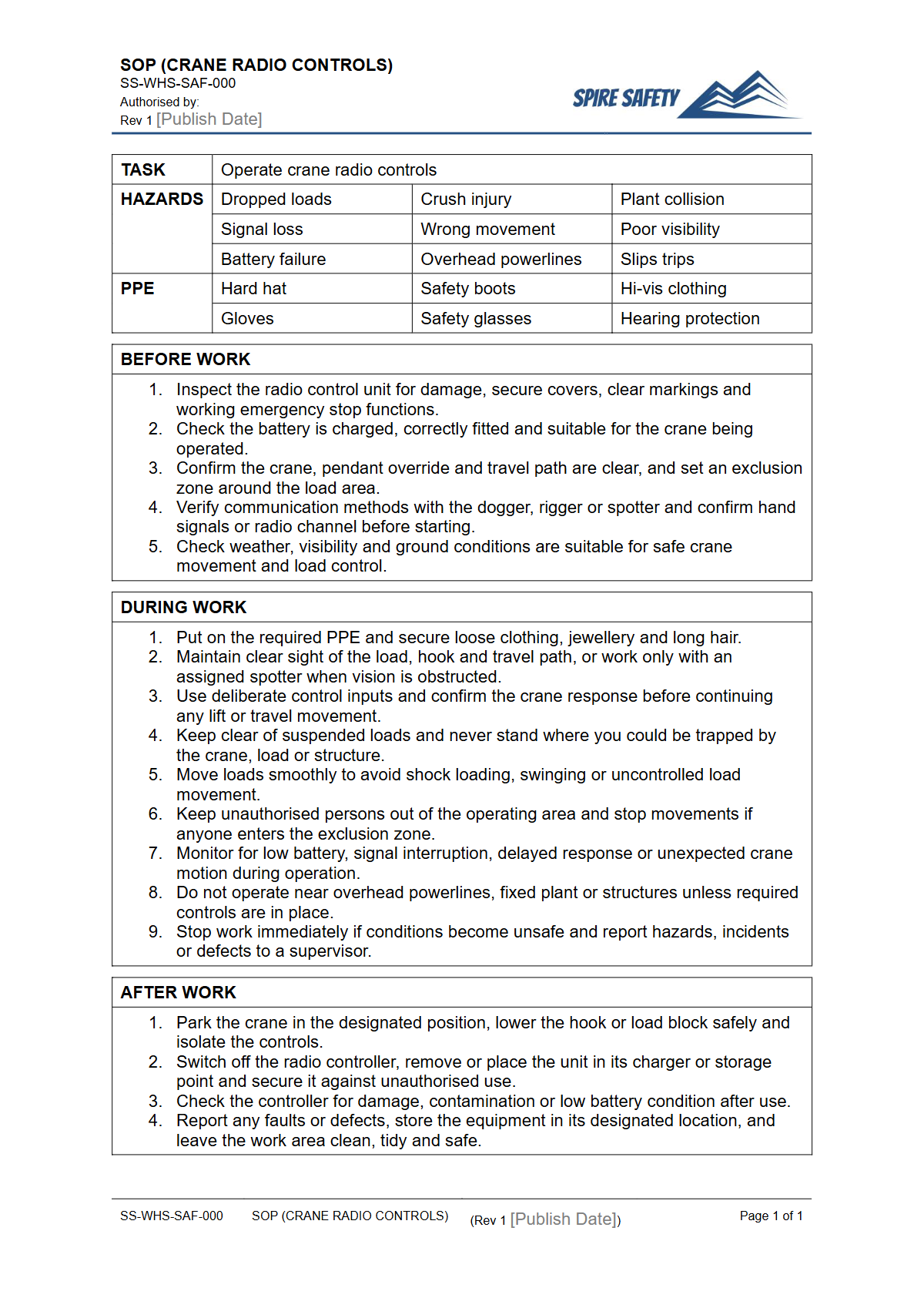
This Free Safe Operating Procedure (Crane Radio Controls) Template provides a structured framework for documenting the safe use of radio-controlled cranes in your workplace. Operating cranes via remote control introduces unique risks, including signal loss, battery failure, interference, and challenges with operator positioning.
An SOP is a critical administrative control that outlines step-by-step instructions to perform this high-risk task safely, helping to meet your duty of care under Australian WHS legislation.
Using a standardised Safe Operating Procedure ensures that all operators follow a consistent, pre-approved process, minimising guesswork and the potential for unsafe acts. This template, aligned with Australian WHS principles, helps your organisation formalise procedures for pre-operational checks, safe lifting techniques, communication protocols, and emergency responses specific to radio-controlled crane operations.
For businesses needing tailored support in developing their safety documentation, engaging with expert WHS consulting services can provide valuable guidance.
Video walkthrough
How to use the Free Safe Operating Procedure (Crane Radio Controls) Template
To implement this Free Safe Operating Procedure (Crane Radio Controls) Template, download the DOCX file and begin adapting it to your specific operational context. It is crucial to replace placeholder text like `[COMPANY NAME]` and fill in details relevant to your equipment and worksite.
Effective safety procedures are not one-size-fits-all and depend on direct input from the people performing the work.
Important: This document is a template and must be customised. To be effective and support your safety obligations, you must adapt it to the specific crane models, radio control systems, loads, and environmental conditions at your workplace.
We strongly recommend you consult with your crane operators, doggers, and safety committee during the customisation process to ensure the final SOP is practical and comprehensive. The completed SOP should form a key part of a comprehensive WHS management system.
When to use this Safe Operating Procedure
A Safe Operating Procedure for crane radio controls should be developed, implemented, and readily available before any worker operates the equipment. It serves multiple functions throughout the operational lifecycle and is not just a one-time document.
Use this SOP as a primary reference during operator training and competency verification. It should also be a key resource during incident investigations to review if procedures were followed, and as a baseline for continuous improvement of your work practices. For other types of material handling plant, you might also require a free Telehandler SOP template.
Who should use it
This SOP is designed for use by several key roles within an organisation. Persons Conducting a Business or Undertaking (PCBUs) and senior management can use it to ensure they are providing a safe system of work.
WHS managers and safety officers will use the template to develop and implement the site-specific procedure. Supervisors and team leaders are responsible for ensuring operators are trained on and adhere to the SOP.
Finally, crane operators themselves should use the SOP as their guide for safe operation and as a tool for pre-start checks and reference. The resulting document can be an important piece of evidence during WHS compliance audits.
Key Elements in the Template
Our template provides a structured format to guide your documentation. It includes dedicated sections for:
- Pre-operational Checks: Detailing inspections for the radio controller (battery level, E-stop test, antenna condition) and the crane itself.
- Operational Procedure: Step-by-step guidance on establishing exclusion zones, ensuring clear line-of-sight, managing signal integrity, and coordinating with doggers or riggers.
- Post-operational Checks: Instructions for safely powering down, stowing equipment, charging batteries, and reporting any faults.
- Personal Protective Equipment (PPE): A list of required PPE for operators and other personnel in the area.
- Emergency Procedures: Clear steps to take in case of radio failure, unintended movement, or other emergencies.
While this document covers lifting, other processes involving plant, like those covered in our free Conveyer System SOP, also require similar detailed procedures. You can browse our entire free WHS resources library for more templates and guides to support your safety goals.
Common mistakes
Common mistakes to avoid
- Failing to customise the template for specific crane models and worksites.
- Neglecting to test the emergency stop function during every pre-operational check.
- Operating the crane without maintaining a clear line of sight to the load and the surrounding area.
- Not training workers on the specific procedures outlined in the finalised SOP.
Legal references
Legal considerations
The following legal requirements may be relevant to this type of work.
- Work Health and Safety Act (Harmonised) — Provides the primary duties for protecting workers and other people from work health and safety risks.
- Work Health and Safety Regulations (Harmonised) — Sets out requirements supporting the management of workplace hazards and risks.
The following codes may be relevant to this type of work.
- Managing WHS Risks Code of Practice — Provides practical guidance on identifying hazards, assessing risks and applying effective controls.
- Work Health and Safety Consultation, Cooperation and Coordination Code of Practice — Provides practical guidance on consulting workers and coordinating with other duty holders.
- Managing the Work Environment and Facilities Code of Practice — Provides practical guidance on safe work environments, workplace facilities and related controls.
Did you know
Signal Blind Spots
Even with modern radio technology, "blind spots" can exist where the signal between the controller and crane is weak or blocked by structures. Operators must always be aware of their position relative to the crane and potential obstructions.
Battery Management
A common cause of incidents is the radio controller's battery dying mid-lift. A robust pre-start check and battery management program, including having a fully charged spare battery available, are essential safety controls.
FAQ
Frequently asked questions
01Is a Safe Operating Procedure legally required for crane radio controls in Australia?
02What is the most important check for a crane radio control?
03How often should our Crane Radio Control SOP be reviewed?
04Can I just use the crane manufacturer's manual instead of an SOP?
Share this resource
Free Safe Operating Procedure (Crane Radio Controls) Template
Browse Categories
How To Use It
- 1Download and open in Word or PDF.
- 2Replace the placeholders with your business details.
- 3Get it reviewed by a WHS specialist before rollout.
Need it customised?
Our WHS consultants can adapt this template to your site, run a gap analysis, or audit what you already have in place.
Book a Free Consultation WHS consulting servicesor call 1300 156 382
Related templates
- Free Safe Operating Procedure (Crane Scale) Template
- Free Safe Operating Procedure (Crash Cart Restocking) Template
- Free Safe Operating Procedure (Crawler Crane Setup) Template
- Free Safe Operating Procedure (Creek Bank Cleanup) Template
- Free Safe Operating Procedure (Crematorium Ash Handling) Template
- Free Safe Operating Procedure (Crew Bus Cleaning) Template