
Free Safe Operating Procedure (Crane Scale) Template
Establish clear, repeatable safety steps for using crane scales with our structured template. Download our free Safe Operating Procedure to get started.
Free Safe Operating Procedure (Crane Scale) Template
DOCX • 126 KB + PDF
Updated Oct 2026
No signup required
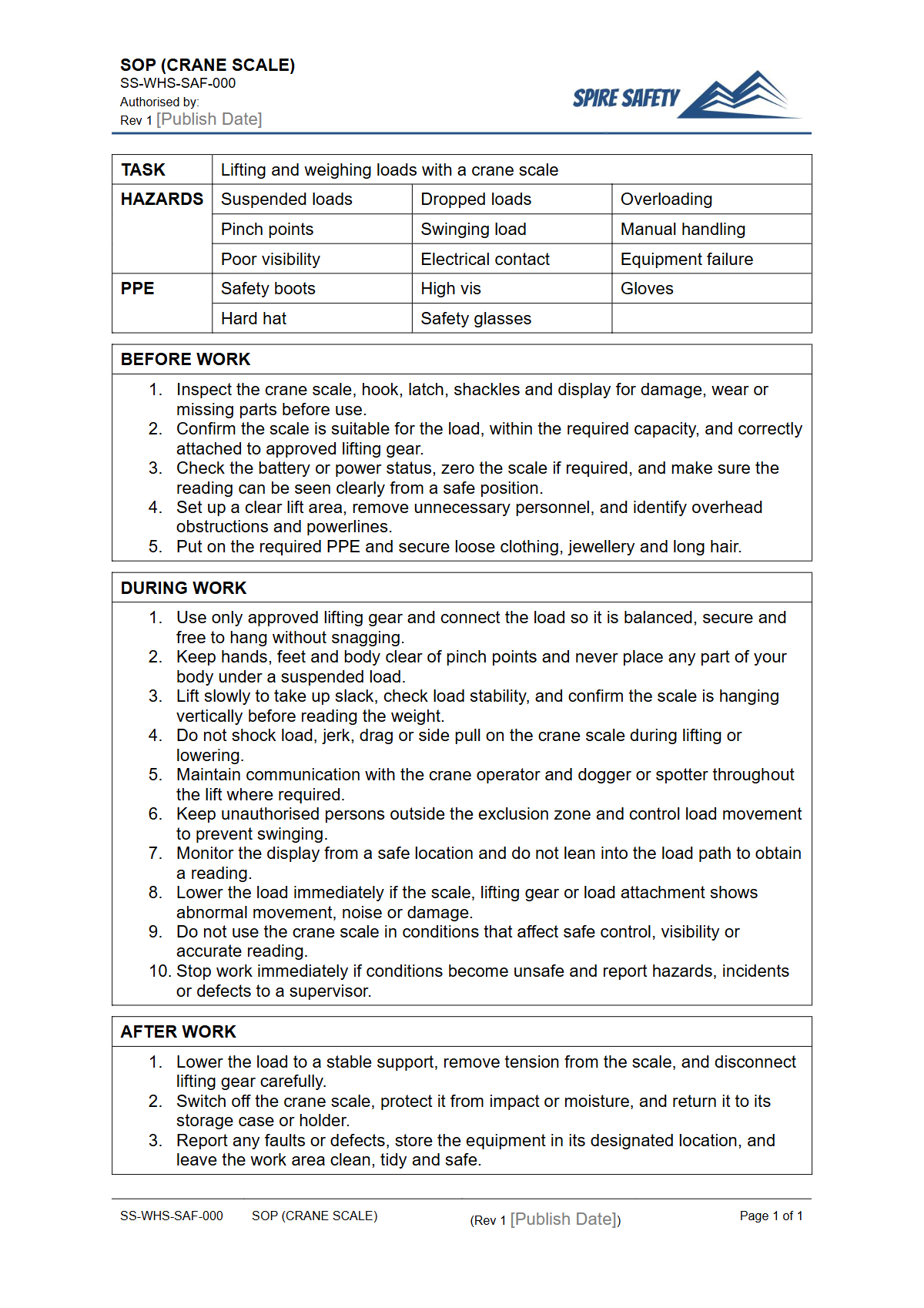
Purpose of the Free Safe Operating Procedure (Crane Scale) Template
Our Free Safe Operating Procedure (Crane Scale) Template provides a structured framework for documenting the safe use of crane scales in your workplace. This essential document helps your organisation manage risks associated with weighing loads during lifting operations, ensuring every task is performed consistently and safely.
The primary purpose of this Safe Operating Procedure for crane scales is to provide clear, step-by-step instructions to workers, formalising safety protocols to minimise the risk of incidents such as load slippage, equipment failure, or inaccurate measurements that could lead to overloading cranes. By implementing a standardised procedure, you create a safer working environment, support consistent training, and demonstrate a commitment to due diligence under Australian WHS legislation. It forms a critical component of a robust WHS management system.
Video walkthrough
How to use the Free Safe Operating Procedure (Crane Scale) Template
This template is provided in both DOCX and PDF formats for your convenience. To use this Safe Operating Procedure, download the DOCX file and customise it to reflect your specific operational context.
This allows you to add, remove, and edit the sections to align with your equipment and internal processes. It is designed as a starting point, aligned with Australian WHS practice, to be adapted for your business.
Important: This document is a template, not a finished procedure. To be effective, you must adapt it by adding details specific to your workplace.
This includes the make and model of your crane scales, specific load capacities, personnel responsibilities, unique environmental conditions, and emergency contact details. We have included prompts and sections to guide you through this critical customisation process.
When should a Crane Scale SOP be used?
A crane scale SOP should be a core part of your daily operations and safety management. It must be consulted before any lifting task that requires load weighing.
It is also an essential training tool for new employee inductions, operator competency assessments, and refresher training sessions. The SOP should be reviewed during toolbox talks before complex lifts and used as a reference document during regular WHS compliance auditing or after any incident or near-miss involving lifting operations.
This ensures the procedure remains relevant and effective.
Who should use this SOP?
This Safe Operating Procedure is intended for all personnel involved in lifting operations where crane scales are used. This includes, but is not limited to:
- Crane Operators
- Riggers and Doggers
- Supervisors and Team Leaders
- Maintenance Personnel (for inspection and calibration sections)
- WHS/Safety Officers
- Warehouse and Logistics Staff
All relevant workers should be thoroughly trained on the contents of the final, site-specific SOP to ensure they understand their roles, responsibilities, and the required safety actions at every stage of the task.
Key Elements of a Crane Scale Safe Operating Procedure
A comprehensive SOP for crane scales should cover all phases of the equipment's use. Our template guides you to include:
Pre-Operational Checks
- Visual inspection of the scale, hook, and safety latch for damage, cracks, or wear.
- Verification of current calibration and inspection tags.
- Battery level checks for digital models to prevent failure mid-lift.
- Confirmation that the scale's Work Load Limit (WLL) is sufficient for the planned lift.
Safe Operating Steps
- Correct procedure for attaching the scale to the crane hook.
- Steps for securely attaching the load to the scale, ensuring the hook is properly seated.
- Instructions for taring the scale (zeroing it out) before lifting the load to get an accurate weight.
- Communication protocols between the operator, rigger, and other personnel.
Post-Operation Procedures
- Properly detaching and storing the crane scale in its designated location.
- Reporting any identified faults, damage, or operational issues to a supervisor.
- Charging batteries as required to ensure readiness for the next use.
The principles of pre-operational checks and clear procedural steps are fundamental to many types of plant. You can see a similar structure applied in our free Telehandler SOP template, which also deals with heavy lifting and equipment inspection.
Integrating the SOP into Your Safety System
A single SOP is most effective when it is part of a wider safety framework. This procedure should support and be supported by other key documents like risk assessments and training plans.
For other material handling equipment, you might develop similar procedures, such as those outlined in our Conveyer System SOP, to ensure consistency in your safety documentation. Regularly reviewing these documents together helps maintain a holistic and effective approach to workplace safety.
By consistently applying these safe operating procedures across all high-risk tasks, your organisation builds a stronger safety culture and a more organised approach to WHS.
Common mistakes
Common mistakes to avoid
- Forgetting to tare the scale before lifting, resulting in an inaccurate weight measurement.
- Using a scale that has not been recently inspected or is past its calibration due date.
- Exceeding the scale's maximum rated capacity (Work Load Limit).
- Failing to account for environmental factors, such as high winds, which can affect the stability of the load.
Legal references
Legal considerations
The following legal requirements may be relevant to this type of work.
- Work Health and Safety Act (Harmonised) — Provides the primary duties for protecting workers and other people from work health and safety risks.
- Work Health and Safety Regulations (Harmonised) — Sets out requirements supporting the management of workplace hazards and risks.
The following codes may be relevant to this type of work.
- Managing WHS Risks Code of Practice — Provides practical guidance on identifying hazards, assessing risks and applying effective controls.
- Work Health and Safety Consultation, Cooperation and Coordination Code of Practice — Provides practical guidance on consulting workers and coordinating with other duty holders.
- Managing the Work Environment and Facilities Code of Practice — Provides practical guidance on safe work environments, workplace facilities and related controls.
Did you know
Dynamic Loading Danger
Shock loading or sudden jerking movements can impose forces on a crane scale far exceeding the static weight of the load. This 'dynamic loading' can lead to catastrophic failure even if the load is below the scale's rated capacity.
Calibration is Key
Crane scales require regular calibration by a competent person to ensure their accuracy. An uncalibrated scale can lead to dangerously inaccurate weight readings, potentially causing a crane to be overloaded.
FAQ
Frequently asked questions
01What is a Safe Operating Procedure (SOP) for a crane scale?
02Is a specific SOP required for every different model of crane scale?
03How often should a crane scale SOP be reviewed?
04Who is responsible for writing and implementing a crane scale SOP?
Share this resource
Free Safe Operating Procedure (Crane Scale) Template
Browse Categories
How To Use It
- 1Download and open in Word or PDF.
- 2Replace the placeholders with your business details.
- 3Get it reviewed by a WHS specialist before rollout.
Need it customised?
Our WHS consultants can adapt this template to your site, run a gap analysis, or audit what you already have in place.
Book a Free Consultation WHS consulting servicesor call 1300 156 382
Related templates
- Free Safe Operating Procedure (Crash Cart Restocking) Template
- Free Safe Operating Procedure (Crawler Crane Setup) Template
- Free Safe Operating Procedure (Creek Bank Cleanup) Template
- Free Safe Operating Procedure (Crematorium Ash Handling) Template
- Free Safe Operating Procedure (Crew Bus Cleaning) Template
- Free Safe Operating Procedure (Cricket Pitch Cover) Template