
Free Safe Operating Procedure (Crane Outrigger Setup) Template
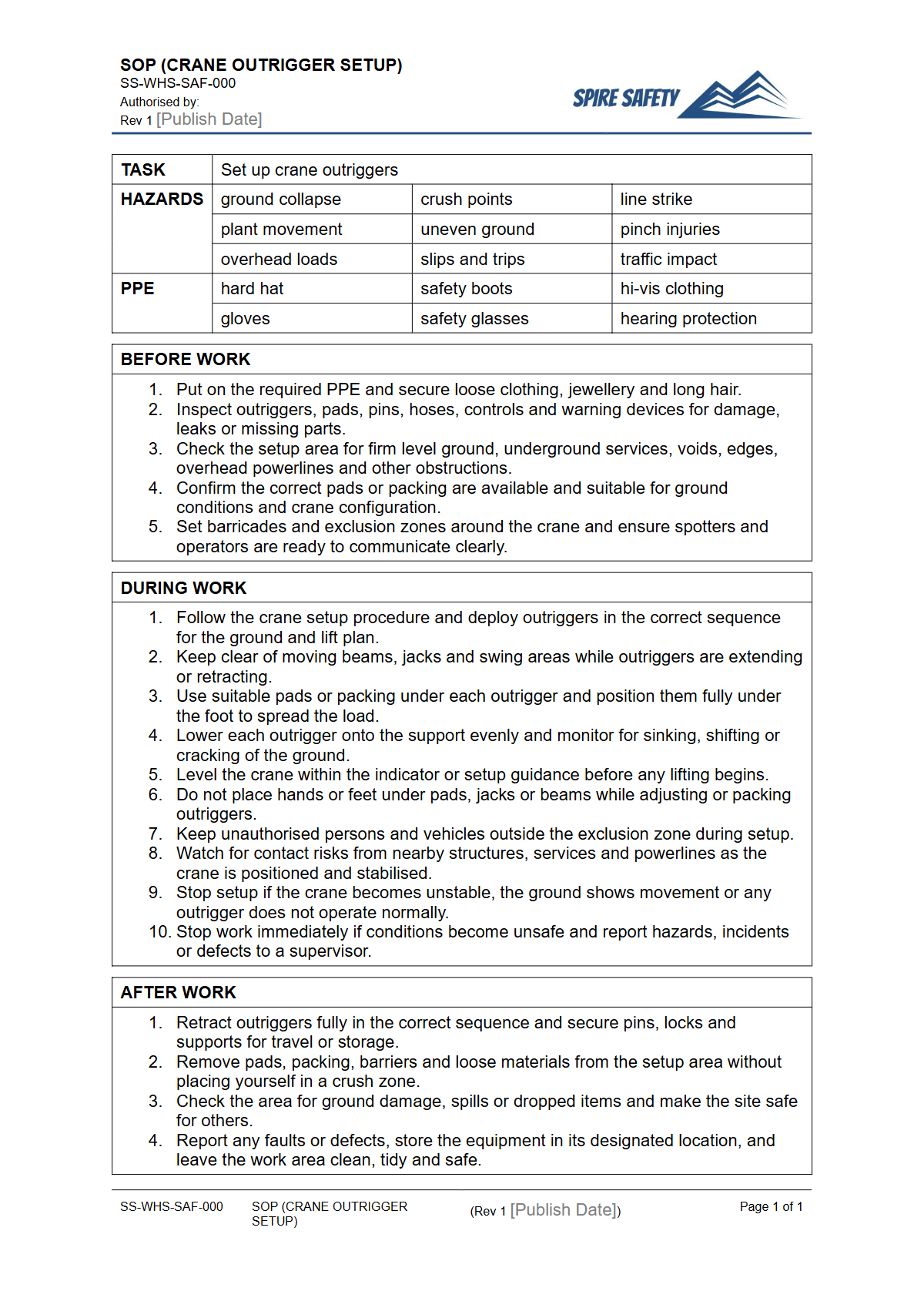
Establish a documented process for safely deploying crane outriggers. Download our free Safe Operating Procedure (SOP) template to get started.
Free Safe Operating Procedure (Crane Outrigger Setup) Template
DOCX • 126 KB + PDF
Updated Oct 2026
No signup required
Purpose of the Free Safe Operating Procedure (Crane Outrigger Setup) Template
This Safe Operating Procedure (SOP) template is designed to help your organisation establish a formal, step-by-step process for the correct setup of crane outriggers. The primary cause of crane-related incidents is often instability, which typically results from an inadequate setup on unsuitable ground.
Using a documented procedure helps standardise this critical task, reduce the risk of human error, and ensure every operator follows a consistent, safe method before commencing any lift. It provides a clear and auditable record of your operational standards, demonstrating a commitment to proactive risk management.
A well-defined SOP serves as a vital training tool for new operators and a valuable reference for experienced personnel. It forms a cornerstone of your overall safety framework, integrating seamlessly with your broader WHS management systems. By formalising the process, you create a baseline for competency, supervision, and incident investigation, ensuring that the known controls for preventing crane tip-overs are always implemented.
Video walkthrough
How to use the Free Safe Operating Procedure (Crane Outrigger Setup) Template
Our free crane outrigger setup template provides a structured foundation for you to build upon. After downloading the DOCX or PDF file, the first step is to customise it with your company's name, logo, and relevant site details.
It is crucial that you then adapt the technical content to align with the specific types of cranes used in your operations, the manufacturer's instructions, and the typical environmental conditions encountered on your work sites. This is not a 'one-size-fits-all' document.
We have provided a comprehensive starting point, but you must make it your own by adding or removing steps to reflect your unique operational risks and control measures. For example, your procedure should specify the type and size of outrigger pads or bog mats required for different ground-bearing capacities.
Just as you would have specific procedures for other high-risk plant, such as those covered in our FREE Telehandler SOP Template, this document must be tailored to be effective.
Customising Your Safe Operating Procedure
To ensure this SOP is effective for your workplace, you should review and modify the following sections:
- Pre-operational Checks: Align the inspection points with the specific make and model of your crane(s).
- Ground Assessment: Include criteria specific to your sites, such as identifying backfilled soil, proximity to trenches, or underground services. Ground preparation is a critical step, often requiring other equipment for which you may need a separate procedure, like our FREE Dozer SOP Template.
- Outrigger Deployment Steps: Detail the exact sequence for extending and setting the outriggers and pads, referencing the crane's load charts and configuration requirements.
- Emergency Procedures: Outline the immediate actions to take in case of ground subsidence, equipment failure, or other emergencies during setup.
When to use this Safe Operating Procedure
This SOP should be used every time a mobile crane is set up for a lift, without exception. It serves as a direct procedural guide for the crane operator and any associated personnel, such as riggers or doggers, who may be involved in the setup.
Beyond its use in daily operations, the SOP is a critical document for several other purposes. It should be used as a primary training document for new operator inductions and as a basis for conducting periodic refresher training and competency assessments.
Supervisors and safety managers should also use the SOP as a checklist during site inspections and safety observations to verify that correct procedures are being followed. For complex lifts or unfamiliar ground conditions, the SOP can be reviewed as part of the pre-lift planning meeting or toolbox talk to reinforce critical safety steps.
Its use ensures a consistent standard is applied across all teams and projects, similar to how a FREE Grader SOP (Safe Operating Procedure) Template ensures uniform operation for that specific plant.
Who should use this Crane Outrigger SOP
This document is intended for a range of personnel within an organisation that operates mobile cranes. The primary users are the crane operators themselves, who are directly responsible for the safe setup and operation of the equipment.
It provides them with a clear, authoritative guide to follow. Crane crews, including riggers and doggers assisting with the setup, must also be familiar with the procedure to ensure coordinated and safe execution.
Site supervisors and project managers are responsible for ensuring that these procedures are available and consistently implemented on-site. They can use the SOP as an auditing tool to confirm safe work practices are being upheld. Furthermore, WHS advisors and safety officers will use this document as part of the site's safety management system, referencing it during risk assessments, incident investigations, and formal worksite reviews. This documented process provides a clear benchmark when undergoing WHS compliance auditing to demonstrate systematic risk management. For more procedural templates, browse our complete free WHS resources library.
Common mistakes
Common mistakes to avoid
- Failing to conduct a thorough assessment of ground conditions before setup.
- Using makeshift, undersized, or damaged outrigger pads (dunnage).
- Not fully extending outrigger beams to the required configuration as per the load chart.
- Setting up too close to excavations, slopes, underground services, or other hazards.
Legal references
Legal considerations
The following legal requirements may be relevant to this type of work.
- Work Health and Safety Act (Harmonised) — Provides the primary duties for protecting workers and other people from work health and safety risks.
- Work Health and Safety Regulations (Harmonised) — Sets out requirements supporting the management of workplace hazards and risks.
The following codes may be relevant to this type of work.
- Managing WHS Risks Code of Practice — Provides practical guidance on identifying hazards, assessing risks and applying effective controls.
- Work Health and Safety Consultation, Cooperation and Coordination Code of Practice — Provides practical guidance on consulting workers and coordinating with other duty holders.
- Managing the Work Environment and Facilities Code of Practice — Provides practical guidance on safe work environments, workplace facilities and related controls.
Did you know
Ground Pressure
A crane's outriggers can exert immense ground pressure, often exceeding 50 tonnes per square metre. Without proper dunnage or pads, this force can easily cause soil, asphalt, or even concrete to fail.
A Leading Cause
According to industry safety reports, improper ground setup and outrigger use is a leading cause of mobile crane tip-overs, which are among the most catastrophic and costly construction incidents.
FAQ
Frequently asked questions
01What should be included in a crane outrigger setup SOP?
02Who is responsible for ensuring the crane outrigger SOP is followed?
03How often should a crane outrigger setup SOP be reviewed?
04Is this template suitable for all types of cranes?
Share this resource
Free Safe Operating Procedure (Crane Outrigger Setup) Template
Browse Categories
How To Use It
- 1Download and open in Word or PDF.
- 2Replace the placeholders with your business details.
- 3Get it reviewed by a WHS specialist before rollout.
Need it customised?
Our WHS consultants can adapt this template to your site, run a gap analysis, or audit what you already have in place.
Book a Free Consultation WHS consulting servicesor call 1300 156 382
Related templates
- Free Safe Operating Procedure (Crane Pendant Control) Template
- Free Safe Operating Procedure (Crane Radio Controls) Template
- Free Safe Operating Procedure (Crane Scale) Template
- Free Safe Operating Procedure (Crash Cart Restocking) Template
- Free Safe Operating Procedure (Crawler Crane Setup) Template
- Free Safe Operating Procedure (Creek Bank Cleanup) Template