
Free Safe Operating Procedure (Courier Bag Handling) Template
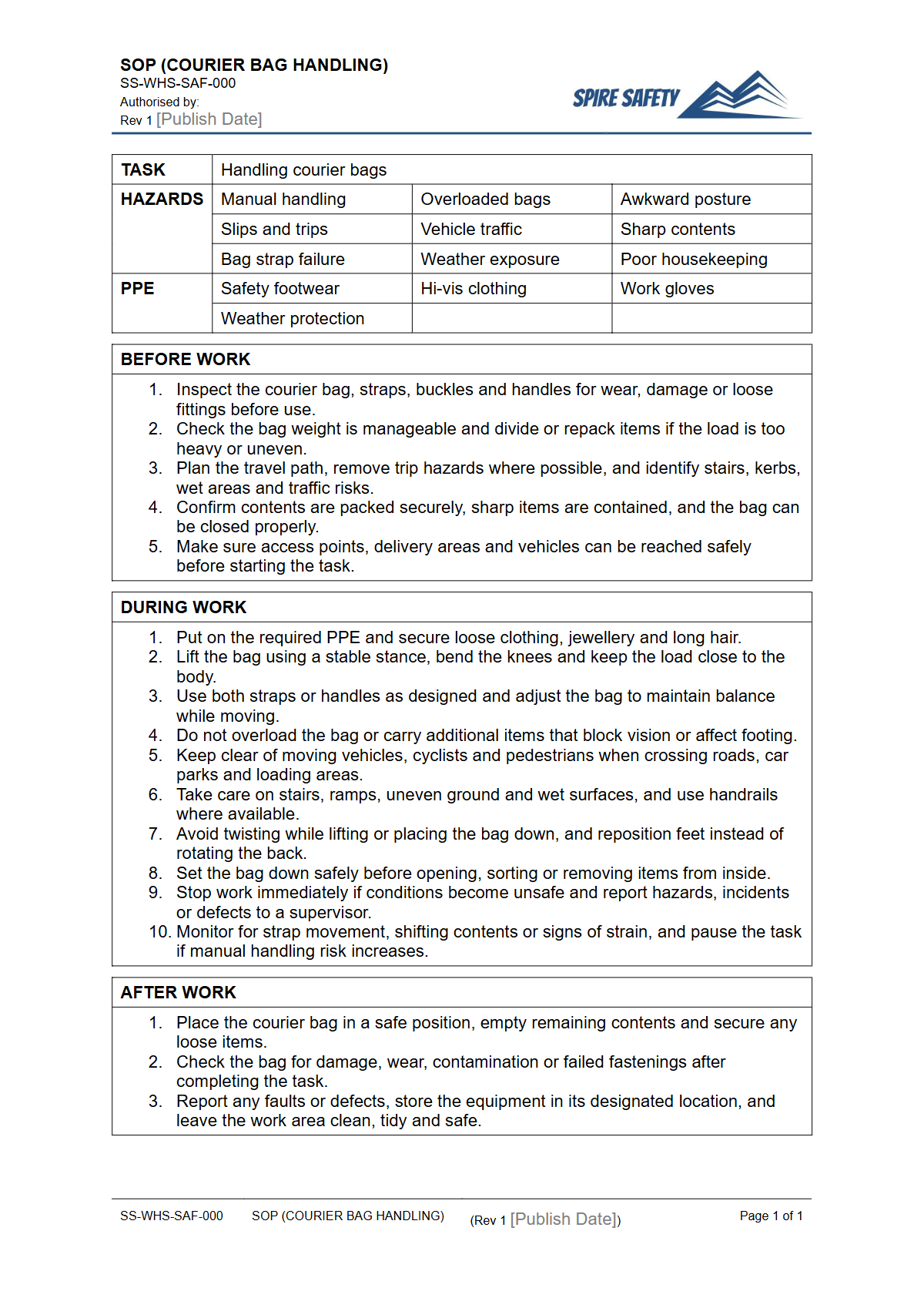
Effectively manage risks like musculoskeletal injuries associated with lifting and moving courier bags. Download our free Safe Operating Procedure template.
Free Safe Operating Procedure (Courier Bag Handling) Template
DOCX • 126 KB + PDF
Updated Oct 2026
No signup required
Purpose of the Free Safe Operating Procedure (Courier Bag Handling) Template
Handling courier bags, parcels, and satchels is a core task in logistics, but it carries significant risks of musculoskeletal injury. Repetitive lifting, awkward postures, and excessive force can lead to sprains, strains, and long-term health issues.
This Free Safe Operating Procedure (Courier Bag Handling) Template provides a structured framework for documenting and implementing safe work practices in your organisation. It is designed to help you formalise safe work methods, reduce the risk of injury, provide a consistent basis for worker training, and demonstrate due diligence in meeting your health and safety obligations.
By clearly defining the steps for safely lifting, carrying, and setting down bags, you establish a benchmark for expected behaviour. A documented procedure is a cornerstone of proactive safety management and is essential for building robust WHS management systems that protect your workers and your business.
Hazards Addressed
This SOP template prompts you to consider common hazards associated with handling courier bags, including:
- Musculoskeletal disorders (MSDs) from incorrect lifting techniques, repetitive actions, and sustained awkward postures.
- Slips, trips, and falls from cluttered work areas or rushing.
- Cuts or lacerations from sharp objects, damaged packaging, or using cutting tools incorrectly.
- Strain from handling unexpectedly heavy or unstable loads.
Video walkthrough
How to use the Free Safe Operating Procedure (Courier Bag Handling) Template
This resource is available for download as a DOCX file for easy editing and as a print-ready PDF. To use the template effectively, you must adapt it to the specific conditions of your workplace.
A generic procedure is not sufficient to control site-specific risks.
Important: This document is a template and must be customised to your business. We recommend you conduct a risk assessment in consultation with your workers to identify all relevant hazards.
You should then update the SOP with site-specific details, such as maximum lifting weights, designated pathways, types of mechanical aids available (e.g., trolleys, carts), and your specific emergency response contacts and procedures.
Regularly reviewing your documented procedures is a critical part of maintaining a safe workplace. These reviews can be integrated into your internal audit schedule or verified through a formal WHS compliance audit to ensure ongoing effectiveness.
When to use this Safe Operating Procedure
A Safe Operating Procedure for courier bag handling should be used as a primary tool for training and operational guidance. It is most effective when integrated into daily routines and safety communications.
Use this SOP during the induction of new employees to establish safe habits from day one. It should also be a key reference for periodic refresher training to prevent complacency and reinforce correct techniques.
The SOP should be readily accessible in work areas where courier bags are handled, such as mailrooms, loading docks, and distribution centres. It is particularly valuable in dynamic environments where workers interact with automated equipment, complementing procedures for other machinery like those outlined in our FREE Conveyer System SOP Template.
Who should use this SOP for Courier Bag Handling?
This procedure is intended for a range of personnel within an organisation:
- Workers: Courier drivers, warehouse staff, mailroom clerks, and any other employees who directly handle bags and parcels should use the SOP as their guide for performing tasks safely.
- Supervisors and Team Leaders: Managers should use the SOP to train their teams, monitor work practices, conduct safety observations, and correct unsafe behaviour.
- WHS Managers and Advisors: Safety professionals can use this template as a foundational document to build out a comprehensive safety system for manual tasks, ensuring alignment with Australian WHS principles.
In a large depot, supervisors must ensure workers are trained across various tasks and equipment. For instance, staff may also require training detailed in our FREE Telehandler SOP Template for moving palletised goods.
Similarly, facility maintenance tasks should be governed by specific procedures, such as those in our Free Air Compressor SOP Template, to ensure all workplace activities are controlled. To discover more helpful documents, you can browse our complete free WHS resources library.
Common mistakes
Common mistakes to avoid
- Using the downloaded template without customising it for specific workplace hazards.
- Failing to train workers on the SOP and verifying they understand the procedures.
- Not reviewing or updating the SOP after an incident, near miss, or change in process.
- Treating the SOP as a document for compliance purposes only, rather than a practical tool for daily use.
Legal references
Legal considerations
The following legal requirements may be relevant to this type of work.
- Work Health and Safety Act (Harmonised) — Provides the primary duties for protecting workers and other people from work health and safety risks.
- Work Health and Safety Regulations (Harmonised) — Sets out requirements supporting the management of workplace hazards and risks.
The following codes may be relevant to this type of work.
- Managing WHS Risks Code of Practice — Provides practical guidance on identifying hazards, assessing risks and applying effective controls.
- Work Health and Safety Consultation, Cooperation and Coordination Code of Practice — Provides practical guidance on consulting workers and coordinating with other duty holders.
- Managing the Work Environment and Facilities Code of Practice — Provides practical guidance on safe work environments, workplace facilities and related controls.
Did you know
Manual Handling Risk
Work-related musculoskeletal disorders, often stemming from hazardous manual tasks, account for a significant portion of all serious workers' compensation claims in Australia each year.
The Importance of Consultation
Under model WHS laws, employers have a legal duty to consult with their workers on matters relating to health and safety. This includes the development of risk controls like Safe Operating Procedures.
FAQ
Frequently asked questions
01What are the main hazards of handling courier bags?
02Does this SOP cover vehicle loading and unloading?
03How often should a Safe Operating Procedure be reviewed?
04Is a Safe Operating Procedure a legal requirement in Australia?
Share this resource
Free Safe Operating Procedure (Courier Bag Handling) Template
Browse Categories
How To Use It
- 1Download and open in Word or PDF.
- 2Replace the placeholders with your business details.
- 3Get it reviewed by a WHS specialist before rollout.
Need it customised?
Our WHS consultants can adapt this template to your site, run a gap analysis, or audit what you already have in place.
Book a Free Consultation WHS consulting servicesor call 1300 156 382
Related templates
- Free Safe Operating Procedure (Courier Route Handover) Template
- Free Safe Operating Procedure (Court Surface Cleaning) Template
- Free Safe Operating Procedure (Courtyard Washdown) Template
- Free Safe Operating Procedure (Crack Monitor) Template
- Free Safe Operating Procedure (Crane Limit Switch Test) Template
- Free Safe Operating Procedure (Crane Outrigger Setup) Template