
Free Safe Operating Procedure (Court Surface Cleaning) Template
Define safe work methods for cleaning sports courts with our structured template. Download your free Safe Operating Procedure to manage risks effectively.
Free Safe Operating Procedure (Court Surface Cleaning) Template
DOCX • 126 KB + PDF
Updated Oct 2026
No signup required
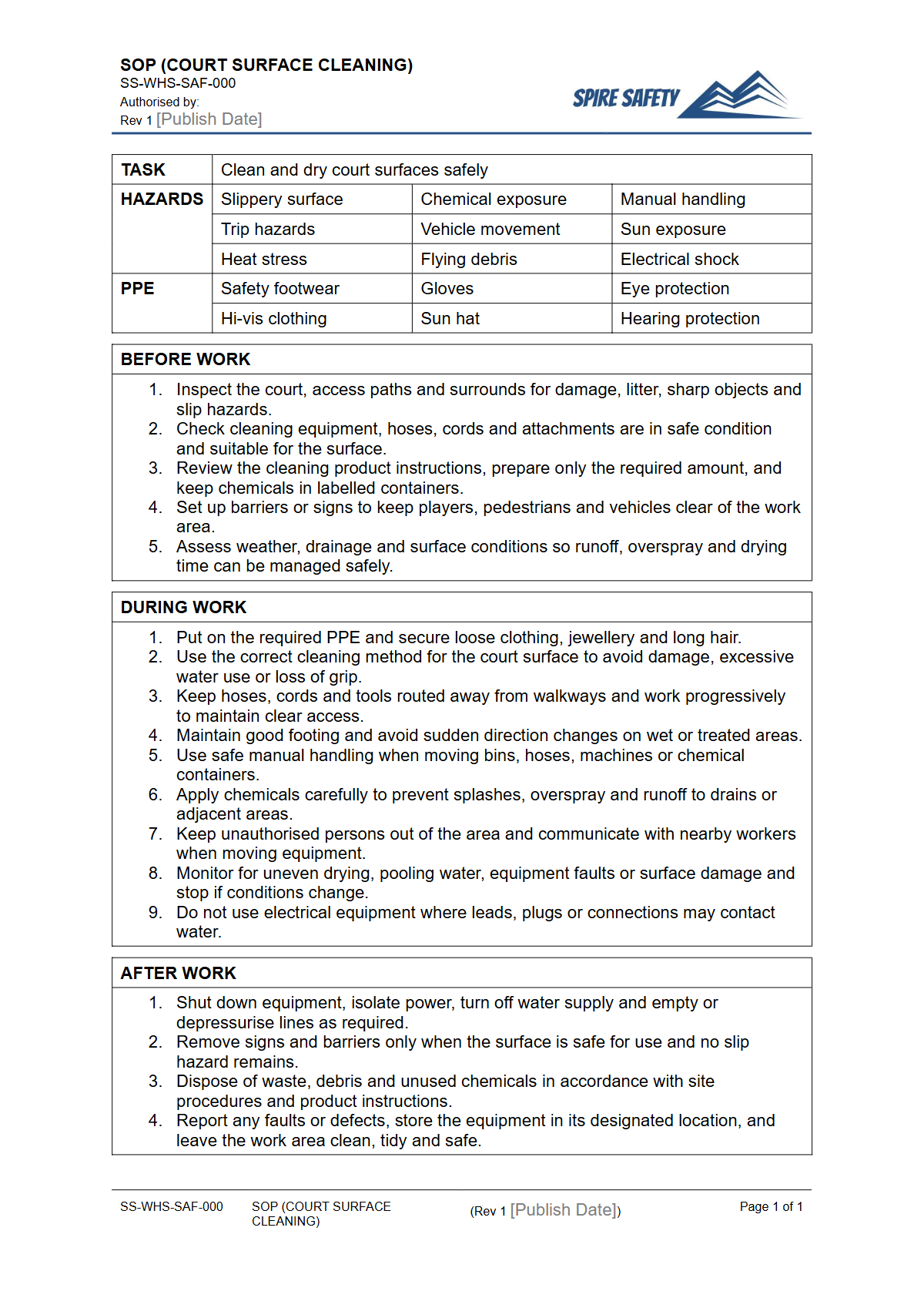
Purpose of the Free Safe Operating Procedure (Court Surface Cleaning) Template
Maintaining sports court surfaces is essential for both performance and player safety, but the cleaning process itself introduces workplace hazards. This Free Safe Operating Procedure (Court Surface Cleaning) Template provides a structured starting point for documenting a safe system of work for this common maintenance task.
An SOP helps control risks such as slips from wet surfaces, trips over hoses and equipment, manual handling injuries, and exposure to cleaning chemicals. By clearly outlining pre-operational checks, step-by-step instructions, and emergency procedures, you can ensure the task is performed consistently and safely every time.
A documented Safe Operating Procedure (SOP) is a fundamental administrative control measure and a critical component of effective WHS management systems. It demonstrates a commitment to managing foreseeable risks and provides a clear training tool for workers, helping your organisation meet its primary duty of care under Australian WHS legislation.
Video walkthrough
How to use the Free Safe Operating Procedure (Court Surface Cleaning) Template
This document is a template and must be customised to reflect the specific circumstances of your workplace. To use it effectively, follow these steps:
- Download the template in your preferred format (DOCX for easy editing or PDF).
- Consult with workers who perform the cleaning tasks to ensure the procedure reflects practical, on-the-ground realities.
- Identify the specific court surfaces (e.g., acrylic hard court, synthetic grass, clay) and the approved cleaning agents for each.
- Detail the equipment to be used, such as pressure washers, rotary scrubbers, leaf blowers, or brooms, including any specific pre-start checks or operating instructions.
- Customise the Personal Protective Equipment (PPE) section to list mandatory items like non-slip waterproof boots, gloves, eye protection, and hearing protection if using loud machinery.
- Incorporate site-specific details, such as the location of water sources, drainage points, and any pedestrian management controls needed during the work.
Remember, this is a guide. We have provided a framework, but you must populate it with information specific to your equipment, chemicals, and work environment. While this SOP covers a common task, procedures for operating specific high-risk plant require significant detail, as seen in examples like our FREE Telehandler SOP Template.
When should a Safe Operating Procedure for Court Surface Cleaning be used?
An SOP for court surface cleaning should be developed, implemented, and readily available before any worker undertakes the task. It is a 'live' document used for:
- Training and Induction: To train new employees or contractors on the established safe method for cleaning courts.
- Pre-Task Planning: As a refresher for workers to review the steps and required safety controls before starting the job.
- Supervision and Monitoring: To provide supervisors with a clear standard against which to monitor performance and ensure procedures are being followed.
- Incident Investigation: As a reference point to determine if procedural deviations contributed to an incident or near-miss.
The procedure should be reviewed regularly and updated whenever there is a change to the task, equipment, chemicals used, or work environment. If ancillary equipment like an industrial blower is used for clearing debris, it may require its own dedicated SOP, similar to our Free Air Compressor SOP (Safe Operating Procedure) Template.
Who is this Safe Operating Procedure for?
This SOP is designed for use by any person conducting a business or undertaking (PCBU) where court surface cleaning is performed. This includes facility managers, sports clubs, schools, and local councils. Key personnel who will use this document include:
- Workers and Groundskeepers: The primary users who follow the procedure to perform their tasks safely.
- Supervisors and Team Leaders: Who use the SOP for training, competency assessment, and work monitoring.
- WHS Managers and Advisors: Who use the SOP as part of the overall risk management framework and to ensure regulatory alignment.
The effectiveness of safety documents like this SOP is often evaluated as part of a formal safety review process. A thorough examination of documented procedures against actual work practices is a key activity within WHS compliance auditing.
Integrating this SOP into your broader safety system ensures a consistent approach to risk management. For complex cleaning tasks or developing a suite of interconnected safety documents, seeking expert advice can streamline the process.
Spire's team provides practical WHS consulting to help businesses build robust and user-friendly safety frameworks.
By implementing a clear, customised SOP, you formalise your safety practices and empower your team to work safely and confidently. For other templates and checklists, you can explore our complete free WHS resources library.
Common mistakes
Common mistakes to avoid
- Using a generic template without customising it for specific site equipment and chemicals.
- Failing to consult with the workers who actually perform the cleaning task when drafting the procedure.
- Not including specific details for emergency procedures, such as chemical first aid or contact information.
- Forgetting to train workers on the finalised SOP and document the training.
Legal references
Legal considerations
The following legal requirements may be relevant to this type of work.
- Work Health and Safety Act (Harmonised) — Provides the primary duties for protecting workers and other people from work health and safety risks.
- Work Health and Safety Regulations (Harmonised) — Sets out requirements supporting the management of workplace hazards and risks.
The following codes may be relevant to this type of work.
- Managing WHS Risks Code of Practice — Provides practical guidance on identifying hazards, assessing risks and applying effective controls.
- Work Health and Safety Consultation, Cooperation and Coordination Code of Practice — Provides practical guidance on consulting workers and coordinating with other duty holders.
- Managing the Work Environment and Facilities Code of Practice — Provides practical guidance on safe work environments, workplace facilities and related controls.
Did you know
Slips, Trips and Falls
Slips, trips and falls are a leading cause of serious injuries in Australian workplaces. Maintaining clean, dry, and unobstructed surfaces is a primary control measure mandated by WHS regulations.
Chemical Safety Data
Under WHS laws, you must have a Safety Data Sheet (SDS) for any hazardous chemical used in the workplace. The SDS provides critical information on handling, storage, first aid, and PPE requirements, which should be referenced in your SOP.
FAQ
Frequently asked questions
01What hazards are involved in cleaning court surfaces?
02Does this SOP cover pressure washing a tennis court?
03Is an SOP the same as a Safe Work Method Statement (SWMS)?
04How often should I review my Court Surface Cleaning SOP?
Share this resource
Free Safe Operating Procedure (Court Surface Cleaning) Template
Browse Categories
How To Use It
- 1Download and open in Word or PDF.
- 2Replace the placeholders with your business details.
- 3Get it reviewed by a WHS specialist before rollout.
Need it customised?
Our WHS consultants can adapt this template to your site, run a gap analysis, or audit what you already have in place.
Book a Free Consultation WHS consulting servicesor call 1300 156 382
Related templates
- Free Safe Operating Procedure (Courtyard Washdown) Template
- Free Safe Operating Procedure (Crack Monitor) Template
- Free Safe Operating Procedure (Crane Limit Switch Test) Template
- Free Safe Operating Procedure (Crane Outrigger Setup) Template
- Free Safe Operating Procedure (Crane Pendant Control) Template
- Free Safe Operating Procedure (Crane Radio Controls) Template