
Free Safe Operating Procedure (Countertop Cleaning) Template
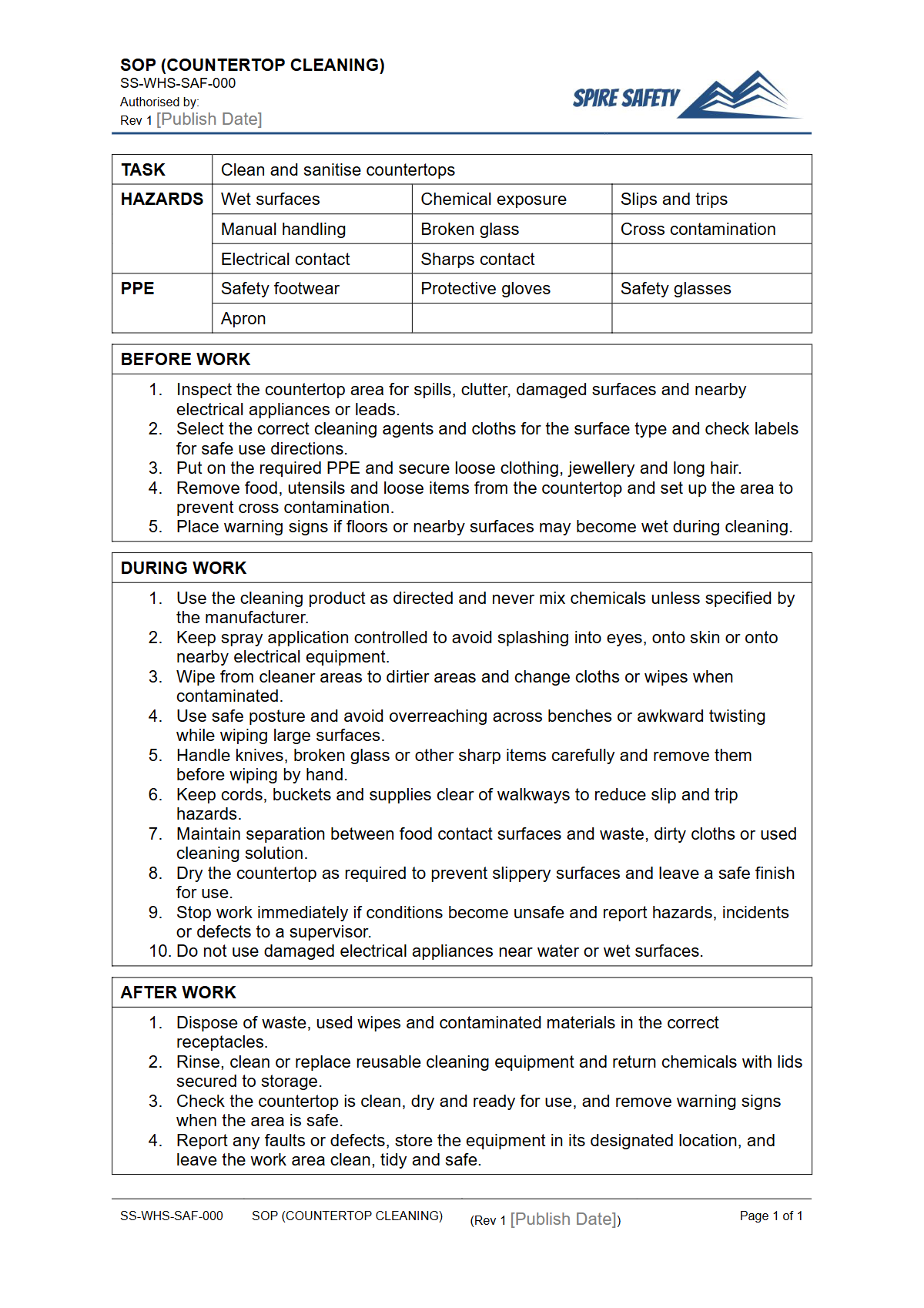
Download our free Safe Operating Procedure for countertop cleaning. This template provides a structured starting point for your workplace safety documents.
Free Safe Operating Procedure (Countertop Cleaning) Template
DOCX • 126 KB + PDF
Updated Oct 2026
No signup required
Purpose of the Free Safe Operating Procedure (Countertop Cleaning) Template
Developing clear, documented processes is fundamental to workplace safety. This Free Safe Operating Procedure (Countertop Cleaning) Template provides a structured starting point for organisations to formalise their cleaning protocols.
Countertop cleaning, a common task across hospitality, healthcare, food service, and office environments, involves hazards that must be managed. These include exposure to cleaning chemicals, ergonomic risks from repetitive motions, and slip hazards from spills.
A documented Safe Operating Procedure (SOP) helps standardise the task, ensuring every worker follows the same safe steps. It serves as a vital training tool, a benchmark for supervision, and a key component in a proactive safety culture.
By clearly outlining hazards, control measures, and emergency responses, this SOP helps your organisation meet its work health and safety obligations. Integrating task-specific SOPs like this one is a practical way to build a robust WHS management system.
Video walkthrough
How to use the Free Safe Operating Procedure (Countertop Cleaning) Template
This template is available for download as a DOCX file for easy editing or as a PDF for immediate use. It is designed to be a foundation, not a finished document.
To be effective, you must adapt it to the specific conditions of your workplace. This involves identifying the unique surfaces, chemicals, and equipment used by your team.
Note: We strongly recommend that you consult with the workers who actually perform the cleaning tasks. Their direct experience is invaluable for identifying all the practical risks and effective control measures. When customising, be sure to include:
- The specific names of cleaning chemicals used and where to find their Safety Data Sheets (SDS).
- The exact Personal Protective Equipment (PPE) required (e.g., specific glove type, safety glasses).
- Step-by-step instructions from preparation to clean-up and waste disposal.
- Site-specific emergency procedures and contact details.
Just as you would create a detailed procedure for a high-risk tool using a FREE Circular Saw SOP, routine tasks like cleaning deserve the same level of care in documentation to effectively manage risk.
When to use a Safe Operating Procedure for Countertop Cleaning
A Safe Operating Procedure for countertop cleaning should be integrated into your daily operations. It is most effective when used as a reference document for training new employees and conducting refresher courses for existing staff.
The SOP should be readily available in the work area for workers to consult as needed. Furthermore, it is critical to review and potentially update the SOP after any workplace incident, or when a new chemical, piece of equipment, or cleaning process is introduced.
Regular reviews of your SOPs can form part of a scheduled WHS compliance auditing program to ensure ongoing relevance and effectiveness.
Who should use this template
This template is designed for anyone responsible for the health and safety of workers performing cleaning tasks. This includes:
- Workplace Health and Safety (WHS) Managers
- Team Leaders and Supervisors in cleaning, hospitality, and healthcare sectors
- Small Business Owners
- Operations Managers
It provides a framework to guide the development of a practical safety document that helps fulfil duties of training, instruction, and supervision. If your organisation needs expert assistance in adapting this template or developing a comprehensive suite of safety documents, our WHS consulting services can provide tailored support.
This document is just one of many tools available to help you build a safer workplace. Explore our complete free WHS resources library for more templates, checklists, and guides to support your safety management system.
Common mistakes
Common mistakes to avoid
- Using a generic SOP without customising it for specific chemicals, surfaces, and equipment.
- Failing to consult with cleaning staff when developing or reviewing the procedure.
- Not providing or enforcing the use of the specific Personal Protective Equipment (PPE) listed in the SOP.
- Forgetting to make Safety Data Sheets (SDS) for all cleaning chemicals readily accessible to workers.
Legal references
Legal considerations
The following legal requirements may be relevant to this type of work.
- Work Health and Safety Act (Harmonised) — Provides the primary duties for protecting workers and other people from work health and safety risks.
- Work Health and Safety Regulations (Harmonised) — Sets out requirements supporting the management of workplace hazards and risks.
The following codes may be relevant to this type of work.
- Managing WHS Risks Code of Practice — Provides practical guidance on identifying hazards, assessing risks and applying effective controls.
- Work Health and Safety Consultation, Cooperation and Coordination Code of Practice — Provides practical guidance on consulting workers and coordinating with other duty holders.
- Managing the Work Environment and Facilities Code of Practice — Provides practical guidance on safe work environments, workplace facilities and related controls.
Did you know
Chemical Safety Data
Many common cleaning chemicals can cause skin irritation, respiratory issues, or other health problems. A Safety Data Sheet (SDS) is required for hazardous chemicals and provides crucial information on safe handling, storage, and first aid.
Slip Hazards
Slips, trips, and falls are a leading cause of workplace injury in Australia. Wet floors from cleaning activities are a common culprit, making warning signage and prompt drying procedures essential safety controls.
FAQ
Frequently asked questions
01What should be included in a countertop cleaning SOP?
02Who is responsible for writing a Safe Operating Procedure?
03How often should we review our cleaning SOPs?
04Is this template enough for WHS compliance?
Share this resource
Free Safe Operating Procedure (Countertop Cleaning) Template
Browse Categories
How To Use It
- 1Download and open in Word or PDF.
- 2Replace the placeholders with your business details.
- 3Get it reviewed by a WHS specialist before rollout.
Need it customised?
Our WHS consultants can adapt this template to your site, run a gap analysis, or audit what you already have in place.
Book a Free Consultation WHS consulting servicesor call 1300 156 382
Related templates
- Free Safe Operating Procedure (Courier Bag Handling) Template
- Free Safe Operating Procedure (Courier Route Handover) Template
- Free Safe Operating Procedure (Court Surface Cleaning) Template
- Free Safe Operating Procedure (Courtyard Washdown) Template
- Free Safe Operating Procedure (Crack Monitor) Template
- Free Safe Operating Procedure (Crane Limit Switch Test) Template