
Free Safe Operating Procedure (Cooling Tower Dosing) Template
Properly manage the risks associated with chemical dosing in cooling towers with our structured template.
Free Safe Operating Procedure (Cooling Tower Dosing) Template
DOCX • 126 KB + PDF
Updated Oct 2026
No signup required
Purpose of the Free Safe Operating Procedure (Cooling Tower Dosing) Template
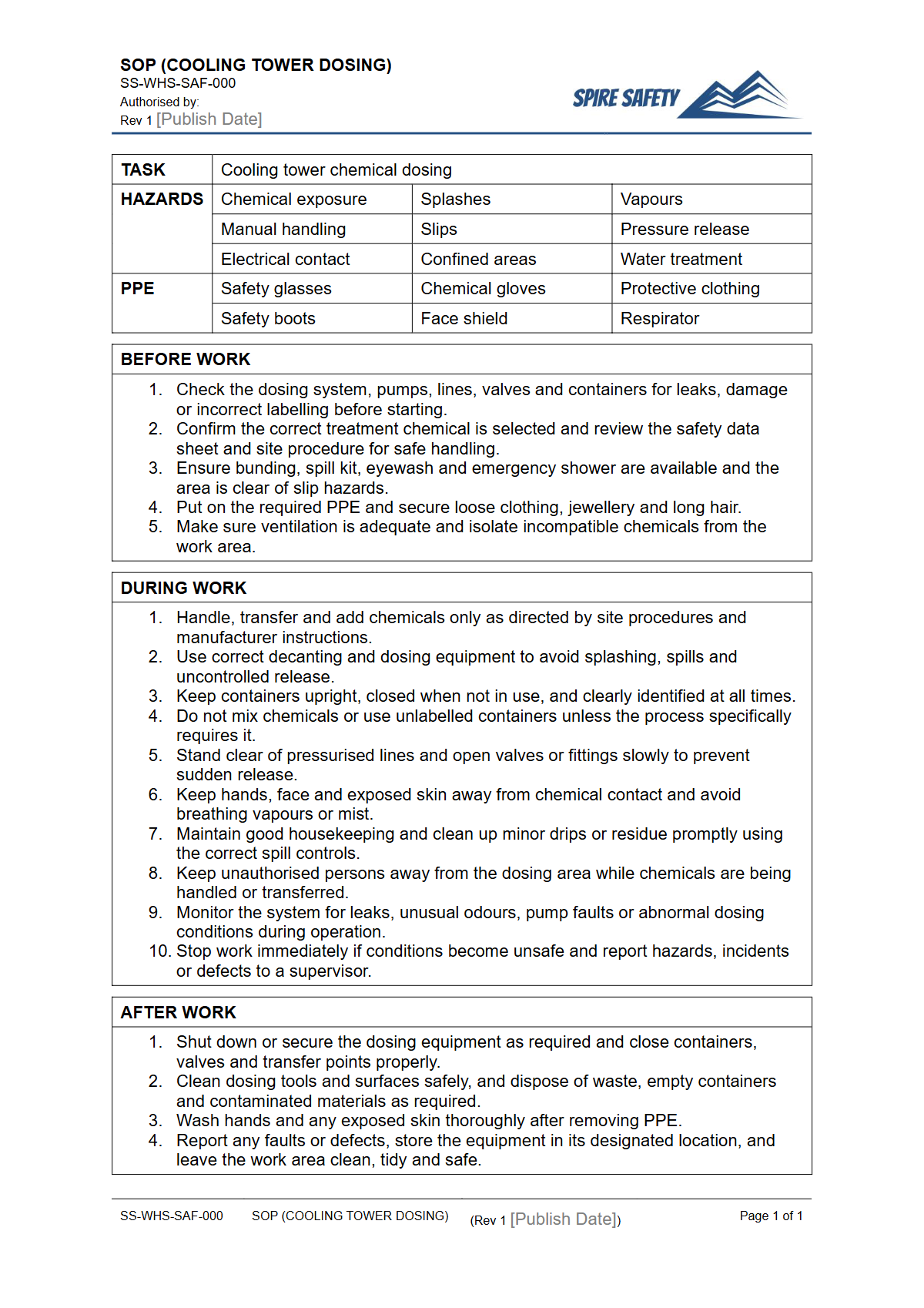
Managing the chemical treatment of cooling towers is a critical task that involves significant health and safety risks. This Free Safe Operating Procedure (Cooling Tower Dosing) Template provides a structured framework for outlining the required steps to perform this task safely.
The primary purpose is to control hazards associated with hazardous chemicals, such as chemical burns, inhalation of toxic vapours, and long-term health effects. It also addresses the serious biological hazard of Legionella bacteria, which can proliferate in poorly maintained water systems.
A documented SOP ensures that all personnel follow a consistent, pre-approved method for handling, mixing, and introducing chemicals into the system. This not only protects workers but also helps maintain the operational integrity of the cooling tower, preventing corrosion, scaling, and biological fouling that can lead to costly damage and inefficient operation.
Implementing robust procedures is a cornerstone of effective WHS management systems, demonstrating a commitment to proactive risk management.
Video walkthrough
How to use the Free Safe Operating Procedure (Cooling Tower Dosing) Template
This document is provided in both DOCX and PDF formats for your convenience. The DOCX file is fully editable, allowing you to tailor the content to the specific requirements of your workplace.
It is essential to customise this template before use. You must insert details relevant to your site, including the specific names of chemicals used, required concentrations, types of cooling tower systems, and emergency contact information.
Important: This is a template, not a finished document. We have provided a comprehensive structure, but you are responsible for ensuring the final procedure accurately reflects your unique operational context and complies with all relevant regulations.
This includes referencing the Safety Data Sheet (SDS) for each chemical and incorporating the specified controls, such as ventilation and Personal Protective Equipment (PPE). If you require assistance with customisation or risk assessment, consider engaging professional WHS consulting services.
When to use this Safe Operating Procedure
This Safe Operating Procedure should be used as the primary reference document for any and all cooling tower chemical dosing activities. It should be readily accessible to all personnel involved in the task. Specific situations where this SOP must be consulted include:
- Routine Dosing: Before performing scheduled additions of biocides, corrosion inhibitors, or anti-scalants.
- Operator Training: As a core training document for new employees or for refresher training for existing staff.
- Risk Assessments: When reviewing the hazards and control measures associated with water treatment tasks.
- Incident Investigation: As a benchmark for correct procedure if a spill, exposure, or other incident occurs.
- Audits and Inspections: To demonstrate that a formal, safe system of work is in place for managing cooling tower chemicals. Conducting regular checks ensures ongoing alignment, a key part of any WHS compliance auditing program.
Who should use it
This SOP is intended for use by all individuals involved in the operation and maintenance of cooling tower systems. This includes, but is not limited to:
- Plant Operators and Technicians: The primary users who perform the physical task of dosing the chemicals.
- Maintenance Personnel: Staff responsible for the upkeep and repair of the dosing equipment and cooling tower itself.
- Water Treatment Specialists: In-house or contracted experts who specify the treatment program and may oversee its implementation.
- Supervisors and Managers: Individuals responsible for overseeing the work, ensuring procedures are followed, and providing the necessary resources and training.
Ultimately, the Person Conducting a Business or Undertaking (PCBU) holds the primary duty of care to ensure a safe work environment. This includes ensuring that effective procedures like this SOP are developed, implemented, and consistently followed. Proper procedures for fixed plant like cooling towers are just as important as those for mobile equipment, which is why we also offer resources like our Free Air Compressor SOP (Safe Operating Procedure) Template.
You can browse our complete free WHS resources library for more templates and guides to support your safety management system.
Common mistakes
Common mistakes to avoid
- Failing to read or follow the Safety Data Sheet (SDS) for each chemical.
- Using incorrect chemical dosages, which can be ineffective or damage the system.
- Not wearing the correct Personal Protective Equipment (PPE) specified for the task.
- Poor record-keeping of dosing activities, water tests, and maintenance.
Legal references
Legal considerations
The following legal requirements may be relevant to this type of work.
- Work Health and Safety Act (Harmonised) — Provides the primary duties for protecting workers and other people from work health and safety risks.
- Work Health and Safety Regulations (Harmonised) — Sets out requirements supporting the management of workplace hazards and risks.
The following codes may be relevant to this type of work.
- Managing WHS Risks Code of Practice — Provides practical guidance on identifying hazards, assessing risks and applying effective controls.
- Work Health and Safety Consultation, Cooperation and Coordination Code of Practice — Provides practical guidance on consulting workers and coordinating with other duty holders.
- Managing the Work Environment and Facilities Code of Practice — Provides practical guidance on safe work environments, workplace facilities and related controls.
Did you know
A Notorious Outbreak
Legionnaires' disease was named after a 1976 outbreak at an American Legion convention in Philadelphia, where the bacteria spread through the hotel's air-conditioning system, which used a cooling tower.
FAQ
Frequently asked questions
01What are the main risks associated with cooling tower dosing?
02What PPE is required for handling cooling tower chemicals?
03Why is it important to control Legionella in cooling towers?
04How often should cooling tower water quality be tested?
Share this resource
Free Safe Operating Procedure (Cooling Tower Dosing) Template
Browse Categories
How To Use It
- 1Download and open in Word or PDF.
- 2Replace the placeholders with your business details.
- 3Get it reviewed by a WHS specialist before rollout.
Need it customised?
Our WHS consultants can adapt this template to your site, run a gap analysis, or audit what you already have in place.
Book a Free Consultation WHS consulting servicesor call 1300 156 382
Related templates
- Free Safe Operating Procedure (Core Drill) Template
- Free Safe Operating Procedure (Core Drilling Rig) Template
- Free Safe Operating Procedure (Cotton Gin) Template
- Free Safe Operating Procedure (Council Bin Cleaning) Template
- Free Safe Operating Procedure (Council Depot Cleanup) Template
- Free Safe Operating Procedure (Countertop Cleaning) Template