
Free Safe Operating Procedure (Council Bin Cleaning) Template
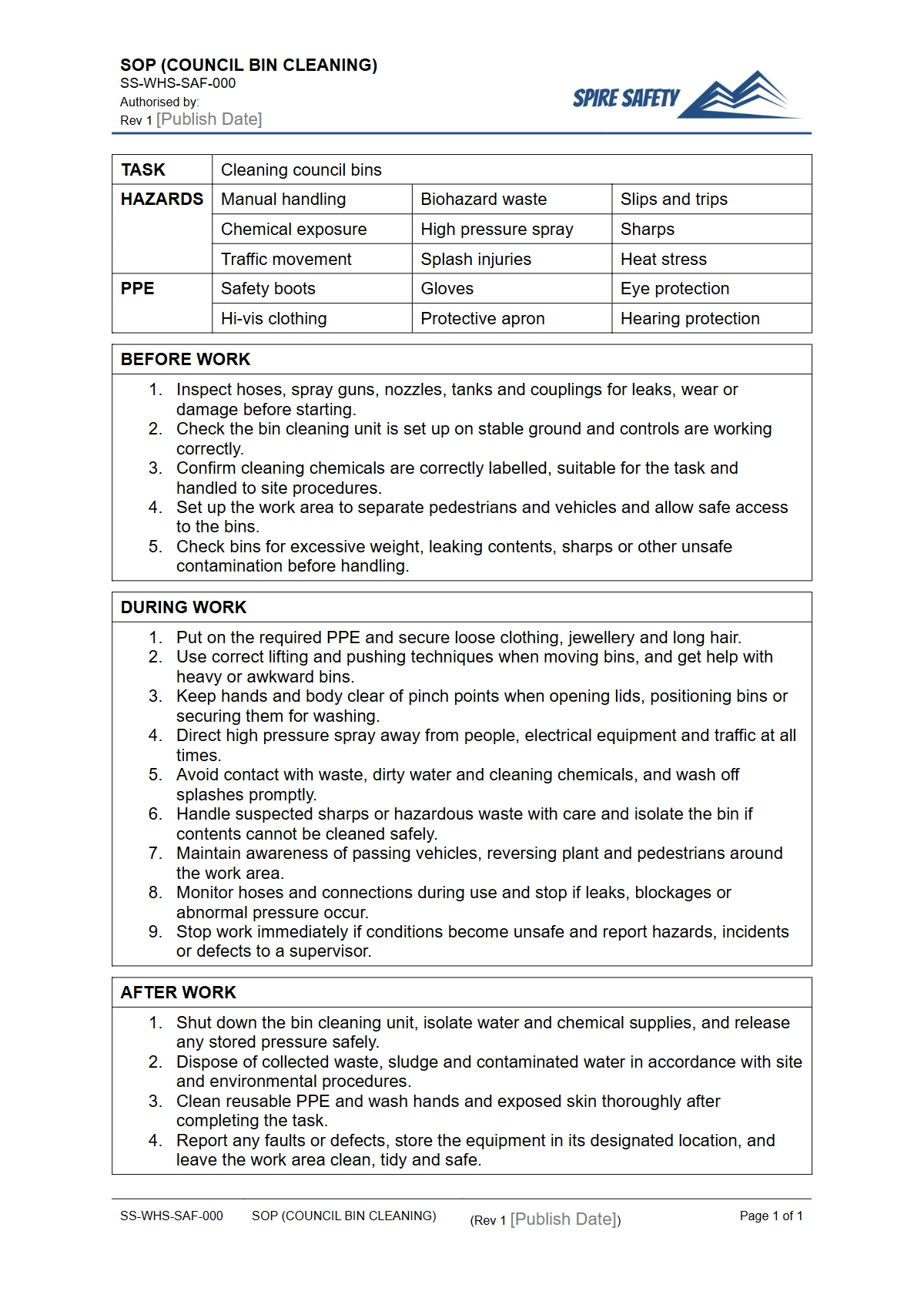
Effectively manage the risks of municipal bin cleaning with our structured Safe Operating Procedure. Download your free template today to get started.
Free Safe Operating Procedure (Council Bin Cleaning) Template
DOCX • 126 KB + PDF
Updated Oct 2026
No signup required
Purpose of the Free Safe Operating Procedure (Council Bin Cleaning) Template
This free Safe Operating Procedure (Council Bin Cleaning) Template provides a comprehensive framework for managing the health and safety risks associated with cleaning public waste and recycling receptacles. Designed for Australian workplaces, this document helps you outline a step-by-step process for workers to follow, ensuring tasks are performed safely and consistently.
Council bin cleaning involves a range of hazards that must be controlled. These include manual handling risks from lifting and moving heavy bins, awkward postures, and slip hazards from water and cleaning agents.
Workers may also face exposure to hazardous chemicals, biological waste, and sharps. This Safe Operating Procedure (SOP) serves as a critical control measure, detailing pre-operational checks, the cleaning sequence, and post-operational procedures to mitigate these risks.
Integrating this SOP into your broader WHS management systems helps demonstrate a commitment to providing a safe work environment.
Key risks addressed in this Safe Operating Procedure:
- Manual handling injuries (sprains, strains)
- Slips, trips, and falls
- Exposure to biological hazards (bacteria, viruses) and sharps
- Chemical exposure from cleaning detergents and disinfectants
- Risks from high-pressure water jetting equipment
- Traffic management and interaction with the public
Video walkthrough
How to use the Free Safe Operating Procedure (Council Bin Cleaning) Template
This template is provided in both DOCX and PDF formats for your convenience. The DOCX version is fully editable, allowing you to adapt the content to the specific requirements of your worksite.
A Safe Operating Procedure is only effective when it accurately reflects the tasks, equipment, chemicals, and environment your workers operate in.
Important: This is a template and must be customised. We recommend you consult with your workers, supervisors, and health and safety representatives during the customisation process.
Their direct experience is invaluable for identifying all relevant hazards and developing practical, effective controls. For guidance on tailoring safety documentation, consider engaging professional WHS consulting services.
For operational teams that handle diverse municipal tasks, it's crucial to have specific procedures for all high-risk equipment. For instance, staff involved in grounds maintenance may also need our FREE Trencher SOP Template.
When to use a Safe Operating Procedure
An SOP for council bin cleaning should be a core part of your daily operations and safety management cycle. It is not a document to be filed away and forgotten. It should be used for:
- Worker Training and Induction: All new workers assigned to bin cleaning tasks must be trained on the contents of the SOP before starting work.
- Pre-start Meetings and Toolbox Talks: Use the SOP as a reference during daily briefings to reinforce safe work methods and discuss any site-specific hazards.
- Task Planning: Workers should review the SOP before commencing a cleaning run to refresh their understanding of the required steps and safety controls.
- Incident Investigation: Following an incident or near-miss, the SOP should be reviewed to determine if the procedure was followed and if it requires updates.
- Audits and Reviews: Procedures should be reviewed regularly as part of your safety assurance activities. Regular WHS compliance auditing ensures your procedures remain current and effective.
Who should use this Safe Operating Procedure
This template is designed for use by any person or organisation involved in the cleaning of municipal or public-space bins. This includes:
- Council Workers: Direct employees of local government responsible for waste management and public space maintenance.
- Cleaning Contractors: Businesses contracted by councils or property managers to perform bin cleaning services.
- Supervisors and Team Leaders: Those responsible for overseeing cleaning crews, providing training, and ensuring procedures are followed correctly.
- WHS Managers and Advisors: Health and safety professionals responsible for developing, implementing, and reviewing safety documentation.
Supervisors should ensure all relevant procedures are available, such as our Free Air Compressor SOP (Safe Operating Procedure) Template for teams using pressurised cleaning equipment. Similarly, for teams managing larger-scale earthmoving as part of their duties, our FREE Grader SOP (Safe Operating Procedure) Template provides essential guidance.
Explore our complete free WHS resources library to find documents for your other operational needs.
Common mistakes
Common mistakes to avoid
- Using the template as-is without customising it for specific equipment, chemicals, and site conditions.
- Failing to provide adequate and properly fitted Personal Protective Equipment (PPE) to workers.
- Neglecting to train workers on the specific procedures outlined in the SOP before they start the task.
- Not planning for interactions with traffic or the public, creating uncontrolled risks.
Legal references
Legal considerations
The following legal requirements may be relevant to this type of work.
- Work Health and Safety Act (Harmonised) — Provides the primary duties for protecting workers and other people from work health and safety risks.
- Work Health and Safety Regulations (Harmonised) — Sets out requirements supporting the management of workplace hazards and risks.
The following codes may be relevant to this type of work.
- Managing WHS Risks Code of Practice — Provides practical guidance on identifying hazards, assessing risks and applying effective controls.
- Work Health and Safety Consultation, Cooperation and Coordination Code of Practice — Provides practical guidance on consulting workers and coordinating with other duty holders.
- Managing the Work Environment and Facilities Code of Practice — Provides practical guidance on safe work environments, workplace facilities and related controls.
Did you know
Bacterial Hotspots
Studies have shown that the average public waste bin can contain high levels of harmful bacteria, including E. coli and Salmonella, making proper PPE and hygiene practices essential for cleaning operatives.
Manual Task Risks
A full 240L wheelie bin can weigh over 70kg. Repetitively moving and tipping bins of this weight is a significant manual task risk, which is a leading cause of workplace sprain and strain injuries in Australia.
FAQ
Frequently asked questions
01What are the main hazards involved in council bin cleaning?
02Is a Safe Operating Procedure a legal requirement for bin cleaning in Australia?
03How often should an SOP for council bin cleaning be reviewed?
04What PPE is typically required for cleaning council bins?
Share this resource
Free Safe Operating Procedure (Council Bin Cleaning) Template
Browse Categories
How To Use It
- 1Download and open in Word or PDF.
- 2Replace the placeholders with your business details.
- 3Get it reviewed by a WHS specialist before rollout.
Need it customised?
Our WHS consultants can adapt this template to your site, run a gap analysis, or audit what you already have in place.
Book a Free Consultation WHS consulting servicesor call 1300 156 382
Related templates
- Free Safe Operating Procedure (Council Depot Cleanup) Template
- Free Safe Operating Procedure (Countertop Cleaning) Template
- Free Safe Operating Procedure (Courier Bag Handling) Template
- Free Safe Operating Procedure (Courier Route Handover) Template
- Free Safe Operating Procedure (Court Surface Cleaning) Template
- Free Safe Operating Procedure (Courtyard Washdown) Template