
Free Safe Operating Procedure (Core Drilling Rig) Template
Manage core drilling risks with our free Safe Operating Procedure template. This customisable document helps you outline step-by-step safety controls.
Free Safe Operating Procedure (Core Drilling Rig) Template
DOCX • 126 KB + PDF
Updated Oct 2026
No signup required
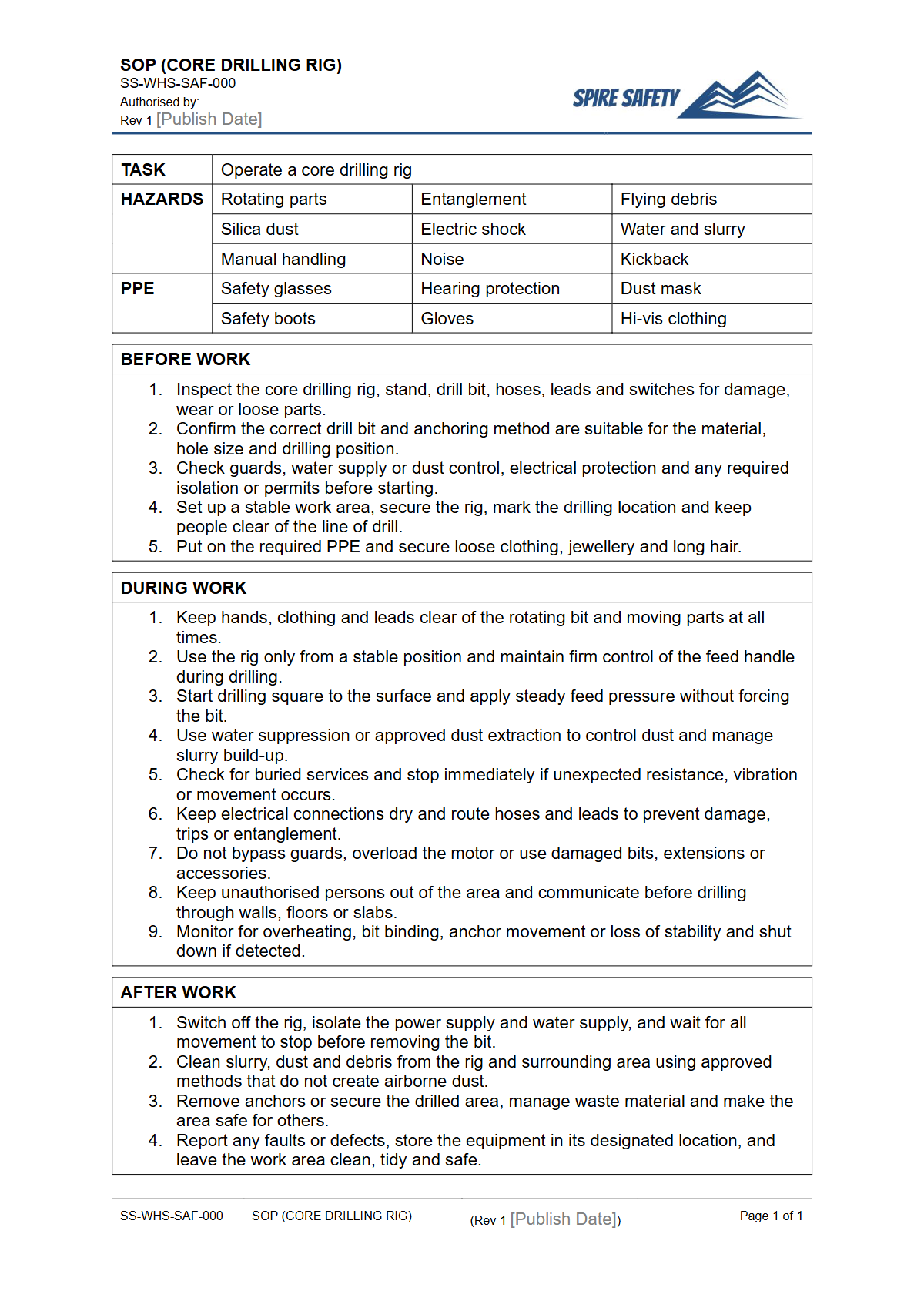
Purpose of the Free Safe Operating Procedure (Core Drilling Rig) Template
Operating a core drilling rig involves significant risks, including entanglement with rotating parts, noise, vibration, hazardous dust exposure, and electrical hazards. This Free Safe Operating Procedure (Core Drilling Rig) Template provides a structured framework for documenting the required safety measures to control these risks.
It outlines the step-by-step process for safely setting up, operating, and shutting down the equipment. Using this SOP helps standardise your work methods, assists in training operators, and demonstrates a commitment to workplace health and safety.
It forms a critical component of your overall WHS management systems, ensuring a consistent approach to managing high-risk plant.
Video walkthrough
How to use the Free Safe Operating Procedure (Core Drilling Rig) Template
This resource is available for immediate download in both DOCX and PDF formats. The DOCX version is fully editable, allowing you to tailor it to your specific operational needs.
A Safe Operating Procedure is only effective when it accurately reflects your workplace environment and equipment.
Important: This is a template and must be customised. We have provided a comprehensive starting point based on Australian WHS principles, but you must adapt this document to reflect the specific core drilling rig models, site conditions, geological formations, and organisational procedures in your workplace.
This includes adding your company branding, specifying exact makes and models, and detailing site-specific emergency contacts.
Key Sections to Customise
To create a robust and effective SOP, ensure you carefully review and populate the following sections:
- Pre-Operational Checks: Detail the visual and functional checks operators must perform before every use. This includes inspecting the drill stand, motor, drill bits, water supply, and electrical cords for damage or defects.
- Personal Protective Equipment (PPE): List all mandatory PPE, such as safety glasses, hearing protection, steel-capped boots, respiratory protection (e.g., P2 masks), and gloves.
- Step-by-Step Operating Sequence: Clearly describe the safe process for securing the rig, selecting the correct drill speed, initiating the drill, applying pressure, and managing water flow for dust suppression. This level of detail is also crucial in procedures for other specialised equipment, as shown in our free Trencher SOP Template.
- Shutdown Procedure: Outline the correct sequence for stopping the drill, retracting the bit, and powering down the equipment safely.
- Emergency Procedures: Document actions to take in case of equipment malfunction, binding, kickback, electric shock, or personal injury.
When to use it
A Core Drilling Rig SOP should be used as a central safety document for all related tasks. It serves as a primary training tool for new operators and a reference guide for experienced workers.
It should be readily accessible near the work area and consulted during pre-start meetings and toolbox talks. Furthermore, the SOP is an essential document for supervisors conducting task observations and for safety professionals performing internal checks. Regular reviews of work practices against the documented SOP are a key part of effective WHS compliance auditing.
Who should use it
This Safe Operating Procedure is intended for several key roles within an organisation:
- Operators: The primary users who must understand and follow the procedure to perform their work safely.
- Supervisors and Managers: To ensure operators are trained, competent, and adhering to the established safe work method.
- WHS/HSE Professionals: For developing, implementing, and reviewing safety protocols as part of the broader safety management system.
- Training Coordinators: As a foundational document for developing training programs and verifying operator competency.
For complex worksites or unique drilling applications, engaging external expertise can help ensure your SOPs are robust and practical. Specialist WHS consulting can provide valuable insight into controlling specific hazards.
A well-written SOP ensures that ancillary tasks, like using generators or compressors, are also considered; you might find our free Air Compressor SOP Template a useful complementary document. Finally, remember to regularly review and update your SOPs, especially after an incident or when new equipment is introduced.
You can find more templates and checklists in our complete free WHS resources library to support your safety efforts.
Common mistakes
Common mistakes to avoid
- Failing to conduct a thorough pre-start inspection of the rig, stand, and drill bits.
- Neglecting or improperly using water suppression controls, leading to excessive silica dust exposure.
- Using incorrect drill speed or pressure for the material, causing the bit to bind or kick back violently.
- Inadequately anchoring the drill stand on uneven or unstable surfaces, leading to rig movement during operation.
Legal references
Legal considerations
The following legal requirements may be relevant to this type of work.
- Work Health and Safety Act (Harmonised) — Provides the primary duties for protecting workers and other people from work health and safety risks.
- Work Health and Safety Regulations (Harmonised) — Sets out requirements supporting the management of workplace hazards and risks.
The following codes may be relevant to this type of work.
- Managing WHS Risks Code of Practice — Provides practical guidance on identifying hazards, assessing risks and applying effective controls.
- Work Health and Safety Consultation, Cooperation and Coordination Code of Practice — Provides practical guidance on consulting workers and coordinating with other duty holders.
- Managing the Work Environment and Facilities Code of Practice — Provides practical guidance on safe work environments, workplace facilities and related controls.
Did you know
Dust Is a Major Hazard
Core drilling materials like concrete, brick, or rock can generate high levels of respirable crystalline silica (RCS). Effective dust suppression, such as wet drilling methods, and appropriate respiratory protection are critical controls to prevent serious lung diseases.
FAQ
Frequently asked questions
01What hazards are associated with core drilling?
02How often should a Safe Operating Procedure for a core drill be reviewed?
03Is a Safe Operating Procedure the same as a Safe Work Method Statement (SWMS)?
04Do I need a licence to operate a core drilling rig in Australia?
Share this resource
Free Safe Operating Procedure (Core Drilling Rig) Template
Browse Categories
How To Use It
- 1Download and open in Word or PDF.
- 2Replace the placeholders with your business details.
- 3Get it reviewed by a WHS specialist before rollout.
Need it customised?
Our WHS consultants can adapt this template to your site, run a gap analysis, or audit what you already have in place.
Book a Free Consultation WHS consulting servicesor call 1300 156 382
Related templates
- Free Safe Operating Procedure (Cotton Gin) Template
- Free Safe Operating Procedure (Council Bin Cleaning) Template
- Free Safe Operating Procedure (Council Depot Cleanup) Template
- Free Safe Operating Procedure (Countertop Cleaning) Template
- Free Safe Operating Procedure (Courier Bag Handling) Template
- Free Safe Operating Procedure (Courier Route Handover) Template