
Free Safe Operating Procedure (Cotton Gin) Template
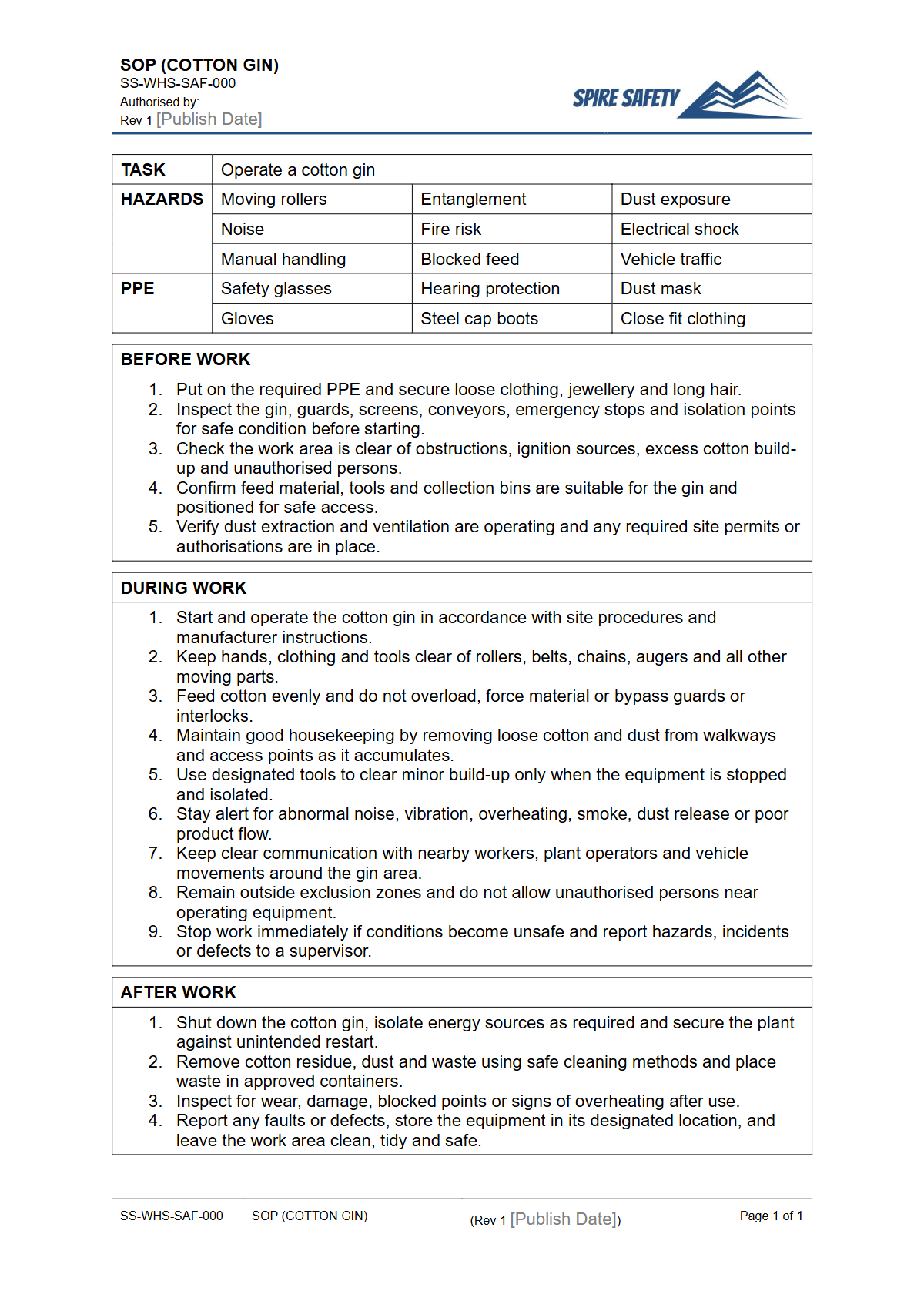
Download our free Safe Operating Procedure for Cotton Gins to formalise safe work practices. This customisable template helps you manage risks. Get started now.
Free Safe Operating Procedure (Cotton Gin) Template
DOCX • 126 KB + PDF
Updated Oct 2026
No signup required
Purpose of the Free Safe Operating Procedure (Cotton Gin) Template
Operating a cotton gin presents significant health and safety risks, including entanglement in moving parts, exposure to high noise levels, and respiratory hazards from cotton dust. A Safe Operating Procedure (SOP) is a critical document that provides clear, step-by-step instructions on how to perform a task safely.
This free Safe Operating Procedure (Cotton Gin) template helps you systematically identify hazards and implement control measures to protect your workers.
By documenting safe work methods, you create a consistent standard for all operators, reducing the likelihood of incidents and injuries. An effective SOP is a cornerstone of a proactive safety culture and an essential component of robust WHS management systems. This template provides a structured starting point aligned with Australian WHS principles, helping you fulfil your duty of care as a Person Conducting a Business or Undertaking (PCBU).
Video walkthrough
How to use the Free Safe Operating Procedure (Cotton Gin) Template
This document is a template, not a finished procedure. To be effective, you must customise it to reflect the specific equipment, processes, and environment of your workplace.
We recommend a collaborative approach: consult with the workers who operate, clean, and maintain the cotton gin. Their firsthand experience is invaluable for identifying all potential hazards and developing practical, effective controls.
Key Customisation Steps:
- Machine Specifics: Detail the make, model, and unique features of your cotton gin.
- Site-Specific Hazards: Incorporate risks unique to your facility's layout, such as traffic management, storage, and associated machinery like a conveyer system SOP.
- Personal Protective Equipment (PPE): List the specific PPE required for each phase of operation, such as respiratory protection, hearing protection, and safety glasses.
- Emergency Procedures: Clearly outline steps for emergency shutdown, fire response, and first aid. Include contact numbers and the location of safety equipment.
- Consultation: Record the names of the workers and supervisors who were consulted during the drafting and review process.
When to use it
A Safe Operating Procedure for a cotton gin should be a living document, integrated into your daily operations. It is not meant to be filed away and forgotten.
It should be readily accessible to all relevant personnel and used consistently during key activities. These include initial operator training and competency verification, pre-start checks before each shift, regular refresher training sessions, and as a reference tool during task performance.
Furthermore, the SOP is a critical reference document following any incident, near miss, or identification of a new hazard. Reviewing and updating the procedure should be a standard part of your incident investigation process to prevent recurrence.
It should also be reviewed as part of regular WHS compliance audits to ensure it remains current and effective.
Who should use it
This SOP should be used by anyone who interacts with the cotton gin. This includes, but is not limited to, machine operators, supervisors, maintenance personnel, cleaners, and safety officers.
Supervisors can use it as a tool for training, monitoring performance, and enforcing safe work practices. Operators rely on it for clear guidance on safe operation, particularly for non-routine tasks or emergency situations.
For complex situations where procedural controls are insufficient, seeking external guidance through WHS consulting may be necessary to ensure all risks are managed.
Training on the contents of the finalised SOP is mandatory for all users. You must ensure that workers understand the procedures and have demonstrated their ability to apply them safely.
Records of this training should be maintained as evidence of compliance with your WHS duties. Similar principles apply when creating procedures for other common equipment, like our Air Compressor SOP.
Beyond the gin itself, consider the other equipment used in your agricultural operation. Standardising your approach to safety documentation by using templates for all key machinery, such as a free spreader SOP, helps create a consistent and comprehensive safety framework across your entire business. You can find these and more in our free WHS resources library.
Common mistakes
Common mistakes to avoid
- Using a generic template without customising for the specific gin model and site conditions.
- Failing to include clear, step-by-step instructions for lockout/tagout (LOTO) before maintenance or clearing blockages.
- Not training workers on the finalised SOP or failing to keep accurate training records.
- Treating the SOP as a one-time document instead of reviewing and updating it regularly.
Legal references
Legal considerations
The following legal requirements may be relevant to this type of work.
- Work Health and Safety Act (Harmonised) — Provides the primary duties for protecting workers and other people from work health and safety risks.
- Work Health and Safety Regulations (Harmonised) — Sets out requirements supporting the management of workplace hazards and risks.
The following codes may be relevant to this type of work.
- Managing WHS Risks Code of Practice — Provides practical guidance on identifying hazards, assessing risks and applying effective controls.
- Work Health and Safety Consultation, Cooperation and Coordination Code of Practice — Provides practical guidance on consulting workers and coordinating with other duty holders.
- Managing the Work Environment and Facilities Code of Practice — Provides practical guidance on safe work environments, workplace facilities and related controls.
Did you know
Cotton Dust
Inhaling cotton dust can cause byssinosis, an occupational lung disease also known as 'brown lung disease'. Effective ventilation, dust suppression systems, and respiratory protective equipment are critical controls in a ginning environment.
FAQ
Frequently asked questions
01What are the main hazards of operating a cotton gin?
02Is an SOP a legal requirement for cotton gins in Australia?
03How often should a Cotton Gin SOP be reviewed?
04Who needs to be trained on a Cotton Gin SOP?
Share this resource
Free Safe Operating Procedure (Cotton Gin) Template
Browse Categories
How To Use It
- 1Download and open in Word or PDF.
- 2Replace the placeholders with your business details.
- 3Get it reviewed by a WHS specialist before rollout.
Need it customised?
Our WHS consultants can adapt this template to your site, run a gap analysis, or audit what you already have in place.
Book a Free Consultation WHS consulting servicesor call 1300 156 382
Related templates
- Free Safe Operating Procedure (Council Bin Cleaning) Template
- Free Safe Operating Procedure (Council Depot Cleanup) Template
- Free Safe Operating Procedure (Countertop Cleaning) Template
- Free Safe Operating Procedure (Courier Bag Handling) Template
- Free Safe Operating Procedure (Courier Route Handover) Template
- Free Safe Operating Procedure (Court Surface Cleaning) Template