
Free Safe Operating Procedure (Coolant Change) Template
Our Safe Operating Procedure for coolant changes provides a structured framework for managing this common maintenance task safely and effectively. Download now.
Free Safe Operating Procedure (Coolant Change) Template
DOCX • 126 KB + PDF
Updated Oct 2026
No signup required
Purpose of the Free Safe Operating Procedure (Coolant Change) Template
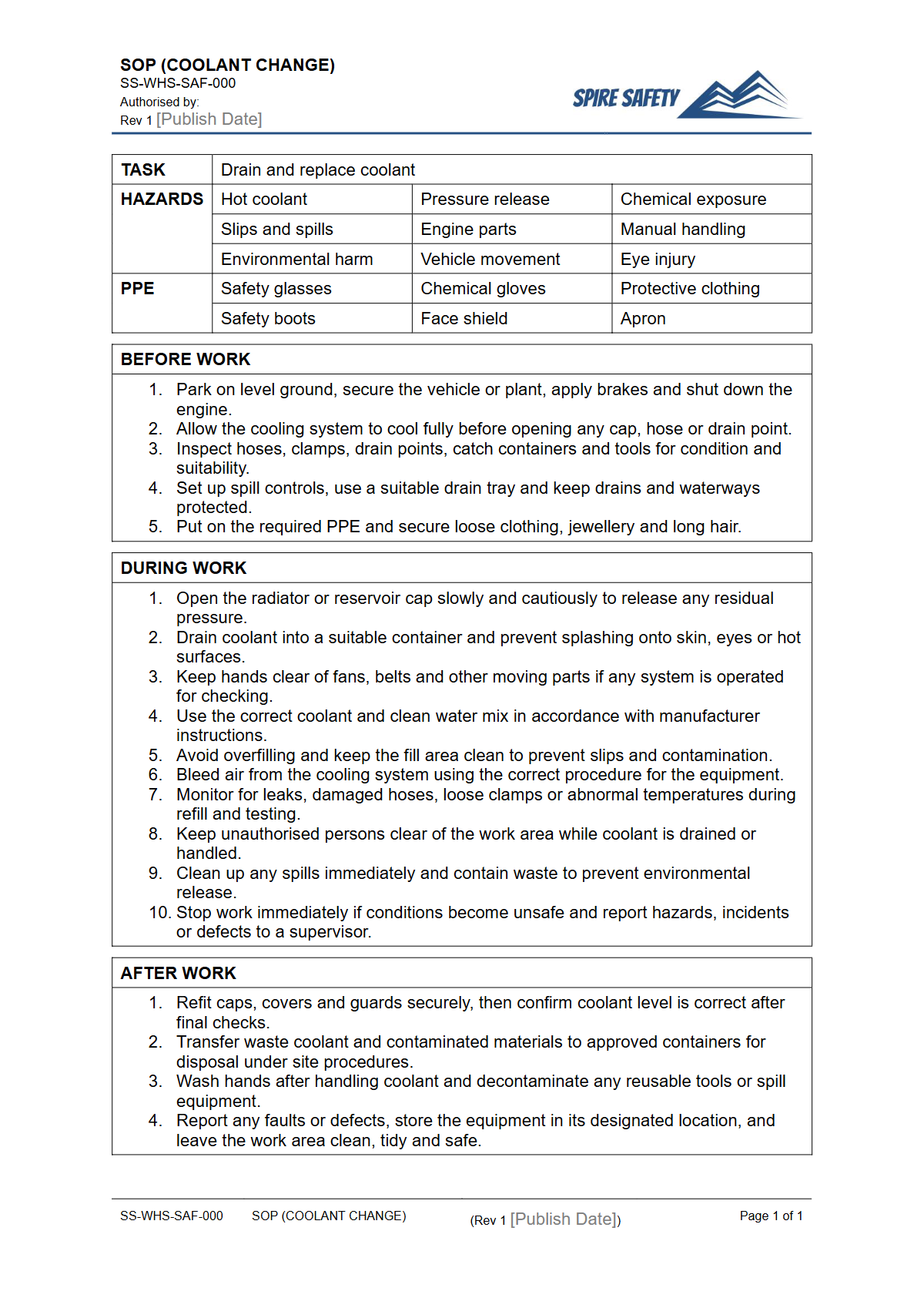
Effectively managing routine vehicle and machinery maintenance is fundamental to workplace safety. Our Free Safe Operating Procedure (Coolant Change) Template offers a comprehensive, structured starting point for organisations to formalise their process for this common but hazardous task.
This document helps standardise procedures to minimise risks such as chemical exposure, thermal burns, and environmental contamination. By outlining the required steps, safety controls, and personal protective equipment (PPE), this SOP helps you establish a safe system of work aligned with Australian WHS principles and practices.
Video walkthrough
How to use the Free Safe Operating Procedure (Coolant Change) Template
This Safe Operating Procedure template is available for download as a DOCX file for easy editing or as a PDF for straightforward printing and distribution. To use it effectively, download the document and integrate the specific details of your workplace.
This includes identifying the exact types of machinery, coolants used, local environmental regulations, and emergency procedures. It is crucial to understand that this template is a starting point.
We have designed it to be adapted; you must customise it to reflect the specific equipment, chemicals, and environmental conditions at your worksite before implementation.
Key Hazards in Coolant Change Procedures
Changing engine coolant involves several significant hazards that must be controlled. The primary risks include thermal hazards from hot engine components and pressurised coolant, which can cause severe burns.
There are also chemical hazards associated with coolant ingredients like ethylene glycol, which is toxic if ingested and can cause skin or eye irritation upon contact. Manual handling risks exist when lifting heavy containers of new or waste coolant, and there is a significant environmental risk from spills if not contained properly. Many workshop tasks share similar risks that require formalised procedures, as seen in our Air Compressor SOP template.
When to Use This Safe Operating Procedure
This SOP should be used every time a coolant change is performed, whether as part of a scheduled maintenance program or as a one-off repair. It serves as a practical guide for workers executing the task and as a training document for new or inexperienced employees.
It should also be readily available for reference during toolbox talks on vehicle maintenance safety. Integrating such procedures consistently ensures that safety is not left to chance and becomes an embedded part of your operational culture. This process-driven approach is a cornerstone of effective WHS management systems.
Who Should Use It
This Safe Operating Procedure is intended for all personnel involved in vehicle and equipment maintenance, including qualified mechanics, trade assistants, apprentices, and mobile plant operators who perform their own basic servicing. Supervisors and safety managers should also use the document to ensure they are providing a safe system of work and to verify that correct procedures are being followed.
The principles are scalable from light vehicle workshops to heavy industrial settings, where maintaining equipment like that covered in our Dozer SOP template is a daily activity.
Personal Protective Equipment (PPE) Requirements
The correct selection and use of PPE is a critical control measure for this task. The SOP specifies the minimum required PPE, which typically includes safety glasses or a face shield to protect against splashes, chemical-resistant gloves (e.g., nitrile) to prevent skin contact, and enclosed safety footwear.
Depending on the specific circumstances, additional PPE like aprons or coveralls may be necessary. Ensuring workers understand and use the correct PPE for each task is a universal safety requirement, whether they are changing coolant or operating equipment detailed in our FREE Telehandler SOP Template.
Integrating the SOP into Your Safety Framework
A Safe Operating Procedure is most effective when it is part of a living safety system, not just a document filed away. This coolant change SOP should be included in worker inductions and job-specific training.
It should be reviewed regularly and updated whenever a process, chemical, or piece of equipment changes. Regular reviews of your procedures are a key part of maintaining safety standards, often verified through professional WHS compliance auditing. Find more templates to build out your safety system in our complete free WHS resources library.
Common mistakes
Common mistakes to avoid
- Opening a radiator cap while the system is hot, leading to severe burns from pressurised steam and coolant.
- Mixing different types of coolant, which can cause chemical reactions, gelling, and blockages in the cooling system.
- Disposing of old coolant improperly, such as pouring it down a stormwater drain, which causes environmental pollution.
- Failing to wear appropriate PPE, particularly safety glasses and chemical-resistant gloves, leading to eye injuries or skin irritation.
Legal references
Legal considerations
The following legal requirements may be relevant to this type of work.
- Work Health and Safety Act (Harmonised) — Provides the primary duties for protecting workers and other people from work health and safety risks.
- Work Health and Safety Regulations (Harmonised) — Sets out requirements supporting the management of workplace hazards and risks.
The following codes may be relevant to this type of work.
- Managing WHS Risks Code of Practice — Provides practical guidance on identifying hazards, assessing risks and applying effective controls.
- Work Health and Safety Consultation, Cooperation and Coordination Code of Practice — Provides practical guidance on consulting workers and coordinating with other duty holders.
- Managing the Work Environment and Facilities Code of Practice — Provides practical guidance on safe work environments, workplace facilities and related controls.
Did you know
The Colour Myth
Coolant colour does not reliably indicate its type or specification. Always refer to the manufacturer's specifications or the product data sheet, as mixing incompatible coolants can cause gelling and serious engine damage.
Sweet but Deadly
The sweet smell of ethylene glycol, the primary component in most coolants, can attract pets and children. However, it is highly toxic and can be fatal if ingested, making secure storage and spill cleanup critical.
FAQ
Frequently asked questions
01What should be included in a coolant change SOP?
02Is ethylene glycol coolant dangerous?
03How do you dispose of used engine coolant in Australia?
04Why can't I just top up coolant with water?
Share this resource
Free Safe Operating Procedure (Coolant Change) Template
Browse Categories
How To Use It
- 1Download and open in Word or PDF.
- 2Replace the placeholders with your business details.
- 3Get it reviewed by a WHS specialist before rollout.
Need it customised?
Our WHS consultants can adapt this template to your site, run a gap analysis, or audit what you already have in place.
Book a Free Consultation WHS consulting servicesor call 1300 156 382
Related templates
- Free 3D Printer SOP (Safe Operating Procedure) Template
- FREE Agricultural Equipment SOP (Safe Operating Procedure) Template
- Free Air Compressor SOP (Safe Operating Procedure) Template
- Free Angle Grinder SOP (Safe Operating Procedure) Template
- FREE Backhoe SOP (Safe Operating Procedure) Template
- FREE Baler SOP (Safe Operating Procedure) Template