
Free Safe Operating Procedure (Cooling Coil Cleaning) Template
Effectively manage the risks of HVAC maintenance with our free cooling coil cleaning template.
Free Safe Operating Procedure (Cooling Coil Cleaning) Template
DOCX • 126 KB + PDF
Updated Oct 2026
No signup required
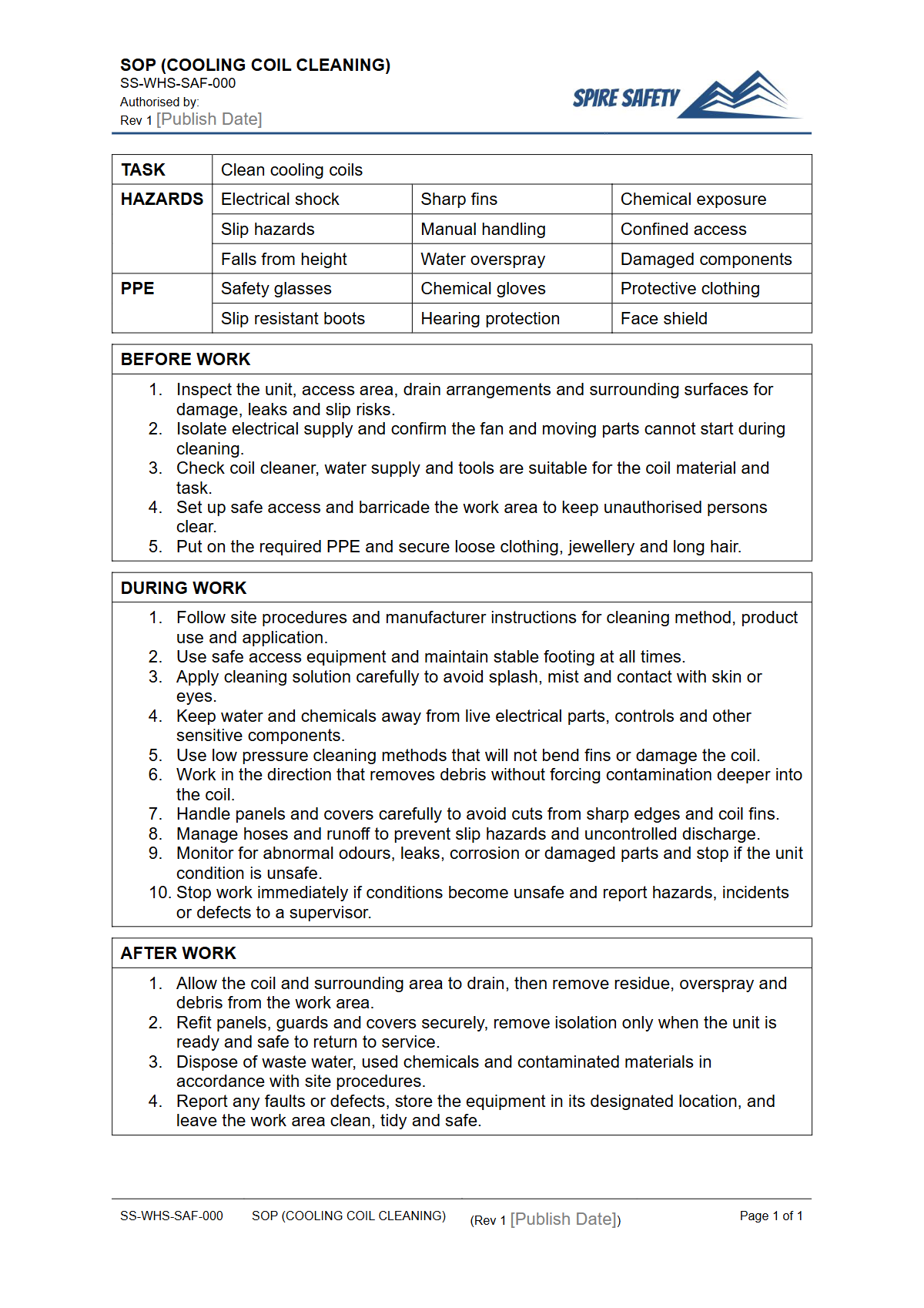
Purpose of the Free Safe Operating Procedure (Cooling Coil Cleaning) Template
Cleaning cooling coils in air-conditioning and refrigeration systems is a critical maintenance task, but one that carries significant risks. This Free Safe Operating Procedure (Cooling Coil Cleaning) Template provides a structured framework for documenting a safe system of work.
It helps your organisation manage hazards such as chemical exposure, electrical shock, sharp fins, biological contaminants, and manual handling. By implementing a clear SOP, you standardise procedures for all workers, ensuring safety protocols are consistently followed and helping meet your WHS obligations.
A documented SOP is essential for high-risk activities involving plant and hazardous chemicals. The principles of isolating energy sources and managing chemical risks are fundamental to workplace safety, whether dealing with HVAC units or other machinery.
For related guidance on equipment safety, our Free Air Compressor SOP (Safe Operating Procedure) Template provides a similar structure for a different type of plant.
Video walkthrough
How to use the Free Safe Operating Procedure (Cooling Coil Cleaning) Template
This template is a starting point, not a finished document. You must adapt it to the specific context of your workplace.
Before use, a competent person must conduct a thorough risk assessment for the cooling coil cleaning tasks performed at your site. The findings of that assessment should be used to add detail to each section of this document.
Important: It is crucial that you customise this template to reflect the specific equipment, chemicals, and work environment at your site. We've provided a framework aligned with Australian WHS practice, but you must fill in the details to create a usable and effective procedure.
This customisation process should be done in consultation with the workers who will be performing the task. Once customised, the SOP should be integrated into your overall WHS management systems.
Key Sections to Customise
- Pre-Operational Checks: Detail the inspection of tools, equipment, and the work area, including checking for ventilation and managing pedestrian traffic.
- Personal Protective Equipment (PPE): List the exact PPE required, such as specific glove types (e.g., nitrile, cut-resistant), safety glasses, face shields, and respiratory protection suitable for the chemicals and potential biological hazards.
- Isolation and De-energisation: Document your site-specific Lock-Out/Tag-Out (LOTO) procedure for the equipment. This must be unambiguous and clear to prevent accidental re-energisation. The principles of effective LOTO are universal for powered equipment, from HVAC units to workshop tools covered in resources like our FREE Circular Saw SOP (Safe Operating Procedure) Template.
- Chemical Handling: Specify the approved cleaning chemicals by name and link to their Safety Data Sheets (SDS). Outline safe mixing, application, and storage procedures.
- Step-by-Step Cleaning Process: Write a clear, sequential guide for the task, from gaining access to the coils through to rinsing and final checks.
- Waste Disposal: Describe how to safely dispose of used chemicals, contaminated water, and other waste materials in accordance with environmental regulations.
When to use it
This Safe Operating Procedure should be used every time cooling coils are cleaned, whether as part of a scheduled preventative maintenance program or as a reactive task. It serves as a vital tool for worker training, induction for new employees, and refresher courses for experienced staff.
Furthermore, the document acts as a benchmark during safety observations or formal reviews of your safety processes. Should you engage external experts for WHS compliance auditing, this SOP will be a key piece of evidence demonstrating your commitment to managing operational risks.
Who should use it
This document is designed for several groups within an organisation:
- Workers: HVAC technicians, refrigeration mechanics, and facilities maintenance staff who perform the cleaning task must follow the approved procedure.
- Supervisors and Managers: They use the SOP to supervise work, deliver training, and ensure that safety standards are being upheld. They are responsible for ensuring the procedure is understood and implemented correctly.
- PCBUs (Persons Conducting a Business or Undertaking): The PCBU can use the finalised SOP to demonstrate they have provided a safe system of work.
- Safety Professionals: WHS advisors and trainers use the SOP as a foundational document for building risk assessments and training programs, especially where complex access is required using plant such as that covered in our FREE Telehandler SOP Template.
By establishing and following a robust SOP, every person involved in the task can better understand their role in maintaining a safe work environment. For more templates and safety resources, browse our complete free WHS resources library.
Common mistakes
Common mistakes to avoid
- Failing to perform a full lock-out/tag-out (LOTO) procedure before starting work.
- Using incompatible or non-approved chemicals that can damage coils or create toxic fumes.
- Neglecting to wear appropriate Personal Protective Equipment (PPE), especially respiratory and eye protection.
- Not properly rinsing coils, leaving behind chemical residue that can corrode components or enter the air stream.
Legal references
Legal considerations
The following legal requirements may be relevant to this type of work.
- Work Health and Safety Act (Harmonised) — Provides the primary duties for protecting workers and other people from work health and safety risks.
- Work Health and Safety Regulations (Harmonised) — Sets out requirements supporting the management of workplace hazards and risks.
The following codes may be relevant to this type of work.
- Managing WHS Risks Code of Practice — Provides practical guidance on identifying hazards, assessing risks and applying effective controls.
- Work Health and Safety Consultation, Cooperation and Coordination Code of Practice — Provides practical guidance on consulting workers and coordinating with other duty holders.
- Managing the Work Environment and Facilities Code of Practice — Provides practical guidance on safe work environments, workplace facilities and related controls.
Did you know
Energy Savings
Clean cooling coils can improve HVAC system efficiency by 5% to 15%. Dirty coils force the system to work harder, increasing energy consumption and running costs.
Legionella Risk
Poorly maintained air-conditioning cooling coils and drain pans can become breeding grounds for Legionella bacteria, the cause of the potentially fatal Legionnaires' disease.
FAQ
Frequently asked questions
01What are the key hazards when cleaning cooling coils?
02Why is a specific Safe Operating Procedure needed for this task?
03Who is responsible for creating and approving a cooling coil cleaning SOP?
04How often should this SOP be reviewed?
Share this resource
Free Safe Operating Procedure (Cooling Coil Cleaning) Template
Browse Categories
How To Use It
- 1Download and open in Word or PDF.
- 2Replace the placeholders with your business details.
- 3Get it reviewed by a WHS specialist before rollout.
Need it customised?
Our WHS consultants can adapt this template to your site, run a gap analysis, or audit what you already have in place.
Book a Free Consultation WHS consulting servicesor call 1300 156 382
Related templates
- Free Safe Operating Procedure (Cooling Tower Blowdown) Template
- Free Safe Operating Procedure (Cooling Tower Cleaning) Template
- Free Safe Operating Procedure (Cooling Tower Dosing) Template
- Free Safe Operating Procedure (Core Drill) Template
- Free Safe Operating Procedure (Core Drilling Rig) Template
- Free Safe Operating Procedure (Cotton Gin) Template