
Free Safe Operating Procedure (Cooling Tower Blowdown) Template
Manage cooling tower blowdown risks with our structured Safe Operating Procedure. Download your free template to formalise safety steps and controls today.
Free Safe Operating Procedure (Cooling Tower Blowdown) Template
DOCX • 126 KB + PDF
Updated Oct 2026
No signup required
Purpose of the Free Safe Operating Procedure (Cooling Tower Blowdown) Template
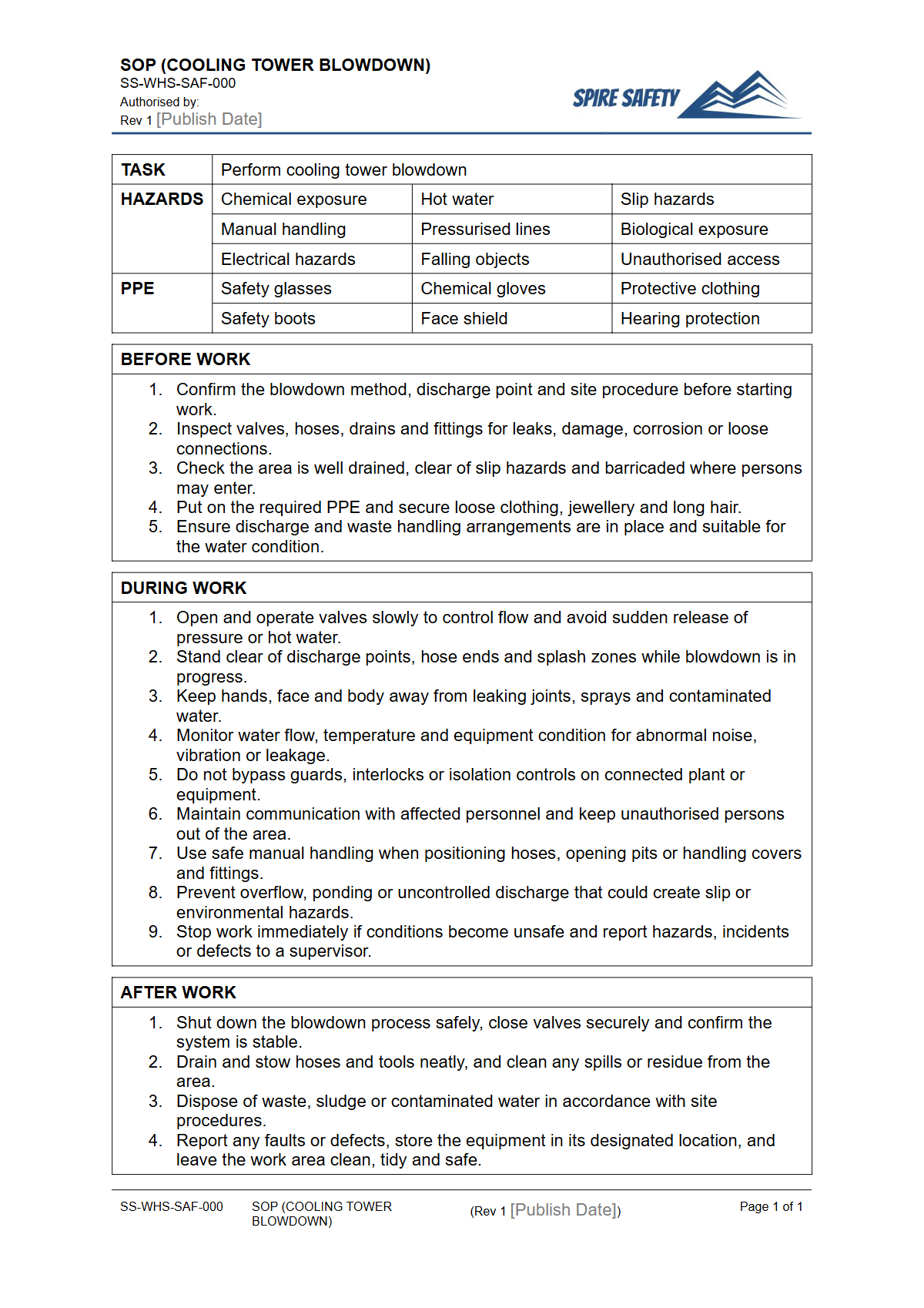
This Safe Operating Procedure (SOP) template provides a structured framework for documenting the steps required to safely perform a cooling tower blowdown. Its purpose is to help Persons Conducting a Business or Undertaking (PCBUs) control the significant risks associated with this task, including exposure to hazardous chemicals, hot water, pressurised systems, and microbiological hazards like Legionella.
By formalising the procedure, you can ensure tasks are performed consistently and safely, providing a clear reference for training, supervision, and incident investigation. A well-developed SOP is a cornerstone of effective WHS management systems.
Cooling tower blowdown involves discharging a portion of the concentrated recirculating water and replacing it with fresh make-up water to control the level of dissolved solids. This process is critical for efficient operation but presents numerous hazards.
This document helps you systematically address those hazards by outlining pre-operational checks, personal protective equipment (PPE) requirements, step-by-step instructions, and emergency response actions, all aligned with Australian WHS principles.
Video walkthrough
How to use the Free Safe Operating Procedure (Cooling Tower Blowdown) Template
To effectively use this free Safe Operating Procedure for cooling tower blowdown, download the DOCX file and adapt it to your specific operational context. The template is logically structured with sections for identifying hazards, listing required PPE, and detailing the sequence of actions.
You should conduct a site-specific risk assessment to identify all relevant hazards and control measures, then use that information to populate and expand upon the template's sections.
Important: This document is a starting point, not a finished product. You must customise it to reflect your specific equipment, chemicals, workplace layout, and environmental conditions.
We cannot know the unique variables of your site, so it is your responsibility to ensure the final SOP is accurate and provides adequate control measures for the risks present in your operation. This process of customisation is vital for creating a tool that genuinely enhances workplace safety.
This SOP should form part of a library of procedures for all key plant and equipment on site. Just as you would document the safe use of other machinery, such as with a Free Air Compressor SOP (Safe Operating Procedure) Template, this document ensures a critical maintenance task is managed with the same level of rigour.
When to use it
A Safe Operating Procedure for cooling tower blowdown should be used every time the task is performed, whether as part of a scheduled maintenance program or as an ad-hoc operational requirement. It is particularly critical for new and young workers who may be unfamiliar with the risks involved.
It also serves as a valuable refresher for experienced personnel to prevent complacency and procedural drift.
The SOP should also be referenced during worker training, competency assessments, and safety observations. Furthermore, it should be formally reviewed and updated whenever there is a change to the equipment, chemicals used, work environment, or relevant legislation.
Periodic reviews, often conducted as part of broader WHS compliance auditing, ensure the procedure remains relevant and effective.
Who should use it
This SOP is primarily for operators and maintenance personnel who are directly responsible for carrying out the cooling tower blowdown process. It provides them with clear, unambiguous instructions to follow. However, its use extends to several other roles within an organisation:
- Supervisors and Team Leaders: To induct and train workers, supervise the task, and verify that the correct procedure is being followed safely.
- Facilities and Engineering Managers: To ensure maintenance activities are standardised and risks are controlled across the site.
- WHS/HSE Advisors and Managers: To develop and review safety documentation, assist with risk assessments, and use as evidence of risk management controls.
Effectively managing fixed plant involves documenting procedures for all key systems. Similar to how you would define steps for material handling equipment using a FREE Conveyer System SOP (Safe Operating Procedure) Template, this procedure ensures a critical water management task is not overlooked.
Implementing robust safety procedures across all operational areas can be complex. For tailored advice on integrating SOPs and managing specific workplace risks, consider seeking professional guidance from WHS consulting experts.
If you're looking to build out your safety documentation, you can browse our complete free WHS resources library for a wide range of templates, checklists, and guides.
Common mistakes
Common mistakes to avoid
- Using a generic procedure that doesn't detail site-specific valves, chemical injection points, or discharge locations.
- Failing to wear appropriate chemical-resistant PPE, including gloves, face shields, and aprons.
- Neglecting to follow Lockout/Tagout (LOTO) procedures for relevant energy sources before starting work.
- Inadequate training, leading to workers being unaware of the specific hazards like chemical reactions or thermal shock.
Legal references
Legal considerations
The following legal requirements may be relevant to this type of work.
- Work Health and Safety Act (Harmonised) — Provides the primary duties for protecting workers and other people from work health and safety risks.
- Work Health and Safety Regulations (Harmonised) — Sets out requirements supporting the management of workplace hazards and risks.
The following codes may be relevant to this type of work.
- Managing WHS Risks Code of Practice — Provides practical guidance on identifying hazards, assessing risks and applying effective controls.
- Work Health and Safety Consultation, Cooperation and Coordination Code of Practice — Provides practical guidance on consulting workers and coordinating with other duty holders.
- Managing the Work Environment and Facilities Code of Practice — Provides practical guidance on safe work environments, workplace facilities and related controls.
Did you know
Legionella Risk
Cooling towers are a known breeding ground for Legionella bacteria. The aerosolised water drift created during operation and maintenance, including blowdown, can spread the bacteria, leading to the potentially fatal Legionnaires' disease.
FAQ
Frequently asked questions
01What are the main hazards of cooling tower blowdown?
02Is a Safe Operating Procedure a legal requirement for cooling tower blowdown in Australia?
03How often should a cooling tower blowdown SOP be reviewed?
04What's the difference between an SOP and a SWMS for this task?
Share this resource
Free Safe Operating Procedure (Cooling Tower Blowdown) Template
Browse Categories
How To Use It
- 1Download and open in Word or PDF.
- 2Replace the placeholders with your business details.
- 3Get it reviewed by a WHS specialist before rollout.
Need it customised?
Our WHS consultants can adapt this template to your site, run a gap analysis, or audit what you already have in place.
Book a Free Consultation WHS consulting servicesor call 1300 156 382
Related templates
- Free Safe Operating Procedure (Cooling Tower Cleaning) Template
- Free Safe Operating Procedure (Cooling Tower Dosing) Template
- Free Safe Operating Procedure (Core Drill) Template
- Free Safe Operating Procedure (Core Drilling Rig) Template
- Free Safe Operating Procedure (Cotton Gin) Template
- Free Safe Operating Procedure (Council Bin Cleaning) Template