
Free Safe Operating Procedure (Cooking Oil Storage) Template
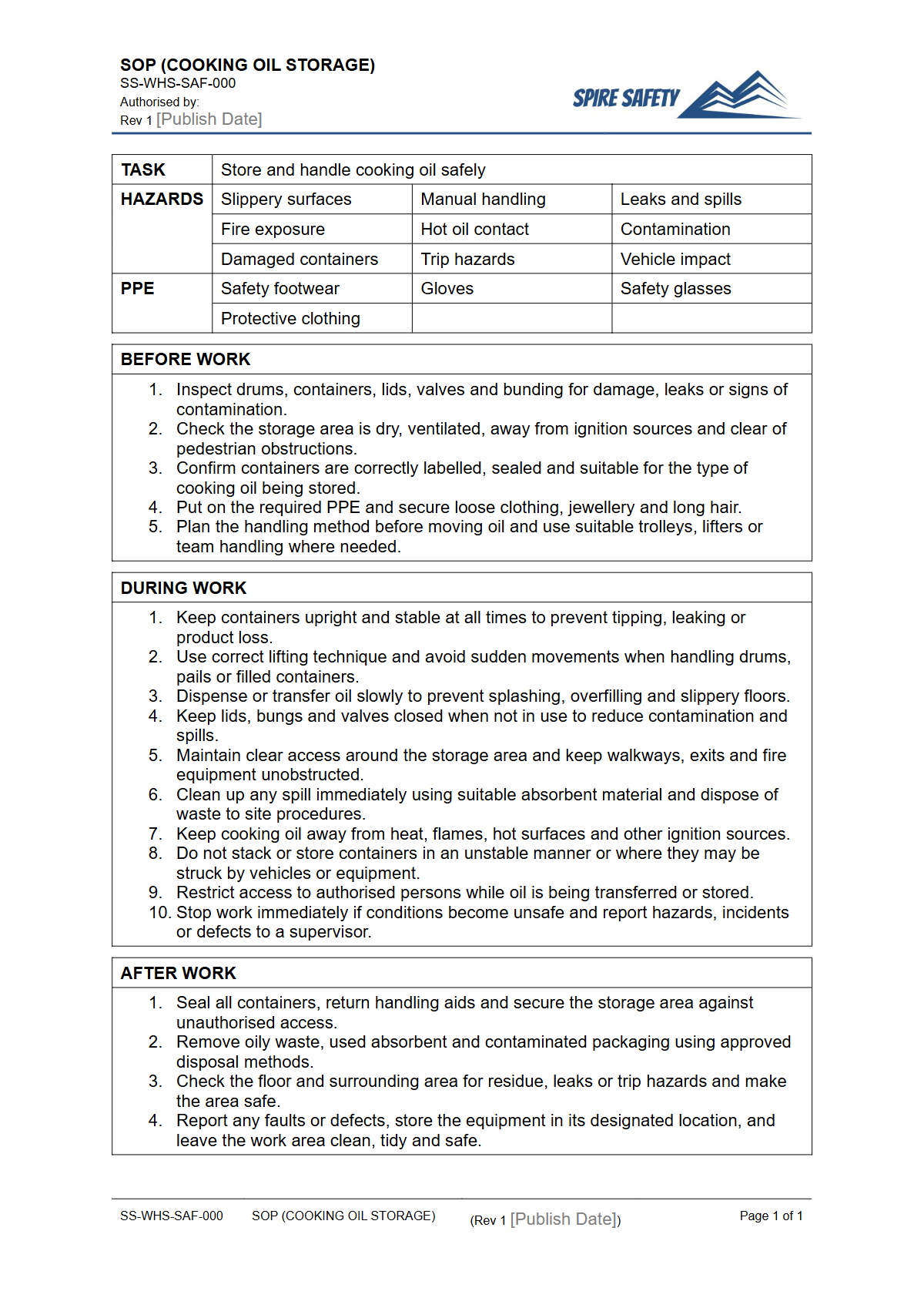
Download our free Safe Operating Procedure (Cooking Oil Storage) template. This Word doc provides a structured starting point for managing cooking oil risks.
Free Safe Operating Procedure (Cooking Oil Storage) Template
DOCX • 126 KB + PDF
Updated Oct 2026
No signup required
Purpose of the Free Safe Operating Procedure (Cooking Oil Storage) Template
Managing the storage of cooking oil, both new and used, is a critical task in any commercial kitchen or food production environment. This Free Safe Operating Procedure (Cooking Oil Storage) Template provides a structured framework for documenting the safe handling, storage, and disposal of cooking oils.
Its purpose is to help your organisation minimise risks such as slips and falls from spills, fire hazards, and manual handling injuries. By establishing a clear, step-by-step process, this SOP serves as a vital tool for worker training and consistent safety practice.
It is designed as a foundational document, aligned with Australian WHS principles, to help you meet your primary duty of care. For tailored advice on identifying specific hazards in your workplace, engaging professional WHS consulting services can provide valuable insights.
Video walkthrough
How to use the Free Safe Operating Procedure (Cooking Oil Storage) Template
This resource is available for download as both an editable DOCX file and a print-ready PDF. We recommend using the DOCX version to adapt the procedure to your specific operational context.
A Safe Operating Procedure is only effective when it accurately reflects your workplace. You should detail the types of oil used, the specific storage locations, the equipment involved (like trolleys or pumps), and your emergency spill response measures.
Please note: This template is a starting point. We have provided a comprehensive framework, but you must customise it to reflect the specific equipment, processes, and risks in your workplace.
Involving your workers in the customisation process is not just good practice; it’s essential for creating a procedure that is practical and effective. Integrating these tailored documents is a key part of building comprehensive WHS management systems.
When to use a Safe Operating Procedure
A Safe Operating Procedure for cooking oil storage should be a core document in any business where cooking oils are handled in significant quantities, such as restaurants, cafes, hotels, and food manufacturing facilities. It should be used as a primary training document for all new kitchen staff, catering employees, and cleaning crews.
The SOP also serves as a benchmark for regular refresher training and competency assessments. Furthermore, it is an essential reference document during safety meetings, incident investigations, or internal and external WHS compliance audits.
Who should use it
This template is designed for use by a range of personnel within a business. A Person Conducting a Business or Undertaking (PCBU), such as a business owner or director, holds the ultimate responsibility for its implementation.
Managers, supervisors, and Head Chefs will use the finalised SOP to train and supervise staff, ensuring the documented procedures are followed correctly. Front-line workers, including chefs, kitchen hands, and maintenance staff, are the end-users who will follow the procedure daily to perform their tasks safely. For related tasks, such as accessing items on high shelving in storage areas, you might also require procedures like our free Step Ladder SOP.
Key Hazards of Cooking Oil Storage
Understanding the specific hazards associated with cooking oil is the first step toward controlling them. This SOP helps address several critical risks:
- Slips, trips, and falls: Oil spills create an extremely hazardous, slippery surface. Even small drips can lead to serious incidents.
- Fire: Cooking oil is flammable, and its flammability increases after use as the flashpoint lowers. Storing it near ignition sources like open flames, pilot lights, or hot equipment is a significant fire risk.
- Manual Handling Injuries: Cooking oil is often supplied in heavy, bulky containers (20L drums are common). Lifting, carrying, and decanting these containers without proper technique or mechanical aids can cause musculoskeletal injuries.
- Environmental Contamination: Improper disposal of used cooking oil can harm the environment and block drainage systems, potentially leading to breaches of local environmental regulations.
For more templates covering a wide range of workplace risks, explore our complete free WHS resources library.
Building a Complete Safety System
A Safe Operating Procedure is a powerful tool, but it works best as part of a broader health and safety framework. To ensure robust protection for your team, your SOP for cooking oil storage should be supported by a specific risk assessment for the task.
You should also maintain clear records of worker training and consultation. Regularly reviewing and updating the SOP—especially after an incident or when processes change—ensures it remains a relevant and useful document.
Adopting this holistic approach is fundamental to implementing a system like ISO 45001, which formalises an organisation's commitment to continuous improvement in occupational health and safety.
Common mistakes
Common mistakes to avoid
- Storing oil containers directly on the floor instead of on shelves or in bunding.
- Failing to have a dedicated, fully stocked spill kit located near the oil storage area.
- Storing cooking oil next to or above heat-producing equipment like deep fryers or stoves.
- Allowing staff to manually lift and pour from heavy 20L+ drums without providing mechanical aids or team lifting procedures.
Legal references
Legal considerations
The following legal requirements may be relevant to this type of work.
- Work Health and Safety Act (Harmonised) — Provides the primary duties for protecting workers and other people from work health and safety risks.
- Work Health and Safety Regulations (Harmonised) — Sets out requirements supporting the management of workplace hazards and risks.
The following codes may be relevant to this type of work.
- Managing WHS Risks Code of Practice — Provides practical guidance on identifying hazards, assessing risks and applying effective controls.
- Work Health and Safety Consultation, Cooperation and Coordination Code of Practice — Provides practical guidance on consulting workers and coordinating with other duty holders.
- Managing the Work Environment and Facilities Code of Practice — Provides practical guidance on safe work environments, workplace facilities and related controls.
Did you know
Slippery Business
Slips, trips, and falls are a leading cause of injury in the hospitality industry, with contaminated floors from substances like water, food, and oil being a primary contributor.
Flashpoint Facts
Fresh vegetable oil typically has a flashpoint over 315°C. However, after repeated use, this can drop below 200°C, significantly increasing the risk of fire in storage.
FAQ
Frequently asked questions
01What should an SOP for cooking oil storage include?
02How often should we review our cooking oil storage procedures?
03Is used cooking oil more dangerous than new oil?
04Where is the best place to store cooking oil?
Share this resource
Free Safe Operating Procedure (Cooking Oil Storage) Template
Browse Categories
How To Use It
- 1Download and open in Word or PDF.
- 2Replace the placeholders with your business details.
- 3Get it reviewed by a WHS specialist before rollout.
Need it customised?
Our WHS consultants can adapt this template to your site, run a gap analysis, or audit what you already have in place.
Book a Free Consultation WHS consulting servicesor call 1300 156 382
Related templates
- Free Safe Operating Procedure (Cooking Oil Transfer) Template
- Free Safe Operating Procedure (Cool Room Access) Template
- Free Safe Operating Procedure (Coolant Change) Template
- Free Safe Operating Procedure (Cooling Coil Cleaning) Template
- Free Safe Operating Procedure (Cooling Tower Blowdown) Template
- Free Safe Operating Procedure (Cooling Tower Cleaning) Template