
Free Safe Operating Procedure (Loading Bay Cleaning) Template
Download a free Safe Operating Procedure (Loading Bay Cleaning) template. This customisable DOCX & PDF helps you document safe work methods for your team.
Free Safe Operating Procedure (Loading Bay Cleaning) Template
DOCX • 126 KB + PDF
Updated Oct 2026
No signup required
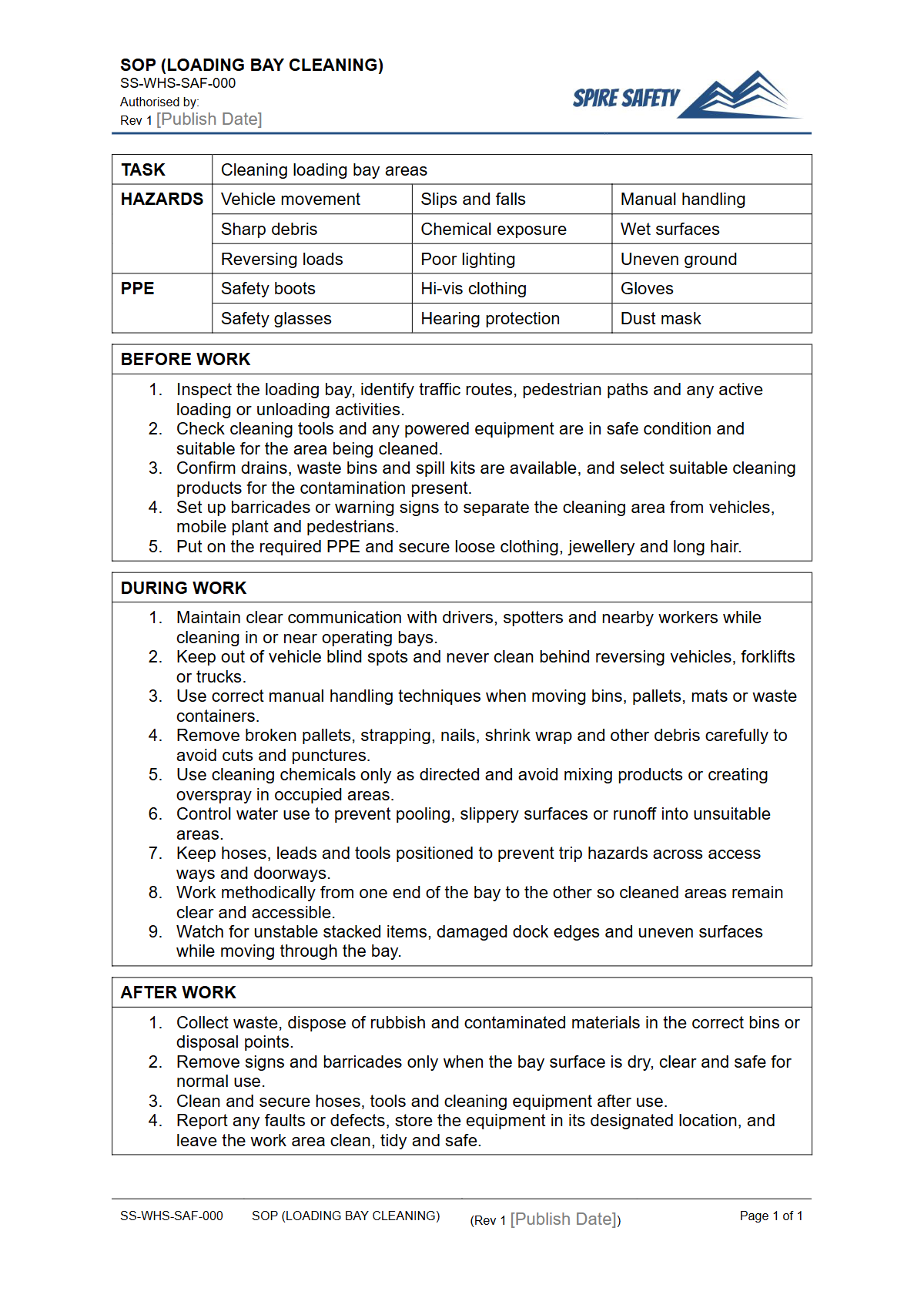
Purpose of the Free Safe Operating Procedure (Loading Bay Cleaning) Template
Loading bays are high-traffic, dynamic environments where the risk of incidents is significant. A systematic approach to cleaning is essential to control hazards and maintain a safe workspace.
This Free Safe Operating Procedure (Loading Bay Cleaning) Template provides a structured framework for documenting the specific steps, risks, and controls associated with this critical maintenance task. Using a formal SOP helps prevent slips, trips, and falls, minimises exposure to hazardous chemicals, manages vehicle and pedestrian interactions, and ensures all personnel understand their safety obligations.
A well-defined SOP is a fundamental component of a proactive safety culture. It transforms assumed knowledge into a clear, repeatable process that reduces the likelihood of injuries and demonstrates a commitment to workplace health and safety.
This document serves as a reliable starting point for developing a procedure tailored to your specific operational needs.
Video walkthrough
How to use the Free Safe Operating Procedure (Loading Bay Cleaning) Template
This Safe Operating Procedure template is provided as a fully editable DOCX file, making it easy to adapt for your business. Simply download the file and open it in Microsoft Word or a compatible program to add your company branding and specific procedural details.
A PDF version is also included for easy distribution and printing.
It is crucial to understand that this template is a starting point. We have provided a solid foundation based on Australian WHS principles, but you must adapt it to reflect the specific equipment (e.g., pressure washers, floor scrubbers), chemicals, and unique layout of your worksite.
Ensure the final document is integrated into your broader WHS management systems for maximum effectiveness.
When to use this Safe Operating Procedure
A Safe Operating Procedure for loading bay cleaning should be used consistently as part of your standard operational workflow. It is particularly important in several key situations:
- Training and Induction: Use the SOP to train new employees or contractors on the correct, safe method for cleaning the loading bay area.
- Pre-Task Planning: Workers should review the SOP before commencing the cleaning task to refresh their understanding of the hazards and control measures.
- Refresher Training: The document should be a centrepiece of periodic refresher training sessions to reinforce safe work practices.
- Incident Investigation: Following an incident or near-miss during cleaning, the SOP should be reviewed to identify any gaps or areas for improvement.
The procedure should be a living document, reviewed regularly as part of your organisation's WHS compliance auditing schedule or whenever a change in process, equipment, or chemicals occurs. This ensures it remains relevant and effective.
Who should use this Safe Operating Procedure
This SOP is designed for use by all personnel involved in the management, supervision, and execution of loading bay cleaning tasks. This includes:
- Warehouse and Logistics Managers: To ensure a standardised and safe process is established and followed.
- WHS/HSE Officers and Coordinators: As a tool for risk management, training, and compliance verification.
- Team Leaders and Supervisors: To conduct pre-start briefings and oversee the cleaning process safely.
- Cleaning Staff and Warehouse Operatives: As a clear, step-by-step guide to performing their duties safely.
For certain tasks, other specific procedures may be required. For example, if compressed air is used to clear debris, it is essential to have a documented procedure like our Free Air Compressor SOP available to workers.
Key Safety Considerations
Beyond the steps in the procedure, always prioritise hazard control. This includes physically barricading the work area, using clear and visible safety signage, and managing vehicle traffic.
Emergency preparedness is also critical; ensure first aid kits are stocked and personnel are aware of emergency protocols. Documenting procedures for life-saving equipment, such as our Free Safe Operating Procedure (Defibrillator Operation) Template, can significantly improve incident outcomes.
If cleaning requires working at height, even on a small ladder, a separate risk assessment is necessary. Our FREE Step Ladder SOP Template can assist in formalising safe practices for this common but high-risk activity.
This document is one of many available in our comprehensive free WHS resources library. If you require further assistance in adapting this template or developing your safety systems, our team of experts is available for WHS consulting.
Common mistakes
Common mistakes to avoid
- Failing to erect barricades and warning signs, exposing pedestrians and vehicles to the hazard.
- Using incorrect or incompatible cleaning chemicals, leading to surface damage or toxic fumes.
- Not inspecting powered cleaning equipment for electrical faults or damage before use.
- Leaving hoses, buckets, or other equipment in walkways, creating new trip hazards.
Legal references
Legal considerations
The following legal requirements may be relevant to this type of work.
- Work Health and Safety Act (Harmonised) — Provides the primary duties for protecting workers and other people from work health and safety risks.
- Work Health and Safety Regulations (Harmonised) — Sets out requirements supporting the management of workplace hazards and risks.
The following codes may be relevant to this type of work.
- Managing WHS Risks Code of Practice — Provides practical guidance on identifying hazards, assessing risks and applying effective controls.
- Work Health and Safety Consultation, Cooperation and Coordination Code of Practice — Provides practical guidance on consulting workers and coordinating with other duty holders.
- Managing the Work Environment and Facilities Code of Practice — Provides practical guidance on safe work environments, workplace facilities and related controls.
Did you know
Slips, Trips, and Falls
According to Safe Work Australia, slips, trips, and falls are the second leading cause of serious workers' compensation claims, highlighting the importance of good housekeeping and systematic cleaning procedures in areas like loading bays.
FAQ
Frequently asked questions
01What are the main hazards when cleaning a loading bay?
02How often should a loading bay cleaning SOP be reviewed?
03Is specific training required to clean a loading bay?
04What PPE is typically required for loading bay cleaning?
Share this resource
Free Safe Operating Procedure (Loading Bay Cleaning) Template
Browse Categories
How To Use It
- 1Download and open in Word or PDF.
- 2Replace the placeholders with your business details.
- 3Get it reviewed by a WHS specialist before rollout.
Need it customised?
Our WHS consultants can adapt this template to your site, run a gap analysis, or audit what you already have in place.
Book a Free Consultation WHS consulting servicesor call 1300 156 382
Related templates
- Free Safe Operating Procedure (Loading Bay Inspection) Template
- Free Safe Operating Procedure (Loading Bridge Operation) Template
- Free Safe Operating Procedure (Loading Dock Gate) Template
- Free Safe Operating Procedure (Loading Dock Handover) Template
- Free Safe Operating Procedure (Loading Zone Control) Template
- Free Safe Operating Procedure (Lobby Floor Cleaning) Template