
Free Safe Operating Procedure (Load Landing) Template
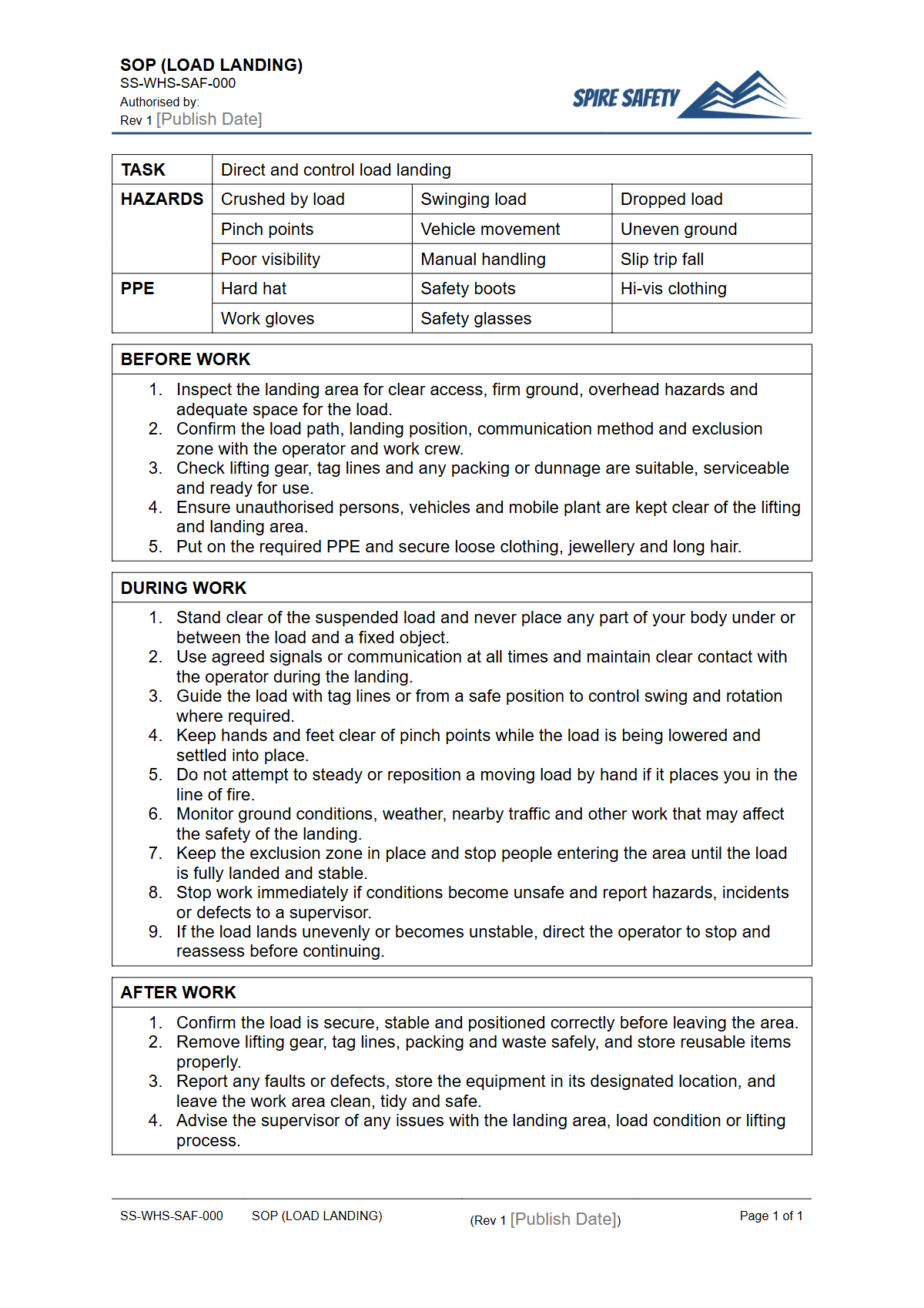
Download our free Safe Operating Procedure (Load Landing) template. This customisable DOCX and PDF provides a structured starting point for managing risks.
Free Safe Operating Procedure (Load Landing) Template
DOCX • 126 KB + PDF
Updated Oct 2026
No signup required
Purpose of the Free Safe Operating Procedure (Load Landing) Template
Effectively managing high-risk tasks is a cornerstone of workplace safety. This free Safe Operating Procedure (Load Landing) template provides a structured starting point for documenting the process of safely placing suspended loads.
Landing loads, whether from a crane, telehandler, or other lifting equipment, introduces significant hazards, including crush injuries, equipment damage, and risks from falling objects. A documented SOP ensures that every person involved understands the required steps, communication protocols, and safety controls needed to perform the task consistently and safely.
This procedure is designed to help organisations meet their duty of care by providing a clear, step-by-step guide for workers. It serves as an essential tool for training, inductions, and ongoing competency verification.
By formalising the process, you minimise the potential for human error and ensure critical safety checks, like verifying ground stability and establishing exclusion zones, are never missed. An effective SOP is a cornerstone of robust WHS management systems, demonstrating a proactive approach to risk management.
Video walkthrough
How to use the Free Safe Operating Procedure (Load Landing) Template
To get started with this free Safe Operating Procedure (Load Landing) template, simply download the DOCX file and open it in a word processor like Microsoft Word or Google Docs. The document is structured with clear headings covering prerequisites, pre-operational checks, step-by-step procedures, and post-task clean-up.
You can edit, add, or remove sections to align the document with your site-specific operations, equipment, and terminology.
It is crucial to understand that this document is a template, not a finished procedure. We have provided a framework based on Australian WHS principles, but you must customise it to reflect the specific equipment, environment, loads, and personnel at your worksite.
The most effective SOPs are developed in consultation with the workers who actually perform the task. Their direct experience is invaluable for identifying practical hazards and effective control measures.
The process of customising this SOP should be treated as a formal risk assessment. This involves identifying all potential hazards associated with landing loads at your site, assessing the risks, and implementing controls according to the hierarchy of controls.
Regular reviews, often part of a formal WHS compliance auditing program, ensure the SOP remains relevant and effective as conditions change.
When to use it
A Safe Operating Procedure for load landing should be used as a primary reference document in several key situations. It is mandatory to use and follow the SOP before and during any task that involves the landing of a mechanically lifted or suspended load.
It forms the basis of pre-start checks and toolbox talks, ensuring all team members are aligned on the day's specific lifting plan and conditions. This is particularly important for complex lifts or operations in unfamiliar environments, where procedures similar to those in our FREE Telehandler SOP Template must be strictly followed.
Furthermore, the SOP is a critical training document. It should be used during the induction of new employees, for refresher training for existing staff, and when verifying the competency of operators and doggers.
It provides a consistent benchmark for safe performance that can be observed and assessed.
Who should use it
This SOP is intended for a wide range of personnel within an organisation. The Person Conducting a Business or Undertaking (PCBU) is ultimately responsible for ensuring it is developed, implemented, and maintained.
Supervisors and managers must use the SOP to train their teams, supervise work, and enforce safe work practices on the ground. Preparing the drop zone may require earthmoving equipment, and workers must understand that each machine has its own safe procedures, such as those detailed in a Scraper SOP Template.
The primary users are the workers who directly perform or supervise the task. This includes crane operators, forklift drivers, telehandler operators, riggers, doggers, and any spotters or general hands working within the lifting area.
WHS advisors and committees will also use the document as a reference for audits, incident investigations, and risk assessments. Having a well-developed SOP is a key element in demonstrating due diligence and a commitment to a safe system of work.
For further guidance, you can explore our full free WHS resources library for more templates and guides.
Common mistakes
Common mistakes to avoid
- Failing to establish a clear, properly signed, and barricaded exclusion zone around the landing area.
- Using a generic SOP without customising it for the specific load, environment, and equipment in use.
- Inadequate assessment of ground conditions, leading to instability when the load's weight is transferred.
- Poor or non-existent communication between the equipment operator, rigger/dogger, and other ground personnel.
Legal references
Legal considerations
The following legal requirements may be relevant to this type of work.
- Work Health and Safety Act (Harmonised) — Provides the primary duties for protecting workers and other people from work health and safety risks.
- Work Health and Safety Regulations (Harmonised) — Sets out requirements supporting the management of workplace hazards and risks.
The following codes may be relevant to this type of work.
- Managing WHS Risks Code of Practice — Provides practical guidance on identifying hazards, assessing risks and applying effective controls.
- Work Health and Safety Consultation, Cooperation and Coordination Code of Practice — Provides practical guidance on consulting workers and coordinating with other duty holders.
- Managing the Work Environment and Facilities Code of Practice — Provides practical guidance on safe work environments, workplace facilities and related controls.
Did you know
Uncontrolled Movement
A significant portion of crane-related incidents occur not during the main lift, but during the landing phase due to uncontrolled load movement, swinging, or instability on the ground.
Ground Pressure
The pressure exerted by a load, dunnage, and supporting equipment can easily exceed the load-bearing capacity of un-assessed ground, leading to subsidence, tipping, and catastrophic failure.
FAQ
Frequently asked questions
01What is a Safe Operating Procedure for load landing?
02Is this load landing SOP template free to use?
03Who is responsible for creating a load landing SOP?
04Why is an exclusion zone important when landing a load?
Share this resource
Free Safe Operating Procedure (Load Landing) Template
Browse Categories
How To Use It
- 1Download and open in Word or PDF.
- 2Replace the placeholders with your business details.
- 3Get it reviewed by a WHS specialist before rollout.
Need it customised?
Our WHS consultants can adapt this template to your site, run a gap analysis, or audit what you already have in place.
Book a Free Consultation WHS consulting servicesor call 1300 156 382
Related templates
- Free Safe Operating Procedure (Load Manifest Check) Template
- Free Safe Operating Procedure (Load Test Setup) Template
- Free Safe Operating Procedure (Loading Bay Cleaning) Template
- Free Safe Operating Procedure (Loading Bay Inspection) Template
- Free Safe Operating Procedure (Loading Bridge Operation) Template
- Free Safe Operating Procedure (Loading Dock Gate) Template