
Free Safe Operating Procedure (Load Test Setup) Template
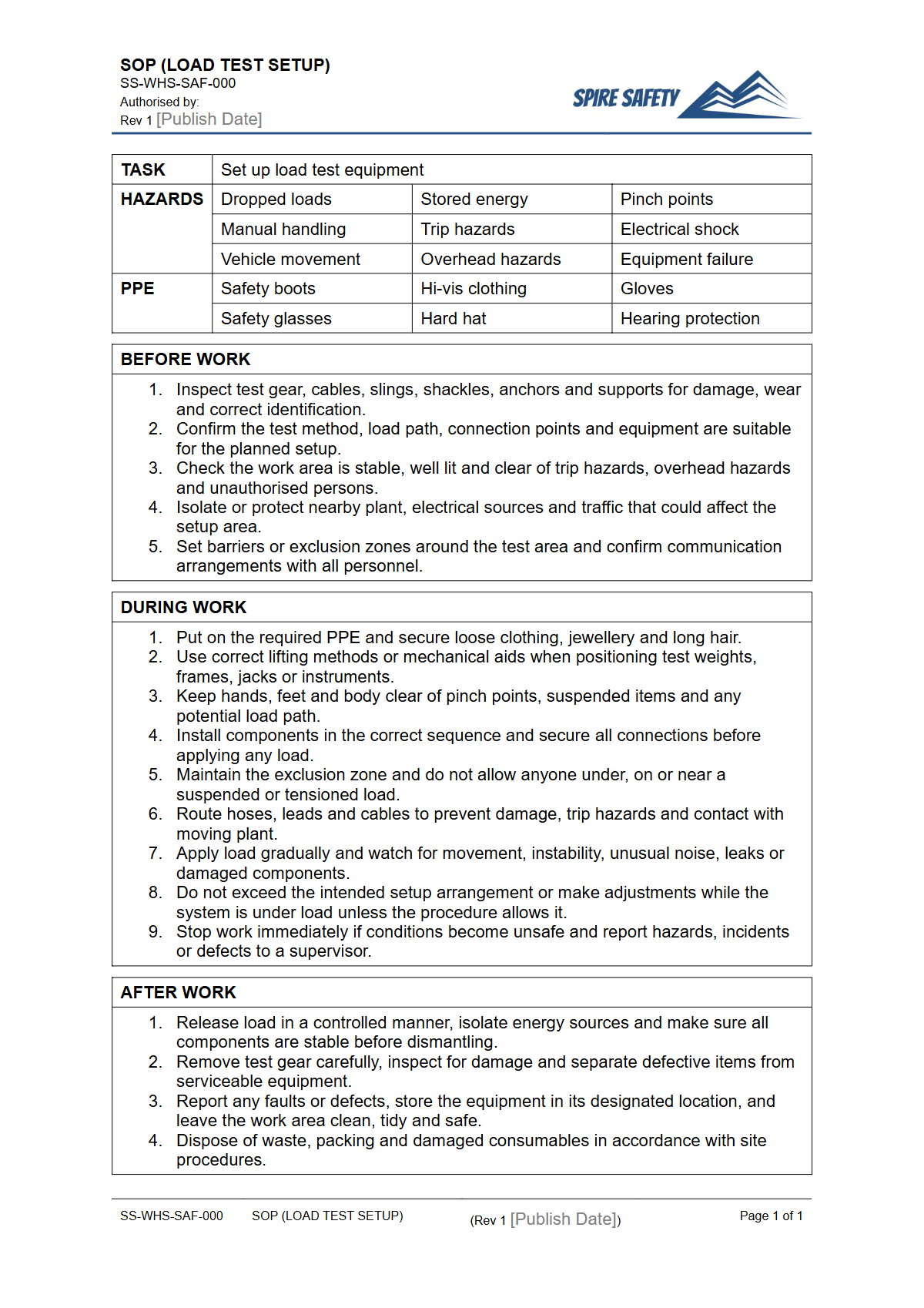
Download our free Safe Operating Procedure (Load Test Setup) template. This document provides a clear framework for conducting load tests safely.
Free Safe Operating Procedure (Load Test Setup) Template
DOCX • 126 KB + PDF
Updated Oct 2026
No signup required
Purpose of the Free Safe Operating Procedure (Load Test Setup) Template
Conducting a load test is a high-risk activity that requires meticulous planning and execution to verify the integrity of lifting equipment, components, and structures. This Free Safe Operating Procedure (Load Test Setup) Template provides a structured framework for outlining the required steps, safety controls, and responsibilities involved in the process.
Using a formal SOP helps your organisation ensure the test is performed consistently and safely every time, minimising the risk of equipment failure, property damage, or serious injury. It serves as a vital tool for demonstrating due diligence and managing your safety obligations under Australian WHS legislation.
A well-defined SOP is essential for managing the risks associated with high-risk plant. This is particularly true for equipment like cranes and hoists, where failure can have catastrophic consequences.
Formalising your process for tasks like load testing is a key part of maintaining a safe system of work. For other plant-specific procedures, you might consider downloading a safe operating procedure for a telehandler to see how different equipment requires unique safety controls.
Video walkthrough
How to use the Free Safe Operating Procedure (Load Test Setup) Template
This Safe Operating Procedure is provided as a starting point in both DOCX and PDF formats. Download your preferred version and begin by thoroughly reviewing its contents.
The key to an effective SOP is customisation. While the template covers common steps and hazards associated with load testing, it must be adapted to reflect the specific context of your workplace.
This means you must edit the document to include details such as:
- The specific make and model of the equipment being tested.
- The names and roles of the competent persons involved.
- Site-specific environmental factors and hazards.
- The exact type and weight of the test loads to be used.
- Emergency procedures relevant to your location.
Remember, a generic document offers limited protection. We have pre-filled common sections, but you must customise the template with your specific site details, personnel roles, and risk control measures to ensure it is effective and relevant for your workplace. Integrating such procedures is a fundamental part of developing robust comprehensive WHS management systems.
When to use it
A formal load test, guided by an SOP, should be conducted in several key situations to verify that equipment can safely handle its rated capacity. It is typically required after the initial installation or commissioning of new lifting equipment before it is put into service.
A load test is also critical following any major repair, modification, or alteration that could potentially affect the equipment's structural integrity or lifting capacity. Furthermore, periodic re-testing may be mandated by the manufacturer’s instructions, relevant Australian Standards, or as a result of a thorough engineering assessment.
If there is ever any doubt about the equipment’s condition or capacity, a load test provides the necessary verification.
Who should use it
This SOP should be used and understood by all personnel involved in the load testing process. This primarily includes the 'competent person'—often an engineer or a certified technician with the requisite knowledge and experience—who is responsible for planning, supervising, and certifying the test.
Equipment operators who will be controlling the plant during the test must also be thoroughly familiar with the procedure. Additionally, WHS managers, safety officers, and supervisors should use the SOP to ensure all safety protocols are being followed, risks are controlled, and compliance obligations are met.
The document serves as a crucial communication and training tool for everyone on the team, clarifying roles and setting clear safety expectations. When looking for other examples, our free Brake Press SOP template shows how procedures are tailored to specific machine operators and supervisors.
Implementing and verifying such critical safety documents is a core function of internal and external safety reviews. Professional WHS compliance auditing services can help identify gaps in your procedures and ensure they are being implemented effectively on the ground, providing an independent assessment of your safety performance.
Effective safety management goes beyond single documents, requiring a holistic approach to identifying and controlling hazards across all operations. If your organisation needs support in developing a more integrated safety framework, engaging specialist WHS consulting can provide the strategic guidance necessary to build a resilient safety culture.
You can also browse our complete free WHS resources library for more templates and guides to support your safety management system.
Common mistakes
Common mistakes to avoid
- Using a generic template without adding site-specific details and controls.
- Failing to ensure a competent and qualified person plans and supervises the test.
- Not establishing and strictly enforcing an adequate exclusion zone around the test area.
- Inadequate or incomplete record-keeping of test parameters, results, and certification.
Legal references
Legal considerations
The following legal requirements may be relevant to this type of work.
- Work Health and Safety Act (Harmonised) — Provides the primary duties for protecting workers and other people from work health and safety risks.
- Work Health and Safety Regulations (Harmonised) — Sets out requirements supporting the management of workplace hazards and risks.
The following codes may be relevant to this type of work.
- Managing WHS Risks Code of Practice — Provides practical guidance on identifying hazards, assessing risks and applying effective controls.
- Work Health and Safety Consultation, Cooperation and Coordination Code of Practice — Provides practical guidance on consulting workers and coordinating with other duty holders.
- Managing the Work Environment and Facilities Code of Practice — Provides practical guidance on safe work environments, workplace facilities and related controls.
Did you know
The Margin of Safety
Proof load tests are designed to apply stress beyond the normal operating limit to provide a margin of safety. This ensures that even with minor overloading or unforeseen dynamic forces, the equipment is unlikely to fail.
FAQ
Frequently asked questions
01What is a proof load test?
02Is an SOP legally required for load testing in Australia?
03Who is considered a 'competent person' for a load test?
04How often does lifting equipment need to be load tested?
Share this resource
Free Safe Operating Procedure (Load Test Setup) Template
Browse Categories
How To Use It
- 1Download and open in Word or PDF.
- 2Replace the placeholders with your business details.
- 3Get it reviewed by a WHS specialist before rollout.
Need it customised?
Our WHS consultants can adapt this template to your site, run a gap analysis, or audit what you already have in place.
Book a Free Consultation WHS consulting servicesor call 1300 156 382
Related templates
- Free Safe Operating Procedure (Loading Bay Cleaning) Template
- Free Safe Operating Procedure (Loading Bay Inspection) Template
- Free Safe Operating Procedure (Loading Bridge Operation) Template
- Free Safe Operating Procedure (Loading Dock Gate) Template
- Free Safe Operating Procedure (Loading Dock Handover) Template
- Free Safe Operating Procedure (Loading Zone Control) Template