
Free Safe Operating Procedure (Load Manifest Check) Template
Download our free Safe Operating Procedure (Load Manifest Check) template.
Free Safe Operating Procedure (Load Manifest Check) Template
DOCX • 126 KB + PDF
Updated Oct 2026
No signup required
Purpose of the Free Safe Operating Procedure (Load Manifest Check) Template
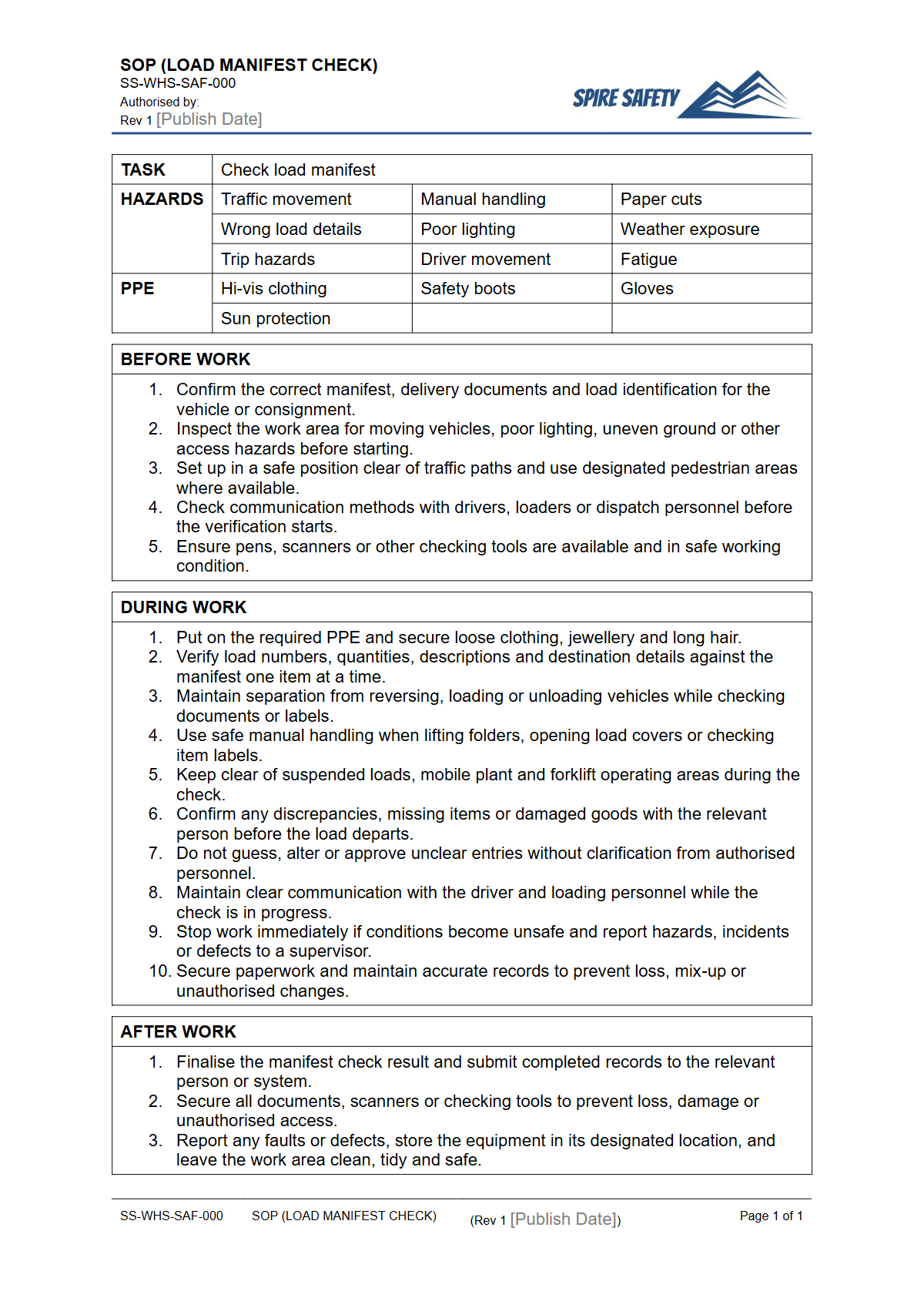
This Free Safe Operating Procedure (Load Manifest Check) Template provides a structured framework for ensuring that goods being transported match their corresponding documentation. Correctly checking a load manifest is a critical control measure in the transport and logistics industry.
It helps prevent incidents arising from overloaded vehicles, improperly restrained cargo, and undeclared hazardous materials. By formalising this process, your business can improve safety, meet its duty of care, and demonstrate due diligence under the Heavy Vehicle National Law's Chain of Responsibility (CoR) provisions.
A systematic manifest check confirms the nature, mass, and dimensions of the load, which is vital information for ensuring the vehicle remains stable and within legal mass limits. It also provides first responders with accurate information in an emergency.
This SOP template outlines the key steps for personnel to follow, from receiving the manifest to physically verifying the load and handling any discrepancies found. Implementing a robust procedure helps create a safer environment for drivers, loaders, and the general public.
Video walkthrough
How to use the Free Safe Operating Procedure (Load Manifest Check) Template
Our Safe Operating Procedure for Load Manifest Checks is provided as a fully editable document in both DOCX and PDF formats. To integrate it into your operations, download the file and customise it to reflect the specific requirements of your workplace, including the types of goods you handle and the equipment you use.
A comprehensive manifest check procedure is a fundamental part of effective WHS management systems, especially for organisations involved in transport and logistics.
Follow these steps to implement the SOP:
- Add your company name, logo, and other relevant details.
- Review the procedural steps and adapt them to your specific workflow. Consider the different stages where checks occur (e.g., pre-loading, post-loading, receiving).
- Consult with your workers, such as drivers, forklift operators, and warehouse staff, to ensure the procedure is practical and clear.
- Define the escalation process for when a manifest does not match the physical load.
- Finalise the document, ensure it is approved, and provide training to all relevant personnel on its contents.
Important: This document is a template only. For it to be effective, you must customise it to suit the unique hazards and operational context of your worksite.
We are not responsible for the outcomes of any actions taken based on the un-customised information provided.
When to use it
This Safe Operating Procedure should be used every time a load is dispatched from or received at your site. It forms a key part of the loading and unloading process.
The procedure should be referenced during the planning stages of a consignment and executed just before a vehicle departs or upon its arrival, before unloading commences. It is a critical checkpoint to ensure safety and compliance before the vehicle enters the public road network.
Furthermore, this SOP serves as an essential training tool for new employees involved in logistics operations and as a refresher for existing staff. It should also be reviewed during regular safety meetings and used as a benchmark during internal or external safety audits.
Consistent application helps embed a strong safety culture and supports ongoing WHS compliance auditing activities by providing clear, documented evidence of your control measures.
Who should use it
This SOP is designed for any person or business involved in the consignment, packing, loading, or transport of goods. Key personnel who should be trained on and use this procedure include:
- Transport Schedulers and Dispatch Officers
- Warehouse and Yard Supervisors
- Forklift Operators and other plant operators involved in loading
- Truck Drivers (both company drivers and contractors)
- Receiving and Despatch Clerks
- WHS Managers and Safety Officers
For workers operating machinery to load vehicles, such as a telehandler, this manifest check is a vital complementary procedure. You can find guidance on the safe use of such equipment in our FREE Telehandler SOP Template. Everyone who has a role in the Chain of Responsibility has an obligation to ensure safety, and a verified manifest is a cornerstone of that process.
Additional Considerations for Safe Loading
Beyond the manifest check itself, consider the physical environment and other tasks associated with loading and unloading. For instance, accessing a truck bed to inspect cargo may require working at height, even if only for a brief period.
Implementing controls for such ancillary tasks is also crucial, and our FREE Step Ladder SOP Template can provide a useful starting point for managing low-level height risks.
In industries handling bulk materials like soil, sand, or minerals, a load manifest or docket is just as important as it is for palletised freight. The principles of verifying mass and material type apply equally, and operators of heavy machinery like bulldozers should be aware of the load's specifications.
Procedures for handling these materials can be documented using resources such as our FREE Dozer SOP (Safe Operating Procedure) Template. You can explore our complete free WHS resources library for more templates to support your organisation's safety framework.
Common mistakes
Common mistakes to avoid
- Failing to physically verify the load and relying solely on the paperwork provided.
- Neglecting to check for undeclared or hidden dangerous goods within a consignment.
- Not having a clear, documented process for managing and reporting discrepancies.
- Poor record-keeping of manifest checks, leaving no evidence of due diligence.
Legal references
Legal considerations
The following legal requirements may be relevant to this type of work.
- Work Health and Safety Act (Harmonised) — Provides the primary duties for protecting workers and other people from work health and safety risks.
- Work Health and Safety Regulations (Harmonised) — Sets out requirements supporting the management of workplace hazards and risks.
The following codes may be relevant to this type of work.
- Managing WHS Risks Code of Practice — Provides practical guidance on identifying hazards, assessing risks and applying effective controls.
- Work Health and Safety Consultation, Cooperation and Coordination Code of Practice — Provides practical guidance on consulting workers and coordinating with other duty holders.
- Managing the Work Environment and Facilities Code of Practice — Provides practical guidance on safe work environments, workplace facilities and related controls.
Did you know
Chain of Responsibility
The Heavy Vehicle National Law (HVNL) extends legal liability to all parties in the supply chain. Fines for breaches can be substantial for both corporations and individuals, emphasising the importance of processes like manifest checks.
FAQ
Frequently asked questions
01What is a load manifest and why is it important?
02What should I do if the physical load doesn't match the manifest?
03Is this Safe Operating Procedure a legal document?
04Who is responsible for the load manifest under Chain of Responsibility (CoR)?
Share this resource
Free Safe Operating Procedure (Load Manifest Check) Template
Browse Categories
How To Use It
- 1Download and open in Word or PDF.
- 2Replace the placeholders with your business details.
- 3Get it reviewed by a WHS specialist before rollout.
Need it customised?
Our WHS consultants can adapt this template to your site, run a gap analysis, or audit what you already have in place.
Book a Free Consultation WHS consulting servicesor call 1300 156 382
Related templates
- Free Safe Operating Procedure (Load Test Setup) Template
- Free Safe Operating Procedure (Loading Bay Cleaning) Template
- Free Safe Operating Procedure (Loading Bay Inspection) Template
- Free Safe Operating Procedure (Loading Bridge Operation) Template
- Free Safe Operating Procedure (Loading Dock Gate) Template
- Free Safe Operating Procedure (Loading Dock Handover) Template