
Free Safe Operating Procedure (Load Distribution Check) Template
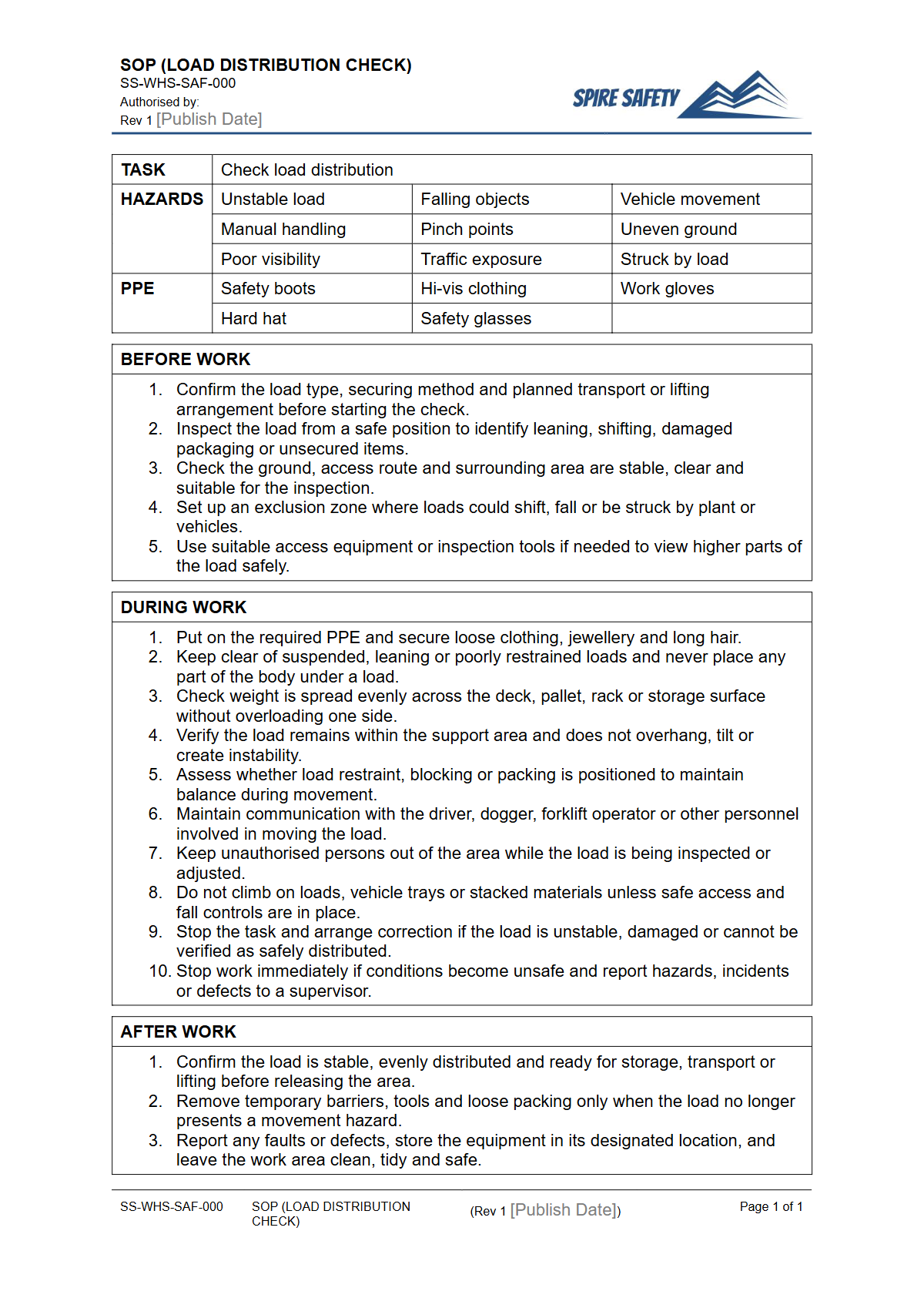
Download our free Safe Operating Procedure (Load Distribution Check) template.
Free Safe Operating Procedure (Load Distribution Check) Template
DOCX • 126 KB + PDF
Updated Oct 2026
No signup required
Purpose of the Free Safe Operating Procedure (Load Distribution Check) Template
Ensuring correct load distribution is a critical safety control for any organisation that transports goods, materials, or mobile plant. An uneven or poorly distributed load can dangerously alter a vehicle's centre of gravity, leading to instability, reduced braking and steering effectiveness, and an increased risk of rollover.
This free Safe Operating Procedure (Load Distribution Check) Template provides a structured framework for documenting the specific steps required to safely load vehicles and equipment at your workplace. Using this SOP helps formalise your process, train your workers effectively, and demonstrate due diligence in managing transport-related risks. A documented procedure for load checks is a fundamental component of effective WHS management systems.
Video walkthrough
How to use the Free Safe Operating Procedure (Load Distribution Check) Template
This document provides a comprehensive starting point for developing a site-specific procedure. To get the most out of our free Safe Operating Procedure (Load Distribution Check) Template, follow these steps:
- Download the template in your preferred format (DOCX for easy editing or PDF).
- Consult with your workers, including operators, drivers, and supervisors who are directly involved in loading activities. Their practical input is invaluable for creating a workable procedure.
- Customise the content to reflect the specific vehicles, equipment (e.g., trucks, trailers, utes), and types of loads handled at your site.
- Insert details about your specific axle load limits, tie-down requirements, and designated loading zones.
- Review and approve the final document through your organisation's safety review process.
- Induct and train all relevant personnel on the finalised SOP, ensuring they understand their roles and responsibilities.
Note: This is a template and must be customised to your specific workplace. We are not responsible for the implementation or the final document's suitability for your business.
You must consult with your team and adapt it to your unique operational risks, including those detailed in resources like our FREE Telehandler SOP Template when loading specific plant.
Key Elements in a Load Distribution Check
A robust load distribution check involves more than just placing items on a truck bed. The procedure should guide workers to consider several factors to ensure stability and compliance. Key elements to include in your customised SOP are:
- Vehicle and Load Assessment: Confirming the vehicle's Gross Vehicle Mass (GVM) and axle load limits are not exceeded.
- Load Sequencing: A plan for loading items in a specific order (e.g., heavier items first, centred, and low).
- Positioning: Placing the load to maintain a low centre of gravity and ensure weight is distributed evenly across axles.
- Securing the Load: While this SOP focuses on distribution, it should reference the need for adequate load restraint as the next critical step.
- Final Verification: A concluding check to ensure the load is stable, secure, and the vehicle appears level before departure.
These checks are particularly important when transporting heavy machinery. The principles in this SOP can be adapted from information found in other equipment-specific guides, such as our FREE Dozer SOP Template.
When to use it
A Safe Operating Procedure for load distribution should be used before the commencement of every loading task. It is not a one-off document but an active tool to be referenced by workers. It is particularly critical when:
- Loading heavy or oversized items.
- Transporting mobile plant and earthmoving equipment.
- Creating mixed loads with items of varying weight and size.
- Loading vehicles that will travel on public roads, where adherence to national transport laws is mandatory.
- Training new employees or conducting refresher training for existing staff.
Documented procedures like this SOP form a key part of the evidence reviewed during WHS compliance auditing to verify that safety processes are being followed.
Who should use it
This procedure is designed for use by a range of personnel within an organisation's 'chain of responsibility' for transport and logistics. This includes:
- Transport and Logistics Managers: For developing and implementing the system.
- Supervisors: For overseeing loading operations and ensuring compliance.
- Forklift and Crane Operators: For physically placing the loads according to the procedure.
- Truck Drivers and Vehicle Operators: For conducting final checks and ensuring their vehicle is safe to operate.
- WHS/HSE Advisors: For integrating the SOP into the broader safety management system.
Just as a grader operator needs a specific guide for their machine, anyone involved in loading needs clear instructions. This SOP complements other task-specific documents like our FREE Grader SOP (Safe Operating Procedure) Template by focusing on the critical transport phase.
Common mistakes
Common mistakes to avoid
- Focusing only on total vehicle weight (GVM) while ignoring individual axle load limits.
- Failing to consider dynamic forces, such as the forward shift during braking or sideways shift during cornering.
- Assuming a 'pyramid' shape is always stable without considering the base weight distribution.
- Not securing smaller, lighter items within the main load, allowing them to shift and upset the balance.
Legal references
Legal considerations
The following legal requirements may be relevant to this type of work.
- Work Health and Safety Act (Harmonised) — Provides the primary duties for protecting workers and other people from work health and safety risks.
- Work Health and Safety Regulations (Harmonised) — Sets out requirements supporting the management of workplace hazards and risks.
The following codes may be relevant to this type of work.
- Managing WHS Risks Code of Practice — Provides practical guidance on identifying hazards, assessing risks and applying effective controls.
- Work Health and Safety Consultation, Cooperation and Coordination Code of Practice — Provides practical guidance on consulting workers and coordinating with other duty holders.
- Managing the Work Environment and Facilities Code of Practice — Provides practical guidance on safe work environments, workplace facilities and related controls.
Did you know
Centre of Gravity
For every 10cm the centre of gravity of a load is raised, its tendency to roll over can increase by as much as 10%. Keeping loads low and centred is a fundamental principle of vehicle stability.
Chain of Responsibility
Under Australia's Heavy Vehicle National Law, legal liability for a load breach (like being overweight or poorly balanced) can apply to every person in the supply chain, not just the driver. This is known as the Chain of Responsibility (CoR).
FAQ
Frequently asked questions
01What is a load distribution check?
02Why is even load distribution so important for safety?
03Does this Safe Operating Procedure cover load restraint?
04How often should our load distribution SOP be reviewed?
Share this resource
Free Safe Operating Procedure (Load Distribution Check) Template
Browse Categories
How To Use It
- 1Download and open in Word or PDF.
- 2Replace the placeholders with your business details.
- 3Get it reviewed by a WHS specialist before rollout.
Need it customised?
Our WHS consultants can adapt this template to your site, run a gap analysis, or audit what you already have in place.
Book a Free Consultation WHS consulting servicesor call 1300 156 382
Related templates
- Free Safe Operating Procedure (Load Guiding) Template
- Free Safe Operating Procedure (Load Indicator Test) Template
- Free Safe Operating Procedure (Load Landing) Template
- Free Safe Operating Procedure (Load Manifest Check) Template
- Free Safe Operating Procedure (Load Test Setup) Template
- Free Safe Operating Procedure (Loading Bay Cleaning) Template