
Free Safe Operating Procedure (LNG Refuelling) Template
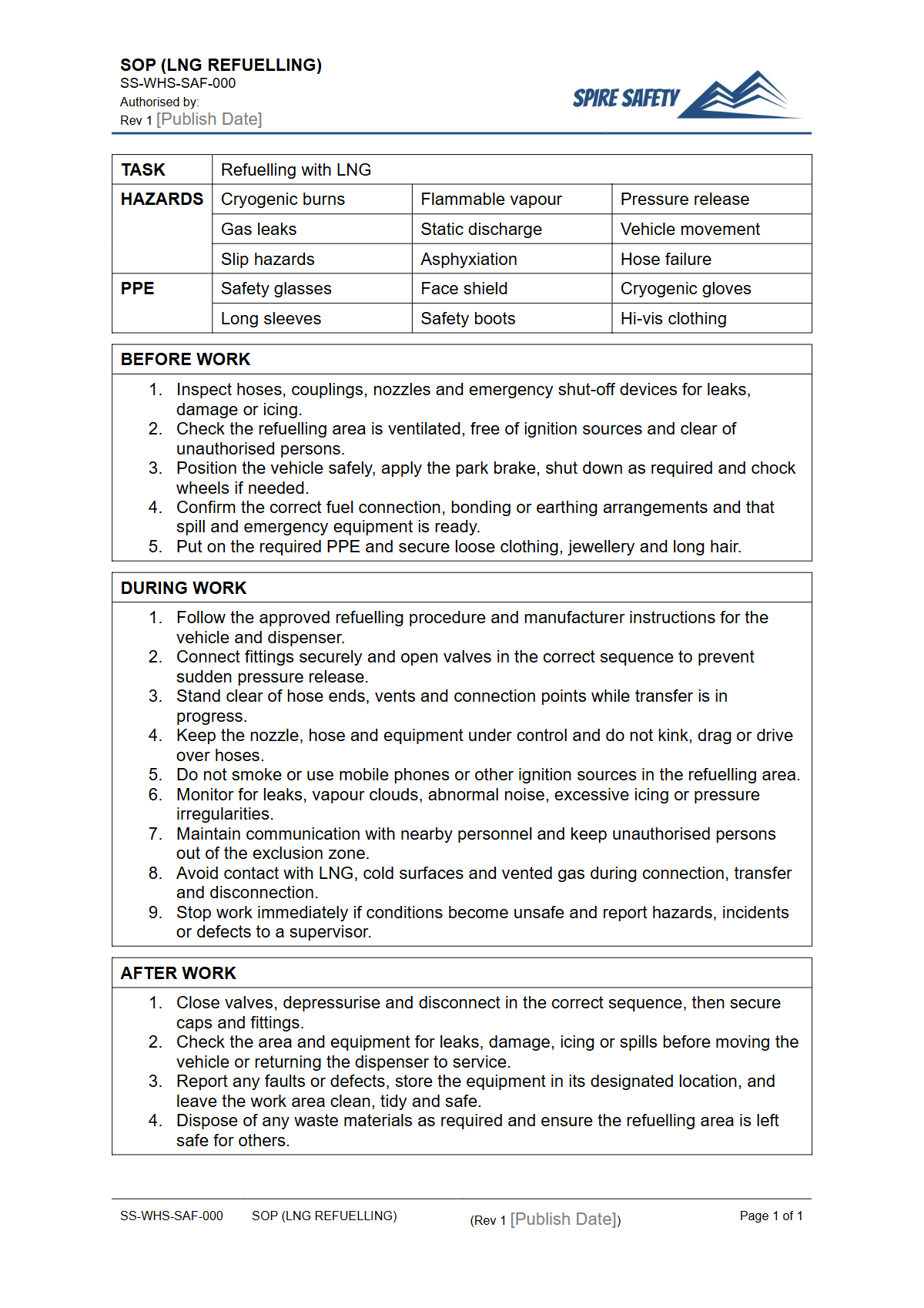
Download our free Safe Operating Procedure (LNG Refuelling) Template. This DOCX and PDF resource helps you outline safe work steps for refuelling with LNG.
Free Safe Operating Procedure (LNG Refuelling) Template
DOCX • 126 KB + PDF
Updated Oct 2026
No signup required
Purpose of the Free Safe Operating Procedure (LNG Refuelling) Template
Handling Liquefied Natural Gas (LNG) presents significant risks, including cryogenic burns, asphyxiation, and fire or explosion hazards. A documented Safe Operating Procedure (SOP) is essential for managing these risks effectively.
This free Safe Operating Procedure (LNG Refuelling) Template provides a structured framework for businesses to create a comprehensive guide for their workers. Using a clear SOP ensures that all personnel follow a consistent, safe, and controlled process, minimising the chance of incidents and promoting a strong safety culture.
It forms a critical part of your broader WHS management systems by formalising expectations and control measures.
Video walkthrough
How to use the Free Safe Operating Procedure (LNG Refuelling) Template
This template is provided as a starting point in both DOCX and PDF formats. You can download and edit the DOCX file to align with your specific operational context.
It is crucial to understand that this is not a finished document. You must customise it by incorporating details about your specific LNG refuelling equipment, site layout, vehicle types, and emergency procedures.
We strongly recommend that a competent person, in consultation with workers who perform the task, leads this customisation process. The final document should be a practical tool that accurately reflects the safest way to perform LNG refuelling in your workplace, including clear steps for first aid and emergency response, which might involve referencing a separate Safe Operating Procedure for defibrillator operation if one is available on site.
When to use this Safe Operating Procedure
An SOP for LNG refuelling should be used in several key situations. It is a primary training document for new employees or workers being trained on LNG refuelling tasks.
It should also be readily available at the refuelling point for reference. Supervisors can use it to conduct pre-start briefings and to observe work practices to ensure they align with the documented procedure.
Furthermore, the SOP is an invaluable tool during incident investigations, helping to identify any deviations from the established safe process. Regular reviews and updates to the SOP should occur whenever new equipment is introduced, a process is changed, or after any near miss or incident.
Who should use this Safe Operating Procedure
This SOP is intended for all personnel involved in the LNG refuelling process. This includes vehicle operators, designated refuelling personnel, and maintenance staff who may work on the refuelling systems.
Supervisors and managers must also be familiar with the procedure to effectively oversee operations and enforce safety standards. The document serves as a clear benchmark for competency, and its use should be integrated into your organisation's training and assessment program.
Regular WHS compliance audits can verify that personnel are not only aware of the SOP but are also correctly applying it in practice.
Key Elements of an LNG Refuelling Safe Operating Procedure
A comprehensive SOP for LNG refuelling should be logically structured and easy to follow. While our template provides a solid foundation, ensure your customised version includes these critical sections:
- Required PPE: Specify all mandatory personal protective equipment, such as cryogenic gloves, safety glasses with side shields, a face shield, and non-static long-sleeved clothing.
- Pre-Operational Checks: Detail the inspection steps for both the vehicle's fuel system and the refuelling station before any connection is made. This includes checking for leaks, ice build-up, and damaged components. Other site-specific checks may also be needed, similar to those found in our Plasma Cutter SOP template for workshop equipment.
- Step-by-Step Refuelling Process: Provide a clear, sequential guide for connecting the nozzle, purging lines, opening valves, starting the pump, monitoring the fill, and safely disconnecting.
- Post-Refuelling Checks: Outline the steps to secure the equipment, check for leaks after disconnection, and stow hoses correctly.
- Emergency Procedures: Detail the immediate actions to take in case of a leak, spill, fire, or personnel exposure to LNG. Include emergency contact numbers and the location of safety showers, eyewash stations, and fire extinguishers.
Developing and implementing a robust SOP for high-risk tasks like LNG refuelling is a cornerstone of meeting your duties under WHS legislation. It demonstrates a commitment to worker safety and systematic risk management.
If you need assistance tailoring this document or developing a complete safety system, consider engaging specialist WHS consulting services. For more document templates and safety guides, browse our complete free WHS resources library.
Common mistakes
Common mistakes to avoid
- Using the generic template without site-specific customisation.
- Providing inadequate training on the specific refuelling equipment and emergency procedures.
- Failing to wear or properly maintain mandatory cryogenic personal protective equipment (PPE).
- Neglecting to perform pre-use and post-use inspections of the refuelling station and vehicle.
Legal references
Legal considerations
The following legal requirements may be relevant to this type of work.
- Work Health and Safety Act (Harmonised) — Provides the primary duties for protecting workers and other people from work health and safety risks.
- Work Health and Safety Regulations (Harmonised) — Sets out requirements supporting the management of workplace hazards and risks.
The following codes may be relevant to this type of work.
- Managing WHS Risks Code of Practice — Provides practical guidance on identifying hazards, assessing risks and applying effective controls.
- Work Health and Safety Consultation, Cooperation and Coordination Code of Practice — Provides practical guidance on consulting workers and coordinating with other duty holders.
- Managing the Work Environment and Facilities Code of Practice — Provides practical guidance on safe work environments, workplace facilities and related controls.
Did you know
Shrinking Gas
When natural gas is cooled to approximately -162°C, it becomes a liquid and its volume shrinks by about 600 times, making it much more efficient to store and transport.
Lighter Than Air
Unlike LPG (Liquefied Petroleum Gas), which is heavier than air and pools at ground level, vaporised LNG is lighter than air and will typically rise and dissipate quickly in open environments.
FAQ
Frequently asked questions
01What are the main hazards of LNG refuelling?
02Does this LNG refuelling SOP template meet Australian Standards?
03What PPE is required for LNG refuelling?
04Who is authorised to perform LNG refuelling?
Share this resource
Free Safe Operating Procedure (LNG Refuelling) Template
Browse Categories
How To Use It
- 1Download and open in Word or PDF.
- 2Replace the placeholders with your business details.
- 3Get it reviewed by a WHS specialist before rollout.
Need it customised?
Our WHS consultants can adapt this template to your site, run a gap analysis, or audit what you already have in place.
Book a Free Consultation WHS consulting servicesor call 1300 156 382
Related templates
- Free Safe Operating Procedure (Load Bay Allocation) Template
- Free Safe Operating Procedure (Load Cell Use) Template
- Free Safe Operating Procedure (Load Damage Inspection) Template
- Free Safe Operating Procedure (Load Distribution Check) Template
- Free Safe Operating Procedure (Load Guiding) Template
- Free Safe Operating Procedure (Load Indicator Test) Template