
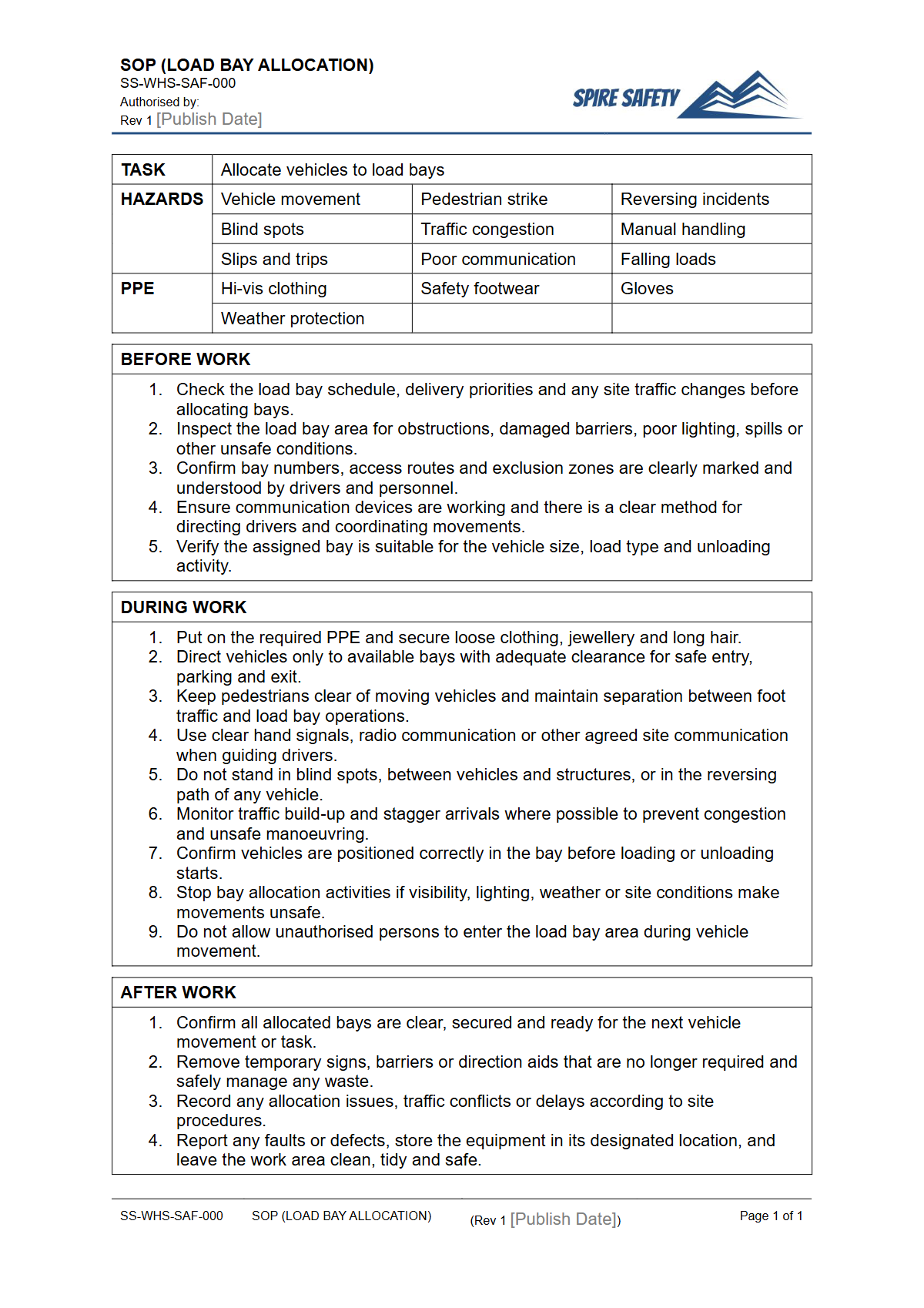
Free Safe Operating Procedure (Load Bay Allocation) Template
Download our free Safe Operating Procedure (Load Bay Allocation) Template.
Free Safe Operating Procedure (Load Bay Allocation) Template
DOCX • 126 KB + PDF
Updated Oct 2026
No signup required
Purpose of the Free Safe Operating Procedure (Load Bay Allocation) Template
Loading bays are high-risk environments where vehicles, mobile plant, and pedestrians interact in confined spaces. Without clear rules, the potential for serious incidents, including collisions and falls from height, is significant.
This free Safe Operating Procedure (Load Bay Allocation) template provides a structured starting point for organisations to formalise their traffic management and allocation processes. It helps to define responsibilities, control vehicle movement, and establish clear communication protocols between drivers and site personnel.
By implementing a robust SOP, you can systematically reduce risks and create a safer, more efficient operational area. Integrating such procedures is a fundamental component of effective WHS management systems.
Video walkthrough
How to use the Free Safe Operating Procedure (Load Bay Allocation) Template
This document is a template, not a finished product. To use it effectively, you must adapt it to the unique conditions of your workplace.
Start by downloading the DOCX file and adding your company name, logo, and relevant site details. Next, conduct a thorough risk assessment of your loading bay area, considering your specific layout, the types of vehicles that visit, the plant used, and environmental factors.
Customise the procedural steps in the template to reflect your findings and your agreed-upon control measures. This includes specifying communication methods (e.g., two-way radio, hand signals), designated waiting areas, speed limits, and emergency protocols. For instance, you should detail the location and use of first aid equipment as outlined in documents like a defibrillator operation Safe Operating Procedure.
Important: We are not a law firm. This template is a starting point and must be customised by a competent person to your specific workplace, equipment, and legal obligations.
Its use does not supports your compliance efforts with any legislation or standard.
When to use this Safe Operating Procedure
A load bay allocation SOP should be used in any workplace that facilitates the loading or unloading of goods from vehicles. This applies to warehouses, distribution centres, manufacturing plants, retail back-of-house areas, and construction sites.
It is a critical administrative control that should be implemented after a risk assessment has identified potential hazards associated with vehicle and pedestrian movement. It serves as both a daily operational guide and a key training document for new employees, contractors, and visiting drivers, ensuring everyone understands and follows the same safe process. The SOP should be regularly reviewed and updated, especially after an incident or when changes are made to the workplace layout or operational flow, such as introducing new equipment covered by a telehandler SOP.
Who should use this document
This Safe Operating Procedure is primarily for use by personnel responsible for managing workplace safety and logistics. This includes Warehouse Managers, Logistics Coordinators, Site Supervisors, and WHS/OHS Advisors.
They are responsible for customising, implementing, and enforcing the procedure. However, the document is also an essential tool for all workers who operate in or near the loading bay area.
This includes forklift operators, storepersons, truck drivers, and any other staff or contractors who may be present. The SOP provides them with clear, step-by-step instructions on how to perform their tasks safely and what to expect from others.
Its effectiveness can be verified through practical observation and formal processes like WHS compliance auditing to ensure the documented steps are being followed correctly.
The procedure also informs the training and induction process, ensuring a consistent standard of safety knowledge across the organisation. While this document focuses on traffic and bay allocation, it's important to consider all associated tasks, such as ensuring workers are provided with and use appropriate equipment like industrial step ladders. For related procedures, you can explore our free WHS resources library.
Common mistakes
Common mistakes to avoid
- Failing to communicate clear instructions to visiting drivers before they enter the loading area.
- Inadequate physical separation between pedestrians and moving vehicles.
- Assuming all drivers are familiar with the site's layout and safety rules.
- Neglecting to inspect and maintain the loading bay area, including lighting, signage, and dock levellers.
Legal references
Legal considerations
The following legal requirements may be relevant to this type of work.
- Work Health and Safety Act (Harmonised) — Provides the primary duties for protecting workers and other people from work health and safety risks.
- Work Health and Safety Regulations (Harmonised) — Sets out requirements supporting the management of workplace hazards and risks.
The following codes may be relevant to this type of work.
- Managing WHS Risks Code of Practice — Provides practical guidance on identifying hazards, assessing risks and applying effective controls.
- Work Health and Safety Consultation, Cooperation and Coordination Code of Practice — Provides practical guidance on consulting workers and coordinating with other duty holders.
- Managing the Work Environment and Facilities Code of Practice — Provides practical guidance on safe work environments, workplace facilities and related controls.
Did you know
Loading Bay Risks
According to Safe Work Australia, the transport, postal, and warehousing industry has one of the highest rates of serious workers' compensation claims, with vehicle incidents being a major contributor.
Pedestrian Segregation
Simply painting lines on the ground is often insufficient for pedestrian safety. Physical barriers like guardrails are considered a more effective control for segregating people from moving vehicles in loading zones.
FAQ
Frequently asked questions
01What is a load bay allocation SOP?
02Why is traffic management important in loading bays?
03Who is responsible for enforcing a loading bay SOP?
04Does this SOP template cover driver and vehicle safety checks?
Share this resource
Free Safe Operating Procedure (Load Bay Allocation) Template
Browse Categories
How To Use It
- 1Download and open in Word or PDF.
- 2Replace the placeholders with your business details.
- 3Get it reviewed by a WHS specialist before rollout.
Need it customised?
Our WHS consultants can adapt this template to your site, run a gap analysis, or audit what you already have in place.
Book a Free Consultation WHS consulting servicesor call 1300 156 382
Related templates
- Free Safe Operating Procedure (Load Cell Use) Template
- Free Safe Operating Procedure (Load Damage Inspection) Template
- Free Safe Operating Procedure (Load Distribution Check) Template
- Free Safe Operating Procedure (Load Guiding) Template
- Free Safe Operating Procedure (Load Indicator Test) Template
- Free Safe Operating Procedure (Load Landing) Template