
Free Safe Operating Procedure (Livestock Ear Tagging) Template
Download our Free Safe Operating Procedure (Livestock Ear Tagging) Template. This customisable DOCX & PDF helps you document safe work methods for your team.
Free Safe Operating Procedure (Livestock Ear Tagging) Template
DOCX • 126 KB + PDF
Updated Oct 2026
No signup required
Purpose of the Free Safe Operating Procedure (Livestock Ear Tagging) Template
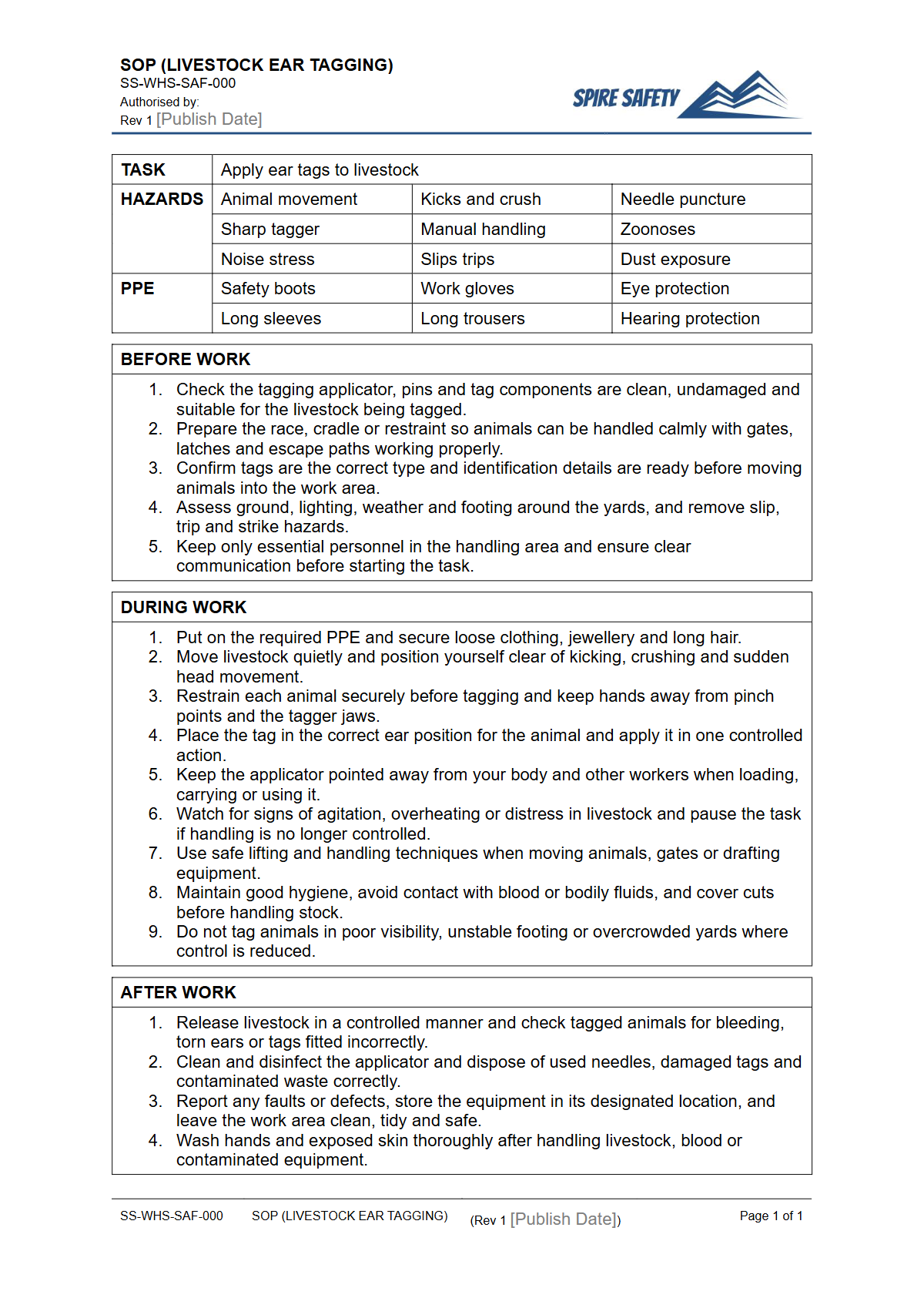
This Free Safe Operating Procedure (Livestock Ear Tagging) Template provides a structured framework for documenting the safe and correct method for applying ear tags to livestock. Ear tagging is a fundamental task in Australian agriculture for identification, biosecurity, and traceability under the National Livestock Identification System (NLIS).
However, it involves significant risks, including musculoskeletal injuries from handling animals, crush injuries, and zoonotic diseases. This SOP helps Persons Conducting a Business or Undertaking (PCBUs) meet their primary duty of care by outlining potential hazards, required personal protective equipment (PPE), and a step-by-step process to minimise risks.
Using a standardised procedure ensures that all workers, from seasoned station hands to new trainees, understand the recognised safe way to perform the task. It serves as an essential training tool and a reference point for daily operations, reinforcing safe behaviour and helping to build a proactive safety culture on your property.
Formalising this process is a key component of building robust WHS management systems, demonstrating a commitment to worker health and safety.
Video walkthrough
How to use the Free Safe Operating Procedure (Livestock Ear Tagging) Template
This template is designed as a comprehensive starting point. After downloading the DOCX or PDF file, you must customise it to reflect the specific conditions of your workplace.
This includes identifying the types of livestock handled, the specific tagging equipment used (e.g., applicator types), and the design of your yards, race, and crush. Effective risk management requires a procedure that is practical and relevant to your unique operational environment.
Important: This document is a template only. We have provided a detailed guide, but you must consult with your workers and adapt the content to suit your specific equipment, site, and internal processes.
The final SOP should be a practical tool that reflects how the work is actually done safely at your business.
To implement the SOP, ensure it is read and understood by all relevant personnel. It should be used during toolbox talks, worker inductions, and refresher training sessions.
Keeping the SOP readily accessible in the work area, such as in the shed or near the yards, allows for quick reference. Like other procedural documents such as a free Grain Drill SOP, it forms a critical part of your farm's safety documentation.
When to use this Safe Operating Procedure
A Safe Operating Procedure for livestock ear tagging should be used whenever the task is performed. It is particularly crucial during mass tagging events, such as marking lambs, calves, or new stock arrivals.
It should also be consulted before training new staff members or when using a new type of tag or applicator for the first time. Regular review, at least annually or after any incident, ensures it remains current.
An SOP provides the foundation for consistent and safe work practices, reducing the chance of injury or error.
In the event of an incident or near-miss, the SOP serves as a benchmark to review what went wrong. The investigation can help identify if the procedure was followed and whether the procedure itself needs improvement.
This continuous improvement cycle is vital for maintaining a safe working environment. For serious incidents, having a clear and accessible Safe Operating Procedure for defibrillator operation can also be a life-saving component of your first aid plan.
Who should use it
This SOP is intended for all individuals involved in livestock handling and tagging operations on a farm or station. This includes farm owners, station managers, supervisors, stockpersons, farm hands, and any contractors engaged to perform the task.
It is a valuable tool for supervisors to ensure work is conducted according to established safety standards and for workers to understand their responsibilities. If you need help integrating this and other procedures into your overall safety framework, our professional WHS consulting services can provide expert guidance.
Ultimately, anyone whose work involves handling livestock for the purpose of ear tagging should be trained in and have access to this procedure. This ensures a consistent approach to safety across the entire team, reducing variability in how tasks are performed and minimising overall risk. For more procedural documents covering a wide range of tasks and equipment, browse our complete free WHS resources library.
Common mistakes
Common mistakes to avoid
- Failing to properly restrain the animal in a suitable crush or cradle, leading to handler injury.
- Incorrect placement of the ear tag, which can cause pain, infection, or the tag to be ripped out.
- Using dirty or unhygienic applicators and tags, increasing the risk of infection for the animal.
- Attempting to tag large or unpredictable animals alone without assistance or an escape route.
Legal references
Legal considerations
The following legal requirements may be relevant to this type of work.
- Work Health and Safety Act (Harmonised) — Provides the primary duties for protecting workers and other people from work health and safety risks.
- Work Health and Safety Regulations (Harmonised) — Sets out requirements supporting the management of workplace hazards and risks.
The following codes may be relevant to this type of work.
- Managing WHS Risks Code of Practice — Provides practical guidance on identifying hazards, assessing risks and applying effective controls.
- Work Health and Safety Consultation, Cooperation and Coordination Code of Practice — Provides practical guidance on consulting workers and coordinating with other duty holders.
- Managing the Work Environment and Facilities Code of Practice — Provides practical guidance on safe work environments, workplace facilities and related controls.
Did you know
NLIS Traceability
Australia's National Livestock Identification System (NLIS) was one of the world's first national traceability systems for livestock, enhancing biosecurity and food safety by tracking animals from their property of birth to slaughter.
Zoonotic Risk
Q Fever is a common zoonotic disease in Australia, often contracted from cattle, sheep, and goats. A key control is vaccination for workers, which should be documented in your risk assessment.
FAQ
Frequently asked questions
01What are the main hazards involved in livestock ear tagging?
02Is a Safe Operating Procedure legally required for ear tagging livestock?
03What Personal Protective Equipment (PPE) is needed for livestock ear tagging?
04How often should an SOP for ear tagging be reviewed?
Share this resource
Free Safe Operating Procedure (Livestock Ear Tagging) Template
Browse Categories
How To Use It
- 1Download and open in Word or PDF.
- 2Replace the placeholders with your business details.
- 3Get it reviewed by a WHS specialist before rollout.
Need it customised?
Our WHS consultants can adapt this template to your site, run a gap analysis, or audit what you already have in place.
Book a Free Consultation WHS consulting servicesor call 1300 156 382
Related templates
- Free Safe Operating Procedure (Livestock Feed Handling) Template
- Free Safe Operating Procedure (Livestock Gate Handling) Template
- Free Safe Operating Procedure (Livestock Yard Cleaning) Template
- Free Safe Operating Procedure (LNG Refuelling) Template
- Free Safe Operating Procedure (Load Bay Allocation) Template
- Free Safe Operating Procedure (Load Cell Use) Template