
Free Safe Operating Procedure (Livestock Feed Handling) Template
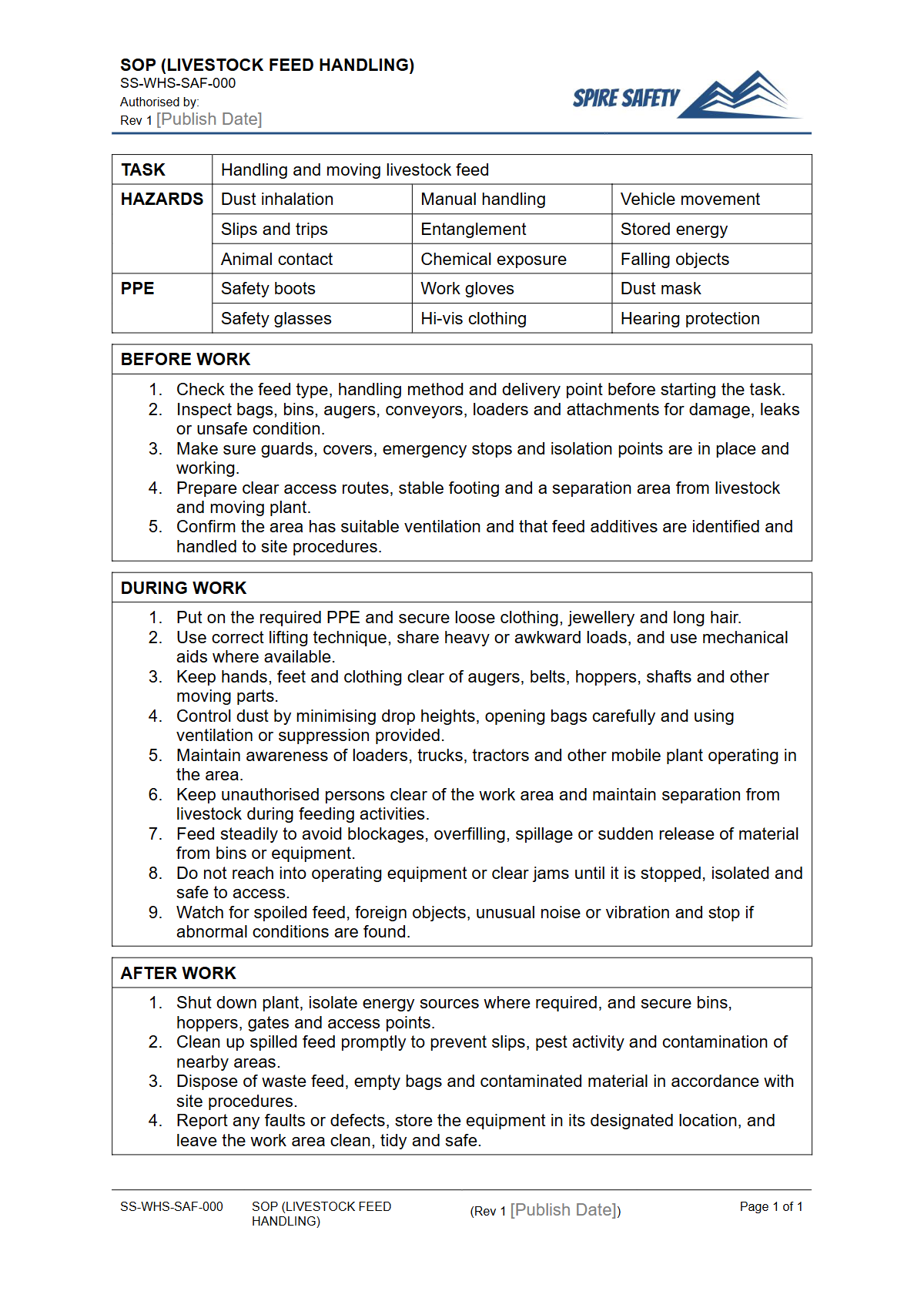
Download our Free Safe Operating Procedure (Livestock Feed Handling) Template. This customisable DOCX and PDF helps agricultural businesses manage risks.
Free Safe Operating Procedure (Livestock Feed Handling) Template
DOCX • 126 KB + PDF
Updated Oct 2026
No signup required
Purpose of the Free Safe Operating Procedure (Livestock Feed Handling) Template
This Free Safe Operating Procedure (Livestock Feed Handling) Template provides a structured framework for documenting the steps required to handle animal feed safely in an agricultural setting. Handling livestock feed, whether in bags or bulk, involves significant risks, including musculoskeletal injuries from manual tasks, respiratory illness from dust exposure, and entanglement with machinery like augers or mixers.
Implementing a clear SOP is a fundamental control measure for any person conducting a business or undertaking (PCBU) in the agricultural sector.
A well-defined SOP helps standardise your processes, ensuring every worker follows the same safe method every time. This not only minimises the risk of injury but also forms a crucial component of your overall safety management system.
By clearly outlining hazards and controls, this document serves as a vital tool for worker training, inductions, and risk assessments, helping to foster a proactive safety culture on your property. Integrating such procedures is a key part of developing robust WHS management systems that protect your people and your business.
Key Hazards in Livestock Feed Handling
When customising this Safe Operating Procedure, it is essential to consider the specific hazards present in your operation. Common risks associated with handling livestock feed include:
- Manual Tasks: Lifting heavy bags of feed, repetitive shovelling, and awkward postures can lead to serious sprains, strains, and long-term musculoskeletal disorders.
- Hazardous Atmospheres: Grain dust, mould, and fumigants in silos or enclosed spaces can cause respiratory diseases, allergic reactions, or asphyxiation. Proper ventilation and respiratory protective equipment (RPE) are critical.
- Plant and Machinery: Augers, conveyors, feed mixers, and tractors present risks of entanglement, crushing, and noise-induced hearing loss. Lockout/tagout procedures are essential during maintenance.
- Slips, Trips, and Falls: Spilled feed, uneven ground, and working at heights on silos or feed bins are common causes of falls. Using equipment like a step ladder safely is crucial.
- Biological Hazards: Feed can be contaminated with bacteria (e.g., Salmonella) or mycotoxins, which can be harmful to both animals and humans.
Video walkthrough
How to use the Free Safe Operating Procedure (Livestock Feed Handling) Template
Our Free Safe Operating Procedure (Livestock Feed Handling) Template is available for immediate download in both DOCX and PDF formats. The DOCX file is fully editable, allowing you to tailor it precisely to your workplace's unique requirements.
This customisation is not just recommended; it is essential for the document to be effective and relevant.
Important: This document is a template, not a finished procedure. We have provided a structured framework, but you must adapt it to reflect the specific equipment (e.g., augers, silos, mixers), types of feed, storage systems, and personnel at your workplace.
You should add details such as machinery model numbers, site-specific emergency contacts, and the exact types of Personal Protective Equipment (PPE) required for each task. If heavy machinery like a telehandler is used for moving bulk bags or pallets, you may also need a specific FREE Telehandler SOP Template to supplement this procedure.
When to use this Safe Operating Procedure
This Safe Operating Procedure should be developed, implemented, and followed for all tasks involving the handling of livestock feed. It is a critical resource during worker inductions, task-specific training, and refresher courses to ensure ongoing competency.
The SOP should be readily accessible to all workers in the areas where feed handling occurs.
Furthermore, this document should be reviewed regularly as part of your WHS processes, and always after an incident, a near-miss, or when a change is introduced to the task, such as new equipment or a different type of feed. Regular reviews can be integrated into broader safety activities, such as internal or third-party WHS compliance auditing, to verify its effectiveness and ensure it continues to reflect current practice.
Who should use this Safe Operating Procedure
This template is designed for use by a range of personnel within the Australian agricultural industry. This includes farm owners, station managers, and supervisors responsible for creating and implementing safety protocols.
It is the primary reference document for all farmhands, stockpeople, and machinery operators who perform feed handling tasks as part of their daily duties.
WHS managers and safety consultants will also find this template a valuable starting point when developing safety documentation for agricultural clients. Ensuring that all relevant workers are trained on the contents of the final, customised SOP is a key responsibility of management.
This commitment to procedural safety can be extended to other common agricultural tasks, such as operating specialised equipment detailed in our FREE Grain Drill SOP (Safe Operating Procedure) Template. For more tailored advice, consider engaging professional WHS consulting services.
Common mistakes
Common mistakes to avoid
- Failing to customise the template with site-specific machinery, feed types, and hazards.
- Neglecting to include detailed requirements for Personal Protective Equipment (PPE), such as specific respirator types.
- Not providing practical, hands-on training to all workers on the finalised SOP.
- Forgetting to review and update the SOP after a near-miss or when new equipment is introduced.
Legal references
Legal considerations
The following legal requirements may be relevant to this type of work.
- Work Health and Safety Act (Harmonised) — Provides the primary duties for protecting workers and other people from work health and safety risks.
- Work Health and Safety Regulations (Harmonised) — Sets out requirements supporting the management of workplace hazards and risks.
The following codes may be relevant to this type of work.
- Managing WHS Risks Code of Practice — Provides practical guidance on identifying hazards, assessing risks and applying effective controls.
- Work Health and Safety Consultation, Cooperation and Coordination Code of Practice — Provides practical guidance on consulting workers and coordinating with other duty holders.
- Managing the Work Environment and Facilities Code of Practice — Provides practical guidance on safe work environments, workplace facilities and related controls.
Did you know
Dust Dangers
Inhaling grain dust can lead to serious respiratory conditions known as 'farmer's lung'. Consistent use of appropriate respiratory protective equipment (RPE) is a critical control measure.
Agriculture Injury Rates
The agriculture, forestry, and fishing industry consistently has one of the highest rates of work-related fatalities and serious injuries in Australia, highlighting the need for robust safety procedures.
FAQ
Frequently asked questions
01What are the main hazards in livestock feed handling?
02How often should a livestock feed handling SOP be reviewed?
03Why is a written SOP better than just verbal instructions?
04Does this SOP cover the operation of specific machinery like feed mixers or augers?
Share this resource
Free Safe Operating Procedure (Livestock Feed Handling) Template
Browse Categories
How To Use It
- 1Download and open in Word or PDF.
- 2Replace the placeholders with your business details.
- 3Get it reviewed by a WHS specialist before rollout.
Need it customised?
Our WHS consultants can adapt this template to your site, run a gap analysis, or audit what you already have in place.
Book a Free Consultation WHS consulting servicesor call 1300 156 382
Related templates
- Free Safe Operating Procedure (Livestock Gate Handling) Template
- Free Safe Operating Procedure (Livestock Yard Cleaning) Template
- Free Safe Operating Procedure (LNG Refuelling) Template
- Free Safe Operating Procedure (Load Bay Allocation) Template
- Free Safe Operating Procedure (Load Cell Use) Template
- Free Safe Operating Procedure (Load Damage Inspection) Template