
Free Safe Operating Procedure (Livestock Bedding Change) Template
Download our free Safe Operating Procedure (Livestock Bedding Change) template. This customisable DOCX & PDF helps manage risks in agricultural settings.
Free Safe Operating Procedure (Livestock Bedding Change) Template
DOCX • 126 KB + PDF
Updated Oct 2026
No signup required
Purpose of the Free Safe Operating Procedure (Livestock Bedding Change) Template
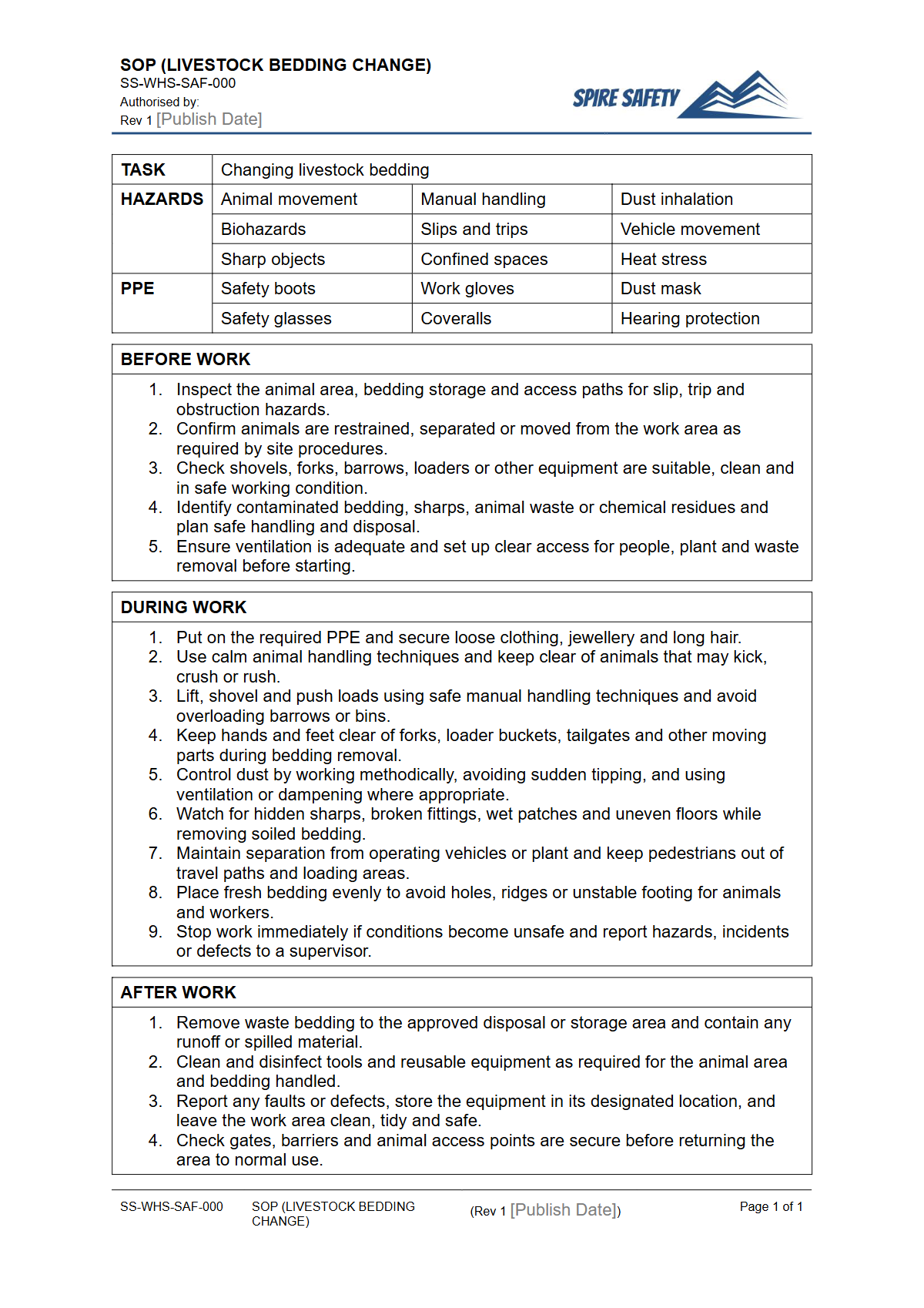
Managing the health and safety of workers in an agricultural setting requires clear, repeatable processes for common tasks. This Free Safe Operating Procedure (Livestock Bedding Change) Template provides a structured starting point for documenting the risks and controls associated with cleaning and replacing bedding in animal enclosures.
Using an SOP helps standardise the task, ensuring everyone performs it the same safe way, every time. It prompts a formal consideration of hazards such as manual handling, respiratory exposure to dust and ammonia, and interaction with livestock and machinery.
Key risks addressed in a structured SOP include musculoskeletal injuries from lifting heavy bedding or awkward postures, slips and trips on uneven surfaces, and exposure to biological hazards. The procedure also guides the safe use of equipment, which may range from simple hand tools like forks and shovels to mechanised plant.
For tasks involving powered equipment, a specific SOP like our FREE Telehandler SOP Template should be developed and used in conjunction with this one.
Video walkthrough
How to use the Free Safe Operating Procedure (Livestock Bedding Change) Template
This document is a template, not a finished product. To be effective, it must be adapted to your specific operational needs.
Download the DOCX file and consult with your workers—the people who actually perform the task—to fill in the details. Your customisation should reflect the exact type of livestock, enclosure design, bedding material, and equipment used at your workplace.
It should also specify the personal protective equipment (PPE) required, such as respiratory protection, gloves, and safety boots.
Important: This is a generic template aligned with Australian WHS principles. We are not WHS consultants for your business just because you download it.
You must customise this document to reflect the specific hazards and control measures relevant to your site. It should be integrated into your broader WHS management systems to ensure it is reviewed, updated, and used correctly as part of your overall safety framework.
Implementing the SOP
Once customised, the SOP should be used as a primary tool for training and competency assessment. All workers required to change livestock bedding must be trained on the procedure and its contents.
Supervisors should use it to monitor that the agreed safe work methods are being followed. Displaying the SOP in a visible location near the work area, such as a break room or equipment shed, can serve as a constant reminder of the required safety standards.
When to use it
A Safe Operating Procedure for livestock bedding changes should be developed and implemented before any worker undertakes the task. It forms a crucial part of the induction process for new employees. Furthermore, the SOP should be reviewed and used for refresher training:
- At regular, scheduled intervals (e.g., annually).
- Whenever the task changes, such as the introduction of new equipment or bedding material.
- After any incident, accident, or near-miss related to the task.
- When legislative requirements or industry best practices are updated.
Regular reviews ensure the procedure remains relevant and effective in controlling risks. This proactive approach is fundamental to maintaining a safe work environment on any farm or livestock operation.
Spire Safety has a wide range of templates for agricultural tasks, such as our FREE Grain Drill SOP Template, which can help build a comprehensive safety system.
Who should use it
This SOP template is designed for anyone with responsibility for workplace health and safety in an agricultural or livestock-handling environment. This includes:
- Farm Owners and Managers (PCBUs): To meet their primary duty of care by providing a safe system of work.
- Supervisors: To train workers, enforce safe procedures, and conduct workplace inspections.
- Workers: To understand the steps and safety precautions required to perform the task safely.
- WHS Officers and Consultants: As a foundational document for developing site-specific risk management plans.
Proper documentation is vital for demonstrating compliance and fostering a strong safety culture. For tasks involving work at height, such as accessing bedding stored in a loft, you should also implement specific procedures like those outlined in our FREE Step Ladder SOP Template. If you need assistance tailoring this or other documents, our WHS consulting team can provide expert guidance.
You can also browse our complete free WHS resources library for more templates.
Common mistakes
Common mistakes to avoid
- Failing to customise the generic template for the specific farm, animal, and equipment used.
- Not providing or enforcing the use of appropriate Personal Protective Equipment (PPE), especially P2-rated respiratory masks.
- Neglecting to train workers on the finalised SOP and confirm they understand the procedures.
- Using machinery, like skid-steer loaders, that is too large for the enclosed space, creating crush and exhaust fume hazards.
Legal references
Legal considerations
The following legal requirements may be relevant to this type of work.
- Work Health and Safety Act (Harmonised) — Provides the primary duties for protecting workers and other people from work health and safety risks.
- Work Health and Safety Regulations (Harmonised) — Sets out requirements supporting the management of workplace hazards and risks.
The following codes may be relevant to this type of work.
- Managing WHS Risks Code of Practice — Provides practical guidance on identifying hazards, assessing risks and applying effective controls.
- Work Health and Safety Consultation, Cooperation and Coordination Code of Practice — Provides practical guidance on consulting workers and coordinating with other duty holders.
- Managing the Work Environment and Facilities Code of Practice — Provides practical guidance on safe work environments, workplace facilities and related controls.
Did you know
Respiratory Risks
Organic dust toxic syndrome (ODTS) and farmer's lung are serious respiratory diseases caused by inhaling high concentrations of dust, mould spores, and endotoxins common in agricultural environments like dusty animal bedding.
Injury Statistics
The agriculture, forestry, and fishing industry consistently has one of the highest rates of serious workers' compensation claims in Australia, with body stressing (manual handling) being a leading cause of injury.
FAQ
Frequently asked questions
01What are the main hazards when changing livestock bedding?
02Is an SOP legally required for changing livestock bedding in Australia?
03How often should I review my Livestock Bedding Change SOP?
04Can I use this template for different types of livestock like poultry and cattle?
Share this resource
Free Safe Operating Procedure (Livestock Bedding Change) Template
Browse Categories
How To Use It
- 1Download and open in Word or PDF.
- 2Replace the placeholders with your business details.
- 3Get it reviewed by a WHS specialist before rollout.
Need it customised?
Our WHS consultants can adapt this template to your site, run a gap analysis, or audit what you already have in place.
Book a Free Consultation WHS consulting servicesor call 1300 156 382
Related templates
- Free Safe Operating Procedure (Livestock Ear Tagging) Template
- Free Safe Operating Procedure (Livestock Feed Handling) Template
- Free Safe Operating Procedure (Livestock Gate Handling) Template
- Free Safe Operating Procedure (Livestock Yard Cleaning) Template
- Free Safe Operating Procedure (LNG Refuelling) Template
- Free Safe Operating Procedure (Load Bay Allocation) Template