
Free Safe Operating Procedure (Litter Trap Inspection) Template
Download our free Safe Operating Procedure for litter trap inspections. This DOCX & PDF template helps you document safe work steps. Download your free SOP now.
Free Safe Operating Procedure (Litter Trap Inspection) Template
DOCX • 126 KB + PDF
Updated Oct 2026
No signup required
Purpose of the Free Safe Operating Procedure (Litter Trap Inspection) Template
Effectively managing stormwater quality is crucial, and litter traps (also known as Gross Pollutant Traps or GPTs) are a key component. However, inspecting and cleaning these devices introduces significant workplace hazards.
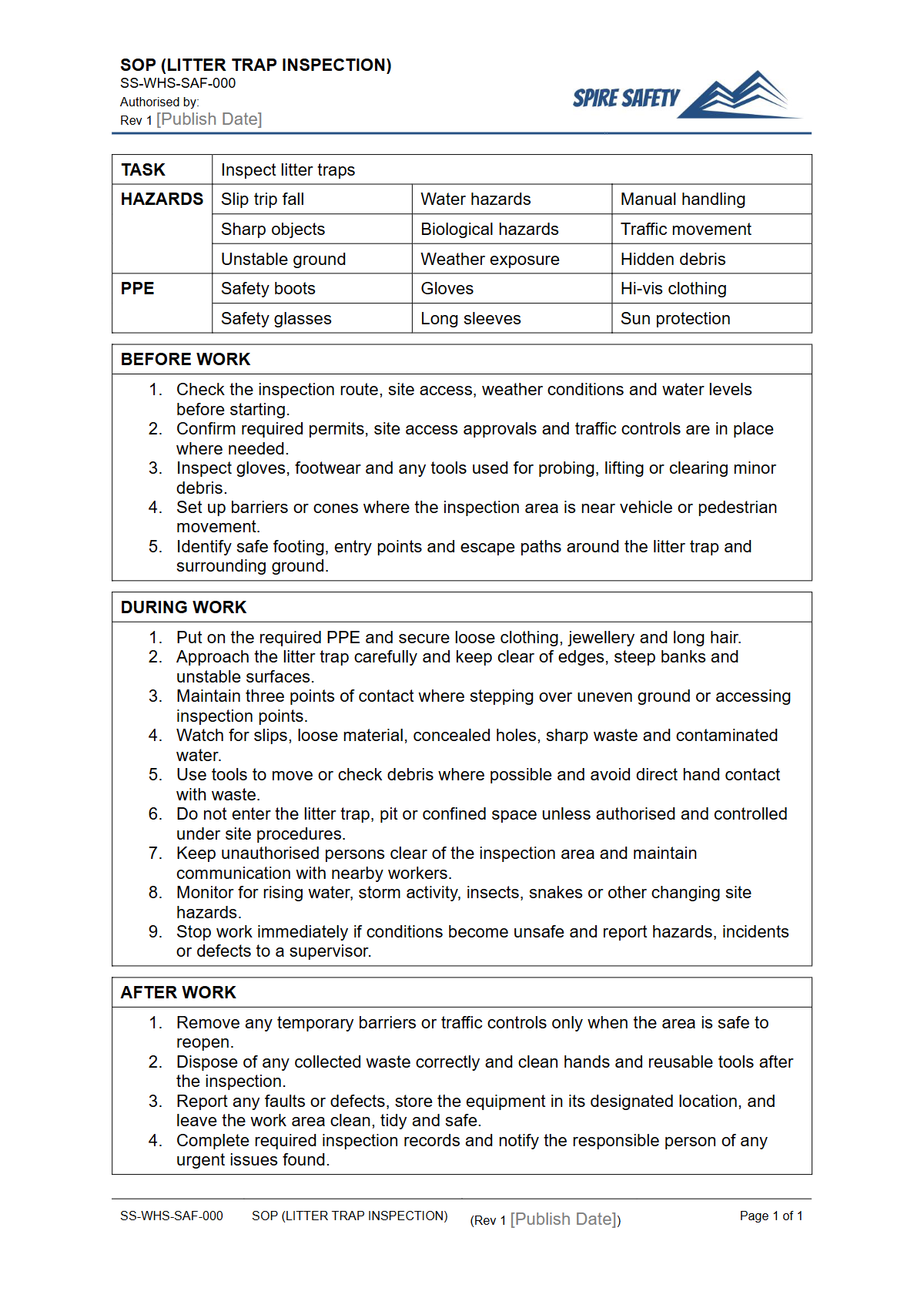
This free Safe Operating Procedure (Litter Trap Inspection) template provides a structured starting point for documenting the required safety measures for this common maintenance task. It is designed to help your organisation formalise a safe system of work, manage risks, and ensure workers are protected.
Using a standardised Safe Operating Procedure helps to clearly outline the step-by-step process, identify potential hazards, and specify the control measures needed. Key risks associated with litter trap maintenance can include manual handling injuries from lifting heavy grates, slips and trips on wet or uneven surfaces, exposure to biological hazards from stagnant water and decaying matter, and potential atmospheric hazards if the trap is considered a confined space.
This template helps you address these risks in a systematic way.
What's included in the template?
This downloadable Safe Operating Procedure template is aligned with Australian WHS principles and provides sections to detail:
- Required personal protective equipment (PPE)
- Pre-operational checks and site assessment
- A step-by-step guide for performing the inspection safely
- Potential hazards and their corresponding control measures
- Emergency procedures and contacts
- Post-task cleanup and reporting requirements
Video walkthrough
How to use the Free Safe Operating Procedure (Litter Trap Inspection) Template
To implement this Safe Operating Procedure effectively, you should download the DOCX file and adapt it to your unique operational context. A generic document cannot account for the specific equipment, environment, and personnel at your workplace.
A robust safety process involves consultation and customisation.
The process should involve reviewing the template with the workers who will be performing the task, as well as their supervisors. Walk through the steps on-site to identify any location-specific hazards, such as nearby vehicle traffic, poor lighting, or difficult access points.
This collaborative approach ensures the final SOP is practical, relevant, and understood by those who rely on it for their safety. Integrating this SOP into a comprehensive WHS management system ensures it is part of a cycle of continuous improvement.
IMPORTANT: This is a template only. We are not familiar with your specific site, equipment, or operational context.
You MUST customise this document in consultation with your team to ensure it reflects the specific risks and control measures relevant to your workplace.
When to use it
A Safe Operating Procedure for litter trap inspection should be used consistently as a primary reference tool for the task. It is not a document to be filed away and forgotten. It should be actively used:
- Before every litter trap inspection or cleaning job.
- As a training document for new employees or workers new to the task.
- As a basis for pre-start meetings or toolbox talks.
- During refresher training sessions to reinforce safe work practices.
- As a reference document during formal WHS compliance audits.
Who should use it
This template is designed for use by any person or business responsible for maintaining property and infrastructure where litter traps are installed. This includes:
- Persons Conducting a Business or Undertaking (PCBUs): To meet their primary duty of care to ensure worker safety.
- Facility and Property Managers: For scheduling and overseeing safe maintenance activities.
- Maintenance Workers and Operators: As a practical guide to performing their job safely.
- WHS Managers and Advisors: As a tool to standardise procedures and facilitate risk management.
Properly defining roles and responsibilities within the SOP is critical. If you require assistance in developing complex procedures or assessing high-risk tasks, engaging specialist WHS consulting can provide valuable expertise and oversight.
In some cases, accessing a litter trap may require more than just lifting a grate. If elevated platforms or ladders are needed to reach the inspection point, a specific step ladder SOP should also be referenced to control risks associated with working at heights.
Furthermore, litter trap maintenance often occurs within a broader context of civil or groundwork. It is important to consider how this task interacts with other site activities.
For example, if excavation work is happening nearby, procedures like a safe operating procedure for trenchers must be followed to prevent collapses or other incidents that could affect the inspection team.
By using this template as a foundation, you can build a robust safety document that protects your workers and helps maintain environmental compliance. For more templates and safety guides, explore our full free WHS resources library.
Common mistakes
Common mistakes to avoid
- Using the template as-is without customising it for site-specific conditions.
- Failing to properly assess if the litter trap constitutes a confined space, which requires specific entry procedures.
- Neglecting to provide workers with adequate training on the finalised SOP.
- Not inspecting or providing the correct personal protective equipment (PPE) for the task.
Legal references
Legal considerations
The following legal requirements may be relevant to this type of work.
- Work Health and Safety Act (Harmonised) — Provides the primary duties for protecting workers and other people from work health and safety risks.
- Work Health and Safety Regulations (Harmonised) — Sets out requirements supporting the management of workplace hazards and risks.
The following codes may be relevant to this type of work.
- Managing WHS Risks Code of Practice — Provides practical guidance on identifying hazards, assessing risks and applying effective controls.
- Work Health and Safety Consultation, Cooperation and Coordination Code of Practice — Provides practical guidance on consulting workers and coordinating with other duty holders.
- Managing the Work Environment and Facilities Code of Practice — Provides practical guidance on safe work environments, workplace facilities and related controls.
Did you know
What's in a Name?
Litter traps are often referred to as Gross Pollutant Traps (GPTs). They are engineered to capture solid waste, sediment, and attached pollutants from stormwater runoff before it enters waterways.
Slips and Trips
Slips, trips, and falls are a leading cause of workplace injury in Australia, making documented controls for work in wet or slippery environments, like those around litter traps, critically important.
FAQ
Frequently asked questions
01What are the main hazards of inspecting a litter trap?
02How often should a Safe Operating Procedure be reviewed?
03Is an SOP legally required for litter trap inspection in Australia?
04Can I use this SOP template for cleaning oil-water separators?
Share this resource
Free Safe Operating Procedure (Litter Trap Inspection) Template
Browse Categories
How To Use It
- 1Download and open in Word or PDF.
- 2Replace the placeholders with your business details.
- 3Get it reviewed by a WHS specialist before rollout.
Need it customised?
Our WHS consultants can adapt this template to your site, run a gap analysis, or audit what you already have in place.
Book a Free Consultation WHS consulting servicesor call 1300 156 382
Related templates
- Free Safe Operating Procedure (Livestock Bedding Change) Template
- Free Safe Operating Procedure (Livestock Ear Tagging) Template
- Free Safe Operating Procedure (Livestock Feed Handling) Template
- Free Safe Operating Procedure (Livestock Gate Handling) Template
- Free Safe Operating Procedure (Livestock Yard Cleaning) Template
- Free Safe Operating Procedure (LNG Refuelling) Template