
Free Safe Operating Procedure (Linen Cupboard Restock) Template
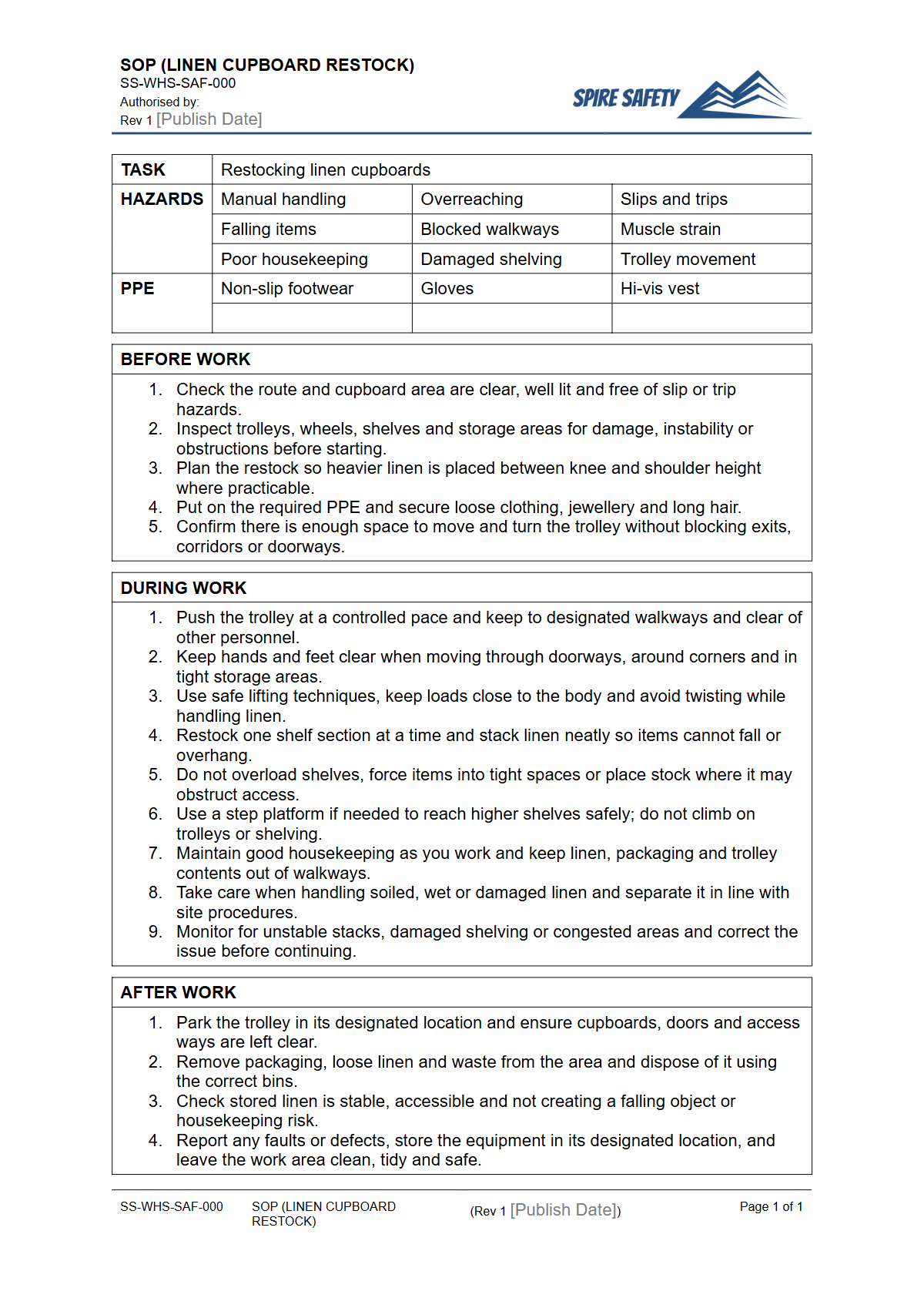
Download our free Safe Operating Procedure for linen cupboard restocking. This customisable DOCX & PDF template helps define safe work steps for your team.
Free Safe Operating Procedure (Linen Cupboard Restock) Template
DOCX • 126 KB + PDF
Updated Oct 2026
No signup required
Purpose of the Free Safe Operating Procedure (Linen Cupboard Restock) Template
Restocking a linen cupboard might seem like a simple administrative task, but it carries genuine work health and safety risks. This Free Safe Operating Procedure (Linen Cupboard Restock) Template provides a structured starting point for any organisation to document and control the hazards associated with this common activity.
A Safe Operating Procedure (SOP), also known as a Safe Work Procedure (SWP), breaks down a task into a logical sequence of steps, highlighting potential hazards and outlining the required safety controls for each one.
The primary purpose of this template is to help you manage risks such as hazardous manual tasks (lifting heavy bundles of linen, pushing and pulling loaded trolleys), awkward postures, and over-reaching. It also prompts consideration of environmental hazards like slips, trips, and falls from spills or clutter.
For tasks involving high shelving, workers may need to use access equipment. You must ensure a separate procedure exists for this, such as our FREE Step Ladder SOP (Safe Operating Procedure) Template, and that workers are trained in its use.
Video walkthrough
How to use the Free Safe Operating Procedure (Linen Cupboard Restock) Template
This resource is available for immediate download in both DOCX and PDF formats. The DOCX version is fully editable, allowing you to tailor it to your specific workplace requirements.
Effective safety management requires more than just a generic document; it demands a procedure that reflects your unique operational context.
It is crucial to remember that this is a template, not a finished document. We have designed it as a starting point, and you must consult with your team to customise it to reflect the specific equipment, environment, and risks present in your workplace. A Person Conducting a Business or Undertaking (PCBU) has a primary duty of care to ensure safe systems of work, which includes developing procedures in consultation with the workers who will perform the task. If you require expert assistance in risk assessment and procedure development, consider engaging professional WHS consulting services.
When to use a Safe Operating Procedure
An SOP for restocking linen cupboards should be a core part of your safety management system. It is most effectively used during the induction and training of new employees in roles within hospitality, healthcare, or accommodation services.
It also serves as an excellent tool for refresher training for existing staff to reinforce safe work habits and introduce any changes to the process.
The procedure should be readily available near the work area for easy reference. It is a critical document to review following any incident or near-miss related to the task, and should be regularly reviewed as part of a scheduled process to ensure it remains current and effective. Integrating this SOP into your broader safety framework helps maintain a consistent approach to risk management across your entire organisation, forming a key component of effective WHS management systems.
Who should use this template
This template is designed for use by anyone responsible for health and safety within an organisation. This typically includes WHS Managers, Health and Safety Representatives (HSRs), Supervisors, and Team Leaders.
It provides them with a clear and logical framework to formalise procedures, train staff, and monitor safe work practices.
Ultimately, the PCBU is responsible for ensuring such procedures are in place and are effective. This template assists them in fulfilling their duty of care.
To ensure these procedures are being followed correctly on the ground, organisations can conduct internal reviews. For a more formal verification of your safety processes against legislative requirements, you may wish to undertake periodic WHS compliance auditing.
Related Safety Documents
A single task often exists within a web of related safety requirements. For instance, in a healthcare or large accommodation facility, the linen cupboard may be located near first aid stations or emergency equipment.
While this SOP covers the restocking task, staff may also need to be familiar with the use of equipment stored in the vicinity. A well-organised safety system ensures all relevant procedures are documented and accessible, such as a Free Safe Operating Procedure (Defibrillator Operation) Template if one is located nearby.
Thinking about how procedures connect helps build a more robust safety culture.
By implementing a clear, task-specific Safe Operating Procedure, you provide your team with the guidance they need to perform their duties safely and efficiently. Explore our full free WHS resources library for more templates to support your safety management system.
Common mistakes
Common mistakes to avoid
- Using a generic SOP template without customising it for the specific workplace, equipment, and environment.
- Failing to adequately train workers on the final, approved procedure and verify their understanding.
- Not making the SOP easily accessible to workers in the area where the task is performed.
- Neglecting to review and update the SOP after an incident, near-miss, or change in process.
Legal references
Legal considerations
The following legal requirements may be relevant to this type of work.
- Work Health and Safety Act (Harmonised) — Provides the primary duties for protecting workers and other people from work health and safety risks.
- Work Health and Safety Regulations (Harmonised) — Sets out requirements supporting the management of workplace hazards and risks.
The following codes may be relevant to this type of work.
- Managing WHS Risks Code of Practice — Provides practical guidance on identifying hazards, assessing risks and applying effective controls.
- Work Health and Safety Consultation, Cooperation and Coordination Code of Practice — Provides practical guidance on consulting workers and coordinating with other duty holders.
- Managing the Work Environment and Facilities Code of Practice — Provides practical guidance on safe work environments, workplace facilities and related controls.
Did you know
Manual Handling Statistics
According to Safe Work Australia, injuries resulting from muscular stress while lifting, carrying, or putting down objects are one of the most common causes of serious workers' compensation claims.
Sector Risk
Workers in the Accommodation and Food Services and Health Care and Social Assistance industries frequently perform tasks involving manual handling, making documented procedures for activities like restocking essential for risk reduction.
FAQ
Frequently asked questions
01What are the main hazards when restocking a linen cupboard?
02Does this SOP template meet Australian WHS legal requirements?
03Who is responsible for creating an SOP for linen cupboard restocking?
04How often should a Safe Operating Procedure be reviewed?
Share this resource
Free Safe Operating Procedure (Linen Cupboard Restock) Template
Browse Categories
How To Use It
- 1Download and open in Word or PDF.
- 2Replace the placeholders with your business details.
- 3Get it reviewed by a WHS specialist before rollout.
Need it customised?
Our WHS consultants can adapt this template to your site, run a gap analysis, or audit what you already have in place.
Book a Free Consultation WHS consulting servicesor call 1300 156 382
Related templates
- Free Safe Operating Procedure (Linen Trolley) Template
- Free Safe Operating Procedure (Liquid Nitrogen Use) Template
- Free Safe Operating Procedure (Litter Trap Cleaning) Template
- Free Safe Operating Procedure (Litter Trap Inspection) Template
- Free Safe Operating Procedure (Livestock Bedding Change) Template
- Free Safe Operating Procedure (Livestock Ear Tagging) Template