
Free Safe Operating Procedure (Linen Trolley) Template
Download our free Safe Operating Procedure (Linen Trolley) Template to manage manual handling risks in healthcare, hospitality, and laundry settings.
Free Safe Operating Procedure (Linen Trolley) Template
DOCX • 126 KB + PDF
Updated Oct 2026
No signup required
Purpose of the Free Safe Operating Procedure (Linen Trolley) Template
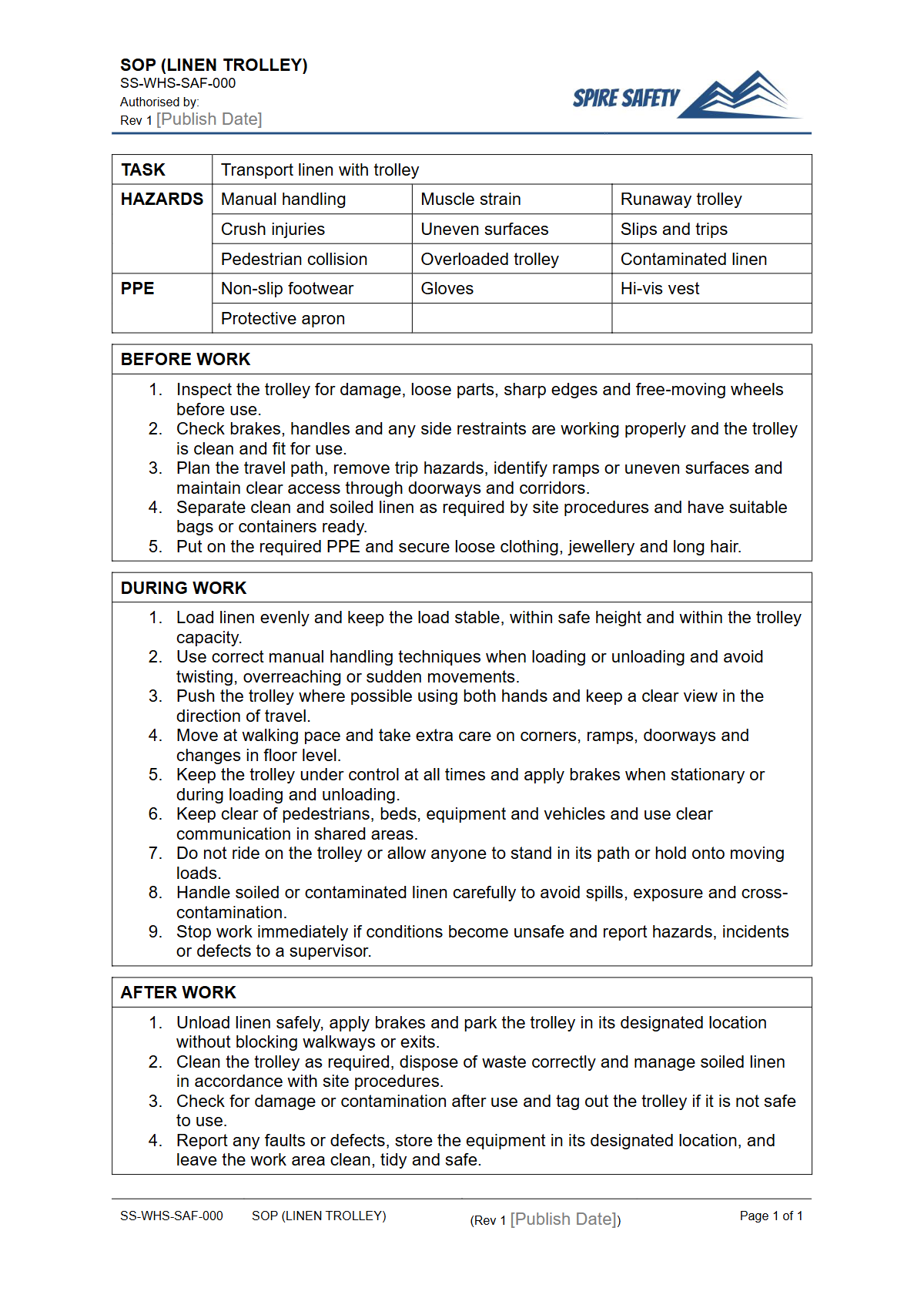
This free Safe Operating Procedure (Linen Trolley) Template provides a structured framework for documenting the safe use of linen trolleys in your workplace. Its primary purpose is to help Persons Conducting a Business or Undertaking (PCBUs) manage risks associated with manual tasks, specifically those involving pushing, pulling, and manoeuvring loaded trolleys.
By clearly outlining hazards, control measures, and step-by-step instructions, this SOP helps protect workers from musculoskeletal injuries, slips, trips, and falls commonly linked to this activity in healthcare, accommodation, and laundry service environments.
A documented SOP serves as a critical training tool and a reference point for workers, ensuring a consistent and safe approach is adopted across your entire organisation. It formalises expectations for pre-operational checks, safe loading, movement, and unloading procedures. Implementing a specific SOP for equipment like this demonstrates a commitment to proactive risk management and is a fundamental component of effective WHS management systems.
Video walkthrough
How to use the Free Safe Operating Procedure (Linen Trolley) Template
Using this Safe Operating Procedure (Linen Trolley) Template is straightforward. First, download the file in your preferred format (DOCX for easy editing or PDF).
Next, review the document in consultation with workers who regularly use linen trolleys. Their direct experience is invaluable for identifying specific site-based hazards, such as sloped corridors, tight corners, or specific flooring types that may affect trolley movement.
The template is designed as a starting point, covering common hazards and controls aligned with Australian WHS practice.
You must adapt the content to reflect your unique operational context. This includes adding site-specific details, specifying the types of trolleys used, and detailing your emergency procedures.
Once customised, the SOP should be used for training all relevant staff and for ongoing refresher sessions. For other simple equipment, you may also find our free Step Ladder SOP useful as a comparative guide for procedure development.
Important: This document is a template and must be customised to suit the specific equipment, environment, and tasks at your workplace. We are not liable for any incidents that may occur from the use of this document.
It is your responsibility to ensure the final procedure is comprehensive and reflects the actual risks present.
When to use it
A Safe Operating Procedure for linen trolleys should be developed and implemented before workers are first required to use the equipment. It should be a core part of the induction and training process for new employees in roles such as housekeeping, patient services, or laundry operations.
The SOP must be readily accessible in the work area for quick reference. It should also be formally reviewed whenever there is a change to the task, equipment, or environment, after an incident or near-miss occurs, or on a scheduled periodic basis (e.g., annually) as part of your standard safety review process.
Who should use it
This SOP is intended for use by all personnel involved with linen trolleys. This includes the workers who use them daily, their direct supervisors who are responsible for overseeing safe work practices, and WHS managers responsible for risk assessment and procedure development.
Health and Safety Representatives (HSRs) can also use this template to facilitate consultation with their work group about manual handling risks. In a healthcare setting, this procedure should be integrated with other safety protocols, such as those outlined in a Safe Operating Procedure for Defibrillator Operation, to form a holistic approach to workplace safety.
Ultimately, anyone in a PCBU role has a duty of care to provide safe systems of work, and this customisable SOP is a practical tool to help fulfil that obligation. If you require assistance in adapting this template or conducting the necessary risk assessments, engaging specialist WHS consulting can provide expert guidance. For more templates and safety documents, browse our complete free WHS resources library.
Common mistakes
Common mistakes to avoid
- Overloading the trolley, which obstructs the operator's view and increases the force required to move it.
- Using poor posture, such as twisting the back or leaning too far forward, instead of using body weight to push.
- Neglecting pre-use checks, particularly for wheel condition, brakes, and structural integrity.
- Failing to customise the SOP to account for site-specific hazards like ramps, doorways, or floor surfaces.
Legal references
Legal considerations
The following legal requirements may be relevant to this type of work.
- Work Health and Safety Act (Harmonised) — Provides the primary duties for protecting workers and other people from work health and safety risks.
- Work Health and Safety Regulations (Harmonised) — Sets out requirements supporting the management of workplace hazards and risks.
The following codes may be relevant to this type of work.
- Managing WHS Risks Code of Practice — Provides practical guidance on identifying hazards, assessing risks and applying effective controls.
- Work Health and Safety Consultation, Cooperation and Coordination Code of Practice — Provides practical guidance on consulting workers and coordinating with other duty holders.
- Managing the Work Environment and Facilities Code of Practice — Provides practical guidance on safe work environments, workplace facilities and related controls.
Did you know
Manual Handling Impact
According to Safe Work Australia, manual handling injuries are the most common type of workplace injury in the country, with the Health care and social assistance industry having one of the highest rates of serious claims.
Wheel Condition
A trolley's wheels have a significant impact on the force required to move it. Worn, damaged, or incorrect wheel types can increase the pushing and pulling effort by over 30%, elevating the risk of a musculoskeletal injury.
FAQ
Frequently asked questions
01What are the main hazards of using a linen trolley?
02How often should a Safe Operating Procedure for a linen trolley be reviewed?
03Does operating a linen trolley require specific training?
04Can this SOP be used for other types of trolleys, like mail or food trolleys?
Share this resource
Free Safe Operating Procedure (Linen Trolley) Template
Browse Categories
How To Use It
- 1Download and open in Word or PDF.
- 2Replace the placeholders with your business details.
- 3Get it reviewed by a WHS specialist before rollout.
Need it customised?
Our WHS consultants can adapt this template to your site, run a gap analysis, or audit what you already have in place.
Book a Free Consultation WHS consulting servicesor call 1300 156 382
Related templates
- Free Safe Operating Procedure (Liquid Nitrogen Use) Template
- Free Safe Operating Procedure (Litter Trap Cleaning) Template
- Free Safe Operating Procedure (Litter Trap Inspection) Template
- Free Safe Operating Procedure (Livestock Bedding Change) Template
- Free Safe Operating Procedure (Livestock Ear Tagging) Template
- Free Safe Operating Procedure (Livestock Feed Handling) Template