
Free Safe Operating Procedure (Liquid Nitrogen Use) Template
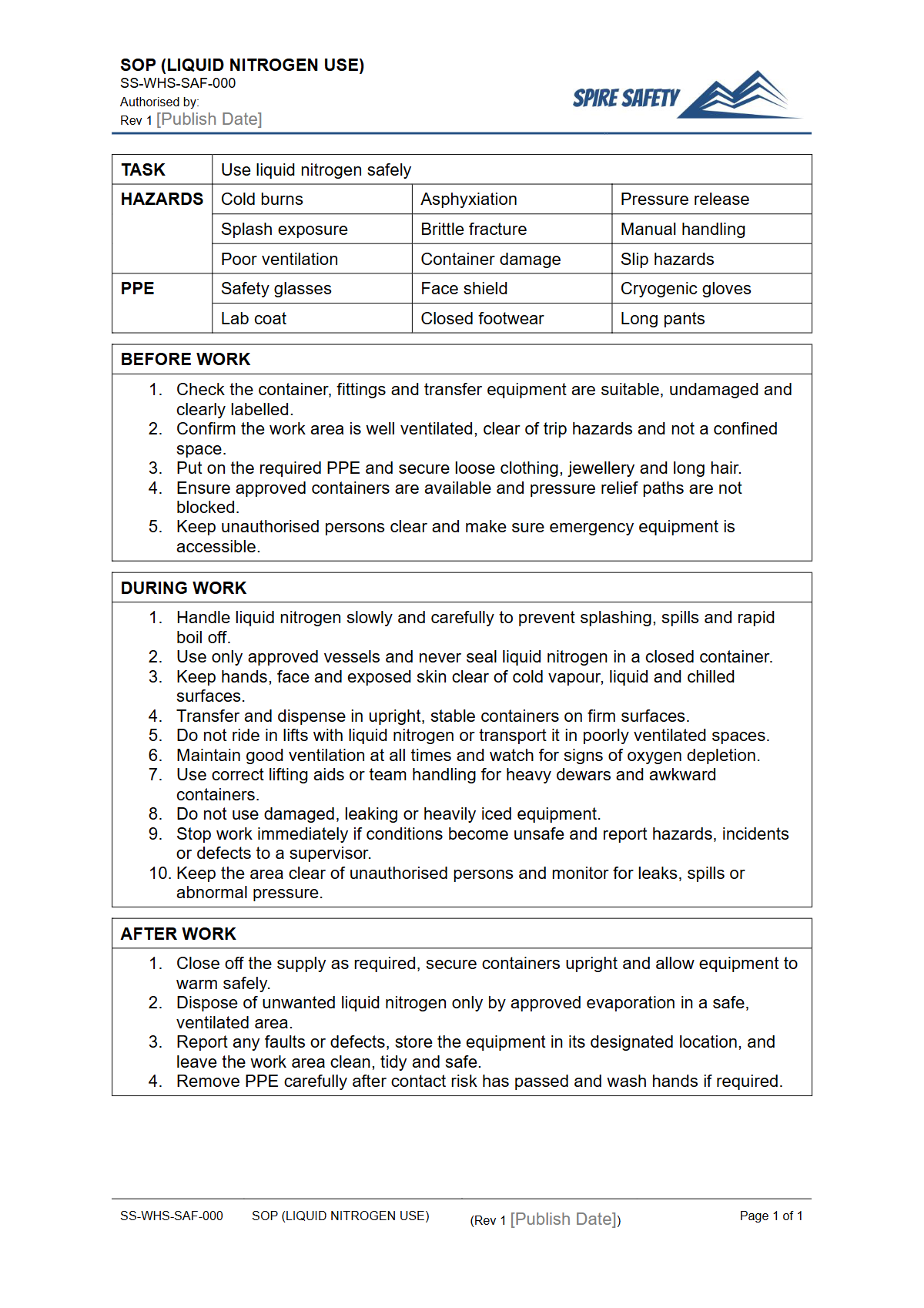
Download our free Safe Operating Procedure (SOP) for liquid nitrogen use. This customisable DOCX and PDF template helps outline safety steps. Get yours now.
Free Safe Operating Procedure (Liquid Nitrogen Use) Template
DOCX • 126 KB + PDF
Updated Oct 2026
No signup required
Purpose of the Free Safe Operating Procedure (Liquid Nitrogen Use) Template
This Free Safe Operating Procedure (Liquid Nitrogen Use) Template provides a structured starting point for organisations to document the safe handling of liquid nitrogen (LN2). Liquid nitrogen is a cryogenic hazardous substance that poses significant risks, including severe cold burns (frostbite), asphyxiation in poorly ventilated areas, and over-pressurisation of containers.
A documented Safe Operating Procedure (SOP) is a critical administrative control measure to ensure workers understand these hazards and follow specific steps to mitigate them. A documented procedure is a cornerstone of a safe workplace, whether you're dealing with hazardous chemicals or complex machinery like that covered in our FREE Plasma Cutter SOP Template.
Using this template helps you establish clear, consistent instructions for all tasks involving liquid nitrogen, from decanting and transport to storage and emergency response. It is designed to be aligned with Australian WHS principles and provides a robust framework for developing a site-specific safety document.
Video walkthrough
How to use the Free Safe Operating Procedure (Liquid Nitrogen Use) Template
This resource is available as an editable DOCX file, allowing for full customisation. After downloading, you will need to methodically work through each section, replacing the placeholder text with information relevant to your specific operational context.
This includes detailing the exact types of dewars or containers used, your site’s storage locations, specific emergency contacts, and the makes and models of any associated equipment.
Important Note: This is a template, not a finished document. You must customise it to reflect the specific equipment, environment, personal protective equipment (PPE), and control measures unique to your workplace.
We recommend a competent person reviews and approves the final document before implementation. Failure to tailor this SOP to your specific circumstances could result in a non-effective procedure and compromise worker safety.
When to use it
A Safe Operating Procedure for liquid nitrogen should be in place and readily accessible before any worker is required to handle, transport, or work in proximity to LN2. It is an essential document for any workplace where liquid nitrogen is used, including research laboratories, medical and veterinary clinics, manufacturing facilities, and food processing plants.
SOPs should be formally integrated into your broader WHS management systems and used as a primary reference during worker training, induction, and competency assessments.
Key Elements of the Safe Operating Procedure
Our template prompts you to address the critical safety components required for managing liquid nitrogen risks. A comprehensive SOP is more than just a list of steps; it's a complete safety guide for a specific task.
Hazard Identification
The first step is clearly identifying the potential dangers. The template covers the primary hazards of LN2: extreme cold, asphyxiation from nitrogen gas displacing oxygen, and the potential for rapid gas expansion causing pressure build-up (rupture) in sealed containers.
Step-by-Step Instructions
The core of the SOP is the detailed, sequential instructions for performing the task safely. This should cover pre-operational checks (e.g., assessing ventilation, inspecting PPE), the decanting or handling process itself, and post-task procedures for cleanup and storage. While this SOP focuses on a hazardous substance, procedures are just as critical for equipment like in our Free Air Compressor SOP Template.
Emergency Procedures
Clarity during an emergency is vital. This section must outline the exact steps to take in case of a spill, skin contact, or an oxygen depletion alarm sounding.
It should include emergency contact numbers and the location of safety equipment like first aid kits and emergency showers. These specific response actions are a key part of any procedural document, similar to what is outlined in our Safe Operating Procedure for Defibrillator Operation.
Integrating SOPs into Your WHS System
A Safe Operating Procedure is most effective when it's treated as a living document within a proactive safety culture. It should not be written once and filed away.
Ensure all relevant workers are trained on the SOP's contents, and that this training is documented. Supervisors should periodically verify that the steps outlined in the SOP are being followed correctly in practice. The effectiveness of your procedures, including this one, can be verified as part of regular WHS compliance audits.
Beyond the Template
This template is a foundational tool, but it should be supported by other key WHS processes. Always base your SOP on a formal risk assessment.
Ensure you consult with your workers during the development of the procedure, as they have first-hand knowledge of the task. Finally, schedule regular reviews of the SOP (e.g., annually, or after any incident) to ensure it remains accurate and effective. For more tools to support your safety management, explore our complete free WHS resources library.
Common mistakes
Common mistakes to avoid
- Using incorrect gloves (e.g., leather or rubber) which can trap liquid against the skin and worsen burns.
- Handling or storing liquid nitrogen in poorly ventilated areas, creating a serious asphyxiation risk.
- Filling or sealing containers not specifically designed for cryogenic liquids, leading to dangerous pressure buildup and explosion.
- Transporting open or unsecure liquid nitrogen dewars in lifts or vehicles with passengers.
Legal references
Legal considerations
The following legal requirements may be relevant to this type of work.
- Work Health and Safety Act (Harmonised) — Provides the primary duties for protecting workers and other people from work health and safety risks.
- Work Health and Safety Regulations (Harmonised) — Sets out requirements supporting the management of workplace hazards and risks.
The following codes may be relevant to this type of work.
- Managing WHS Risks Code of Practice — Provides practical guidance on identifying hazards, assessing risks and applying effective controls.
- Work Health and Safety Consultation, Cooperation and Coordination Code of Practice — Provides practical guidance on consulting workers and coordinating with other duty holders.
- Managing the Work Environment and Facilities Code of Practice — Provides practical guidance on safe work environments, workplace facilities and related controls.
Did you know
Expansion Hazard
Liquid nitrogen expands to approximately 700 times its liquid volume when it vaporises. This is why adequate ventilation is non-negotiable to prevent oxygen displacement and why you must never seal it in a non-vented container.
Everyday Cryogenics
Beyond scientific research, liquid nitrogen is used in dermatology to remove skin lesions, in food production for flash-freezing, and by plumbers to create temporary ice plugs in pipes for repairs.
FAQ
Frequently asked questions
01Is a Safe Operating Procedure a legal requirement for using liquid nitrogen in Australia?
02What is the main hazard when using liquid nitrogen?
03How often should a liquid nitrogen SOP be reviewed?
04What PPE is essential for handling liquid nitrogen?
Share this resource
Free Safe Operating Procedure (Liquid Nitrogen Use) Template
Browse Categories
How To Use It
- 1Download and open in Word or PDF.
- 2Replace the placeholders with your business details.
- 3Get it reviewed by a WHS specialist before rollout.
Need it customised?
Our WHS consultants can adapt this template to your site, run a gap analysis, or audit what you already have in place.
Book a Free Consultation WHS consulting servicesor call 1300 156 382
Related templates
- Free Safe Operating Procedure (Litter Trap Cleaning) Template
- Free Safe Operating Procedure (Litter Trap Inspection) Template
- Free Safe Operating Procedure (Livestock Bedding Change) Template
- Free Safe Operating Procedure (Livestock Ear Tagging) Template
- Free Safe Operating Procedure (Livestock Feed Handling) Template
- Free Safe Operating Procedure (Livestock Gate Handling) Template