
Free Safe Operating Procedure (Lighting Circuit Test) Template
Download our free Safe Operating Procedure (Lighting Circuit Test) Template. This customisable DOCX and PDF helps manage electrical risks. Get started today.
Free Safe Operating Procedure (Lighting Circuit Test) Template
DOCX • 126 KB + PDF
Updated Oct 2026
No signup required
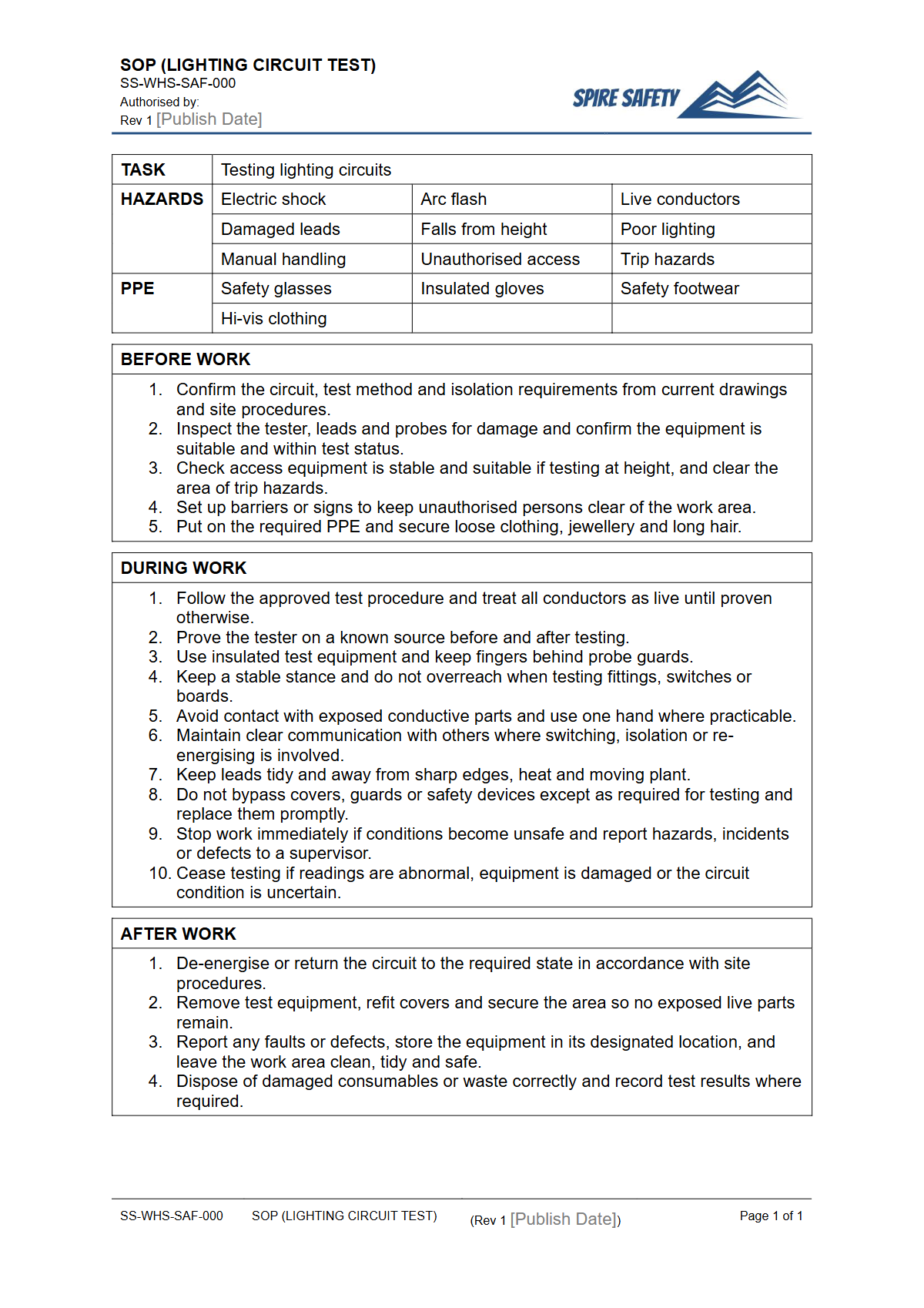
Purpose of the Free Safe Operating Procedure (Lighting Circuit Test) Template
Working with electricity poses significant risks, including electric shock, burns, and fire. This Free Safe Operating Procedure (Lighting Circuit Test) Template provides a structured framework for safely isolating and verifying the de-energisation of lighting circuits before any work begins.
A documented procedure is a critical control measure for managing electrical hazards, ensuring that workers follow a consistent, safe sequence of actions every time. It formalises the 'test-before-you-touch' principle, which is fundamental to preventing electrical incidents. By implementing this SOP, your organisation can demonstrate a commitment to electrical safety and build a key component of its effective WHS management systems.
Video walkthrough
How to use the Free Safe Operating Procedure (Lighting Circuit Test) Template
This template provides a comprehensive starting point, designed to be adapted to your specific workplace environment, equipment, and internal processes. After downloading the DOCX or PDF file, you must review and customise every section to reflect the unique context of your operations.
This includes adding site-specific details, listing the exact types of test equipment used, and referencing your organisation's specific permit-to-work or lockout-tagout (LOTO) systems. In the event of an electrical incident, immediate and correct response is crucial, which is why procedures like our Safe Operating Procedure for defibrillator operation are also vital components of a complete safety plan.
Important Customisation Note
This is a template, not a finished document. To be effective and support your WHS duties, you must customise it for your specific workplace.
We cannot provide a document that is compliant out-of-the-box because every workplace, task, and piece of equipment has unique risks. You must identify and assess the hazards specific to your site and integrate the necessary controls into this procedure.
When to use this Safe Operating Procedure
This Safe Operating Procedure should be used before commencing any task that requires interaction with a lighting circuit that is presumed to be de-energised. This includes activities such as:
- Replacing light fittings, ballasts, or drivers.
- Performing maintenance or repairs on lighting control systems.
- Adding or removing lights from an existing circuit.
- Investigating faults within a lighting circuit.
- Decommissioning old lighting infrastructure.
Consistently using and correctly documenting the steps in this SOP creates a verifiable record of safe practice, which can be invaluable as part of a robust WHS compliance audit trail.
Who should use this Safe Operating Procedure
This procedure is intended for use by competent and authorised personnel only. This typically includes licensed electricians and appropriately trained electrical workers who have demonstrated the skills and knowledge to perform electrical testing safely.
It is also a valuable resource for supervisors and managers responsible for overseeing electrical work, ensuring they understand the required safety protocols. Competency must be verified, and workers must be trained specifically on the procedure as it applies in their workplace. For other high-risk tasks requiring specific instructions, you might also need documents like our Plasma Cutter SOP. For a broader range of templates, you can explore our complete free WHS resources library.
Common mistakes
Common mistakes to avoid
- Assuming a circuit is de-energised after flipping a switch, without performing a physical test.
- Using a multimeter or tester that is faulty, not rated for the voltage, or has not been recently proven on a known live source.
- Failing to implement a personal danger tag and lock as part of a lockout-tagout (LOTO) procedure, allowing someone else to re-energise the circuit.
- Neglecting to wear appropriate PPE, such as insulated gloves and safety glasses, during the testing process.
Legal references
Legal considerations
The following legal requirements may be relevant to this type of work.
- Work Health and Safety Act (Harmonised) — Provides the primary duties for protecting workers and other people from work health and safety risks.
- Work Health and Safety Regulations (Harmonised) — Sets out requirements supporting the management of workplace hazards and risks.
The following codes may be relevant to this type of work.
- Managing WHS Risks Code of Practice — Provides practical guidance on identifying hazards, assessing risks and applying effective controls.
- Work Health and Safety Consultation, Cooperation and Coordination Code of Practice — Provides practical guidance on consulting workers and coordinating with other duty holders.
- Managing the Work Environment and Facilities Code of Practice — Provides practical guidance on safe work environments, workplace facilities and related controls.
Did you know
The Golden Rule
The principle of 'Test Before You Touch' or 'Prove De-energised' is the golden rule of electrical safety. It mandates that workers must never assume a circuit is off; they must physically test and verify it themselves before starting work.
RCDs Save Lives
Residual Current Devices (RCDs), or safety switches, are designed to quickly disconnect power when they detect a fault, but they should never be relied upon as the sole means of protection. Proper isolation and testing procedures remain mandatory.
FAQ
Frequently asked questions
01What is the primary purpose of a lighting circuit test SOP?
02Is this lighting circuit test template compliant with Australian electrical standards?
03Who is considered a 'competent person' for testing lighting circuits?
04What key information should be in a lighting circuit test SOP?
Share this resource
Free Safe Operating Procedure (Lighting Circuit Test) Template
Browse Categories
How To Use It
- 1Download and open in Word or PDF.
- 2Replace the placeholders with your business details.
- 3Get it reviewed by a WHS specialist before rollout.
Need it customised?
Our WHS consultants can adapt this template to your site, run a gap analysis, or audit what you already have in place.
Book a Free Consultation WHS consulting servicesor call 1300 156 382
Related templates
- Free Safe Operating Procedure (Line Marking) Template
- Free Safe Operating Procedure (Linen Cupboard Restock) Template
- Free Safe Operating Procedure (Linen Trolley) Template
- Free Safe Operating Procedure (Liquid Nitrogen Use) Template
- Free Safe Operating Procedure (Litter Trap Cleaning) Template
- Free Safe Operating Procedure (Litter Trap Inspection) Template