
Free Safe Operating Procedure (Lifting Beam) Template
Download our free Safe Operating Procedure (Lifting Beam) template.
Free Safe Operating Procedure (Lifting Beam) Template
DOCX • 126 KB + PDF
Updated Oct 2026
No signup required
Purpose of the Free Safe Operating Procedure (Lifting Beam) Template
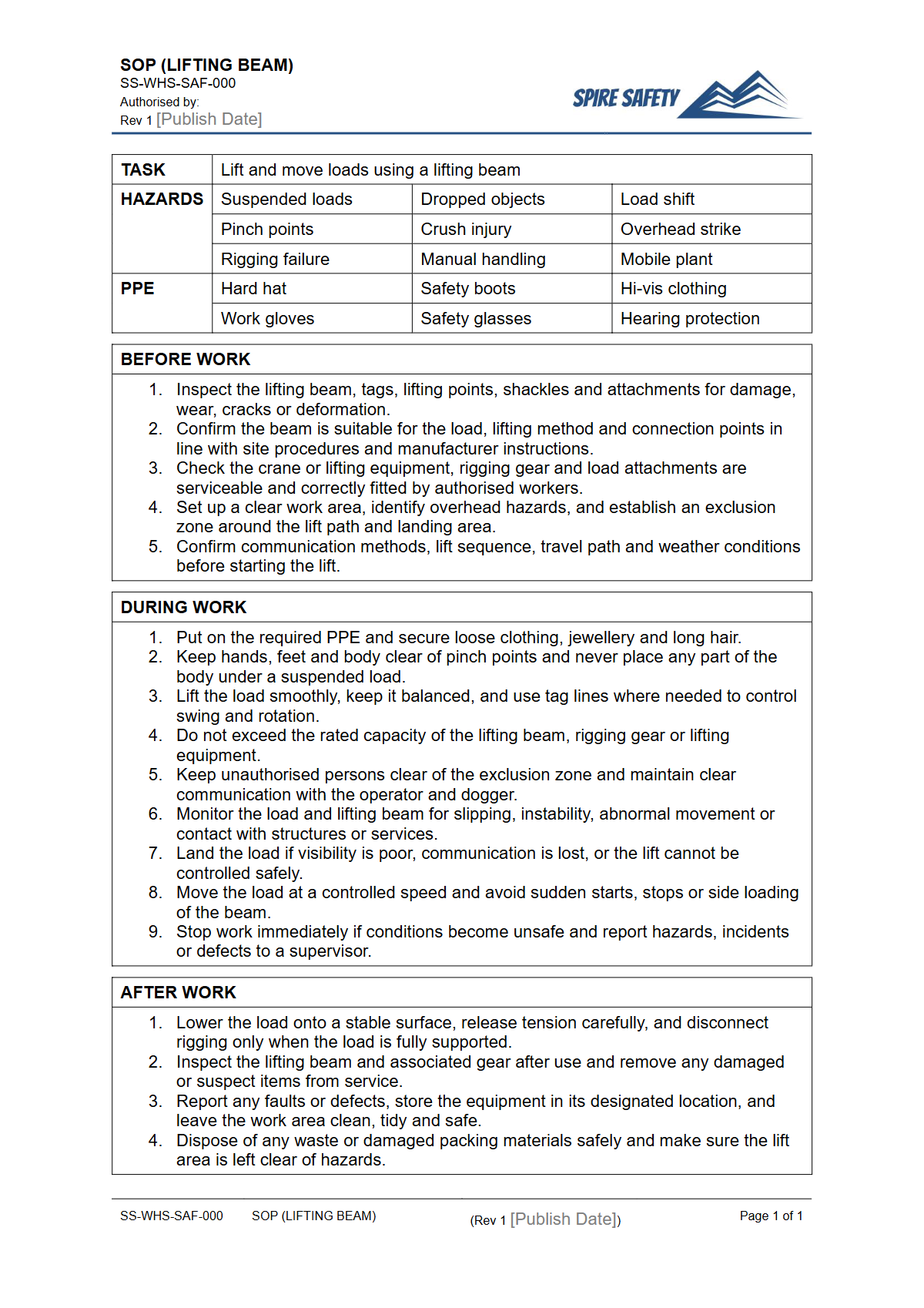
Using a lifting beam requires strict adherence to safety protocols to prevent catastrophic failures, property damage, and serious injury to personnel. Our Free Safe Operating Procedure (Lifting Beam) Template provides a structured framework to help you document the specific risks and control measures relevant to your operations.
This document serves as a vital tool for standardising work methods, ensuring all workers understand the required safety checks, operational steps, and emergency responses associated with lifting beam use.
The primary goal of this Safe Operating Procedure is to guide workers through the process of planning, setting up, and executing lifts safely. It formalises pre-operational checks, details correct attachment and rigging techniques, and outlines procedures for safely completing the lift and storing the equipment.
By implementing a thorough SOP, you create a repeatable and verifiable process that forms a key part of your risk management strategy for high-risk work.
Video walkthrough
How to use the Free Safe Operating Procedure (Lifting Beam) Template
This document is a template, not a finished procedure. To use it effectively, download the DOCX version and meticulously adapt it to your specific context.
You must incorporate details about the make and model of your lifting beams, the types of loads being lifted, the environment (e.g., workshop, construction site), and the competency requirements for your personnel. A generic procedure is insufficient for managing site-specific risks.
Important: You must customise this template to reflect the specific equipment, tasks, and control measures at your site. As a PCBU (Person Conducting a Business or Undertaking), it is your responsibility to ensure the procedure is suitable and sufficient for your workplace.
This SOP should integrate into your broader WHS management systems to be effective.
When to use it
A Safe Operating Procedure for a lifting beam should be consulted before any lifting operation begins. It is a critical document for several key activities:
- Worker Training: Use the SOP as a foundational document when inducting new employees or training workers on the specific procedures for using a lifting beam.
- Pre-Start Meetings and Toolbox Talks: Reference the SOP during daily briefings to reinforce safety requirements before work commences.
- Risk Assessments: The SOP supports the risk assessment process by documenting established control measures for identified hazards.
- Incident Investigations: Following a near-miss or incident, the SOP provides a baseline to review whether procedures were followed and if they need updating.
- Audits and Reviews: Procedures should be regularly reviewed as part of your WHS compliance auditing schedule to ensure they remain current and effective.
Who should use it
This Safe Operating Procedure is intended for all personnel involved in or responsible for lifting operations using a beam. This includes:
- Crane Operators and Riggers: The primary users who must follow the step-by-step instructions for every lift.
- Supervisors and Team Leaders: Responsible for ensuring the procedures are understood, implemented, and enforced on-site.
- WHS Managers and Advisors: Use the SOP for training, auditing, and system-level safety management.
- Maintenance Personnel: To understand the operational context and inspection requirements when servicing or repairing lifting equipment.
The document is crucial for coordinating safety across different roles, especially when lifting tasks involve other plant, a scenario often covered in documents like our FREE Telehandler SOP Template.
Key Information to Include
When customising your SOP, ensure it details the necessary checks and actions for each stage of the operation. This includes pre-operational inspections where you must check for cracks, corrosion, weld integrity, and legibility of markings (e.g., WLL). This principle of systematic checks is fundamental to all equipment safety, from heavy plant to simple access tools detailed in a FREE Step Ladder SOP Template.
Integrating with Other Procedures
Safe work is not performed in a vacuum; it includes the entire work area and associated processes. For instance, fabrication work often precedes heavy lifting, so ensuring procedures like those in a FREE Plasma Cutter SOP Template are also robust is vital for end-to-end safety.
Your lifting beam SOP should exist alongside and complement other procedural documents. You can find a wide range of similar templates in our free WHS resources library to help build out your safety framework.
Common mistakes
Common mistakes to avoid
- Using a generic SOP without customising it for the specific beam, load, and workplace environment.
- Failing to conduct and document thorough pre-use inspections of the beam, shackles, and rigging.
- Exceeding the stated Working Load Limit (WLL) or using the beam for a purpose it was not designed for.
- Allowing untrained or non-competent personnel to plan, rig, or conduct the lift.
Legal references
Legal considerations
The following legal requirements may be relevant to this type of work.
- Work Health and Safety Act (Harmonised) — Provides the primary duties for protecting workers and other people from work health and safety risks.
- Work Health and Safety Regulations (Harmonised) — Sets out requirements supporting the management of workplace hazards and risks.
The following codes may be relevant to this type of work.
- Managing WHS Risks Code of Practice — Provides practical guidance on identifying hazards, assessing risks and applying effective controls.
- Work Health and Safety Consultation, Cooperation and Coordination Code of Practice — Provides practical guidance on consulting workers and coordinating with other duty holders.
- Managing the Work Environment and Facilities Code of Practice — Provides practical guidance on safe work environments, workplace facilities and related controls.
Did you know
Design Factor
Lifting devices like beams are typically designed with a high safety factor, meaning they can withstand forces significantly greater than their rated working load limit (WLL) before failure. This factor accounts for dynamic forces and unforeseen stresses during a lift.
Markings Matter
Australian Standard AS 4991 requires lifting beams to be clearly and permanently marked with the manufacturer's details, a unique serial number, date of manufacture, and the Working Load Limit (WLL).
FAQ
Frequently asked questions
01What is a Safe Operating Procedure for a lifting beam?
02Is this lifting beam SOP template compliant with Australian WHS laws?
03Who is responsible for writing a lifting beam SOP?
04How often should a lifting beam SOP be reviewed?
Share this resource
Free Safe Operating Procedure (Lifting Beam) Template
Browse Categories
How To Use It
- 1Download and open in Word or PDF.
- 2Replace the placeholders with your business details.
- 3Get it reviewed by a WHS specialist before rollout.
Need it customised?
Our WHS consultants can adapt this template to your site, run a gap analysis, or audit what you already have in place.
Book a Free Consultation WHS consulting servicesor call 1300 156 382
Related templates
- Free Safe Operating Procedure (Lifting Magnet) Template
- Free Safe Operating Procedure (Lifting Sling Cleaning) Template
- Free Safe Operating Procedure (Lighting Circuit Test) Template
- Free Safe Operating Procedure (Line Marking) Template
- Free Safe Operating Procedure (Linen Cupboard Restock) Template
- Free Safe Operating Procedure (Linen Trolley) Template