
Free Safe Operating Procedure (Lift Isolation) Template
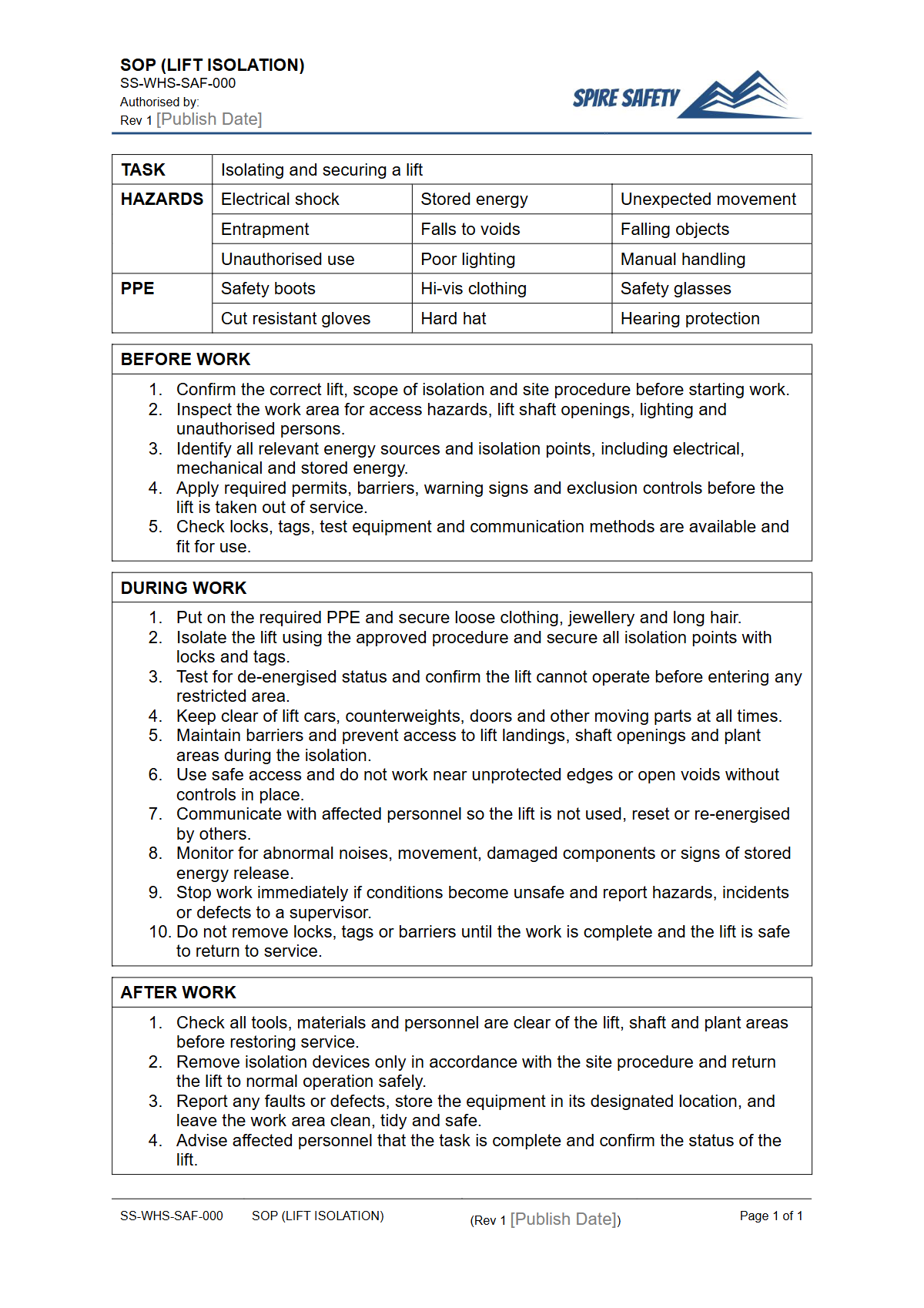
Download our free Safe Operating Procedure (Lift Isolation) Template. This customisable DOCX and PDF provides a clear framework for isolating lifts safely.
Free Safe Operating Procedure (Lift Isolation) Template
DOCX • 126 KB + PDF
Updated Oct 2026
No signup required
Purpose of the Free Safe Operating Procedure (Lift Isolation) Template
This free Safe Operating Procedure (Lift Isolation) Template provides a structured framework for documenting the step-by-step process required to safely isolate a lift before maintenance, repair, or inspection. A Safe Operating Procedure (SOP) is a critical administrative control measure that outlines a safe method of work to minimise risks to health and safety.
Properly isolating a lift prevents unexpected movement or re-energisation, which can lead to catastrophic incidents. This document serves as a foundational tool to help your organisation establish and communicate these vital safety protocols.
Using a standardised procedure for lift isolation is an essential part of a comprehensive WHS management system, ensuring consistency and clarity for all personnel involved in high-risk tasks. It helps a Person Conducting a Business or Undertaking (PCBU) meet their primary duty of care by providing clear, written instructions to workers, reducing the chance of error and protecting individuals from harm.
Video walkthrough
How to use the Free Safe Operating Procedure (Lift Isolation) Template
This template is designed as a starting point. To implement it effectively, you must:
- Download the DOCX file and open it.
- Consult with workers, supervisors, and competent persons who will be performing the lift isolation. Their input is invaluable for creating a practical and effective procedure. For complex sites or if you lack in-house expertise, engaging external WHS consulting can help ensure a robust outcome.
- Customise the content to match your specific lifts (make, model), workplace environment, and internal procedures. Include site-specific details, emergency contacts, required personal protective equipment (PPE), and lockout-tagout (LOTO) device specifications.
- Review and Approve the finalised document through your organisation's safety management process.
- Train all relevant personnel on the finalised SOP, ensuring they understand every step and can demonstrate competence.
Important Note: This document must be customised to your specific workplace and equipment. We provide this template as a guide, but its effectiveness depends entirely on how you adapt it to reflect the specific hazards and control measures relevant to your site.
A completed SOP is also a useful reference during periodic safety reviews or a formal WHS compliance audit. It standardises the approach to safety for specific equipment, similar to how our Free Air Compressor SOP does for pneumatic systems which may also be present in a plant room.
When to use this Safe Operating Procedure
A documented lift isolation procedure should be followed before any work is performed on or near a lift where there is a risk of unexpected activation or movement. This includes, but is not limited to:
- Scheduled maintenance and servicing.
- Unplanned repairs and fault finding.
- Thorough inspections of lift components in the shaft, pit, or machine room.
- Cleaning within the lift shaft or on the car top.
- Modifications or upgrades to the lift system.
In an emergency situation, clear protocols are vital. Your site's emergency plan might also reference other procedures, such as our free Defibrillator Operation SOP, to prepare for a worst-case medical event.
Who should use this Safe Operating Procedure
This SOP is intended for use by competent and authorised personnel. Key roles include:
- Lift Technicians and Mechanics: The primary users who perform the isolation and maintenance tasks.
- Electricians: For tasks involving electrical isolation of lift control panels and drive systems.
- Supervisors and Managers: To oversee the work, ensure procedures are followed, and issue any necessary work permits.
- Work Health and Safety (WHS) Officers: For developing, reviewing, and auditing the procedure as part of the overall safety framework.
Workers performing tasks around isolated equipment, such as cleaning or painting, must also be made aware of the isolation through clear signage and communication. Sometimes simple equipment like ladders are used to access control panels; ensure you have documented processes for their use, like those in our FREE Step Ladder SOP Template.
Developing robust SOPs for all high-risk plant and equipment is a cornerstone of good safety management. For more templates covering a wide range of machinery and tasks, you can browse our complete free WHS resources library.
Common mistakes
Common mistakes to avoid
- Failing to verify that the isolation is effective by testing for zero energy.
- Using personal padlocks or inadequate tags instead of company-issued, designated lockout-tagout equipment.
- Poor communication between the person isolating the lift and others working in the area, leading to premature re-energisation.
- Neglecting to isolate all energy sources, including main power, control circuits, and stored energy (e.g., hydraulic pressure).
Legal references
Legal considerations
The following legal requirements may be relevant to this type of work.
- Work Health and Safety Act (Harmonised) — Provides the primary duties for protecting workers and other people from work health and safety risks.
- Work Health and Safety Regulations (Harmonised) — Sets out requirements supporting the management of workplace hazards and risks.
The following codes may be relevant to this type of work.
- Managing WHS Risks Code of Practice — Provides practical guidance on identifying hazards, assessing risks and applying effective controls.
- Work Health and Safety Consultation, Cooperation and Coordination Code of Practice — Provides practical guidance on consulting workers and coordinating with other duty holders.
- Managing the Work Environment and Facilities Code of Practice — Provides practical guidance on safe work environments, workplace facilities and related controls.
Did you know
The 'Test for Dead' Rule
A fundamental principle of any isolation procedure is to 'test for dead' before starting work. This means using appropriate testing equipment to verify that all energy sources have been successfully de-energised, rather than just assuming the isolation was effective.
FAQ
Frequently asked questions
01What is the primary purpose of a lift isolation procedure?
02Who is authorised to perform a lift isolation?
03Does this lift isolation SOP template cover all types of lifts?
04What should be included in training for lift isolation procedures?
Share this resource
Free Safe Operating Procedure (Lift Isolation) Template
Browse Categories
How To Use It
- 1Download and open in Word or PDF.
- 2Replace the placeholders with your business details.
- 3Get it reviewed by a WHS specialist before rollout.
Need it customised?
Our WHS consultants can adapt this template to your site, run a gap analysis, or audit what you already have in place.
Book a Free Consultation WHS consulting servicesor call 1300 156 382
Related templates
- Free Safe Operating Procedure (Lift Lobby Cleaning) Template
- Free Safe Operating Procedure (Lift Pit Cleaning) Template
- Free Safe Operating Procedure (Lifting Beam) Template
- Free Safe Operating Procedure (Lifting Magnet) Template
- Free Safe Operating Procedure (Lifting Sling Cleaning) Template
- Free Safe Operating Procedure (Lighting Circuit Test) Template