
Free Safe Operating Procedure (Leather Cutter) Template
Download our free Safe Operating Procedure (Leather Cutter) template.
Free Safe Operating Procedure (Leather Cutter) Template
DOCX • 126 KB + PDF
Updated Oct 2026
No signup required
Purpose of the Free Safe Operating Procedure (Leather Cutter) Template
Operating a leather cutter, whether it's a clicker press, beam press, or rotary cutter, introduces significant workplace hazards. The primary risks include severe cuts, amputations, crushing injuries from moving parts, and entanglement.
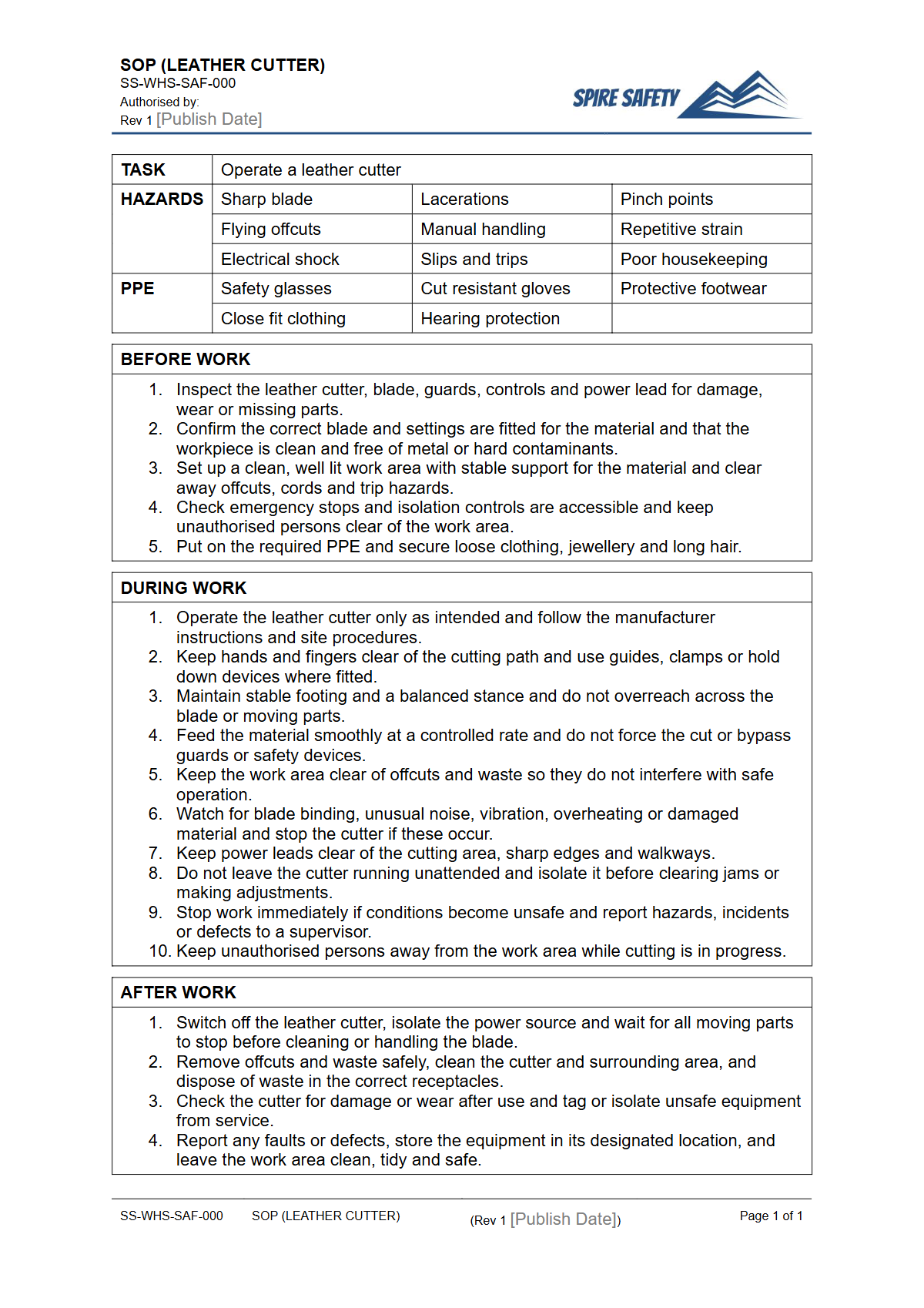
This Free Safe Operating Procedure (Leather Cutter) Template provides a structured starting point for your business to document and standardise the steps required to operate this machinery safely. By formalising your process, you create a clear, repeatable guide for all operators, which is a critical component of managing WHS risks effectively.
A documented SOP serves as a vital training tool for new employees and a consistent reference for experienced operators. It helps demonstrate your organisation's commitment to providing a safe system of work, which is a key duty for a Person Conducting a Business or Undertaking (PCBU) under Australian WHS legislation.
Using this template helps ensure all personnel are aware of the specific hazards and the necessary control measures, from pre-start checks to shutdown procedures.
Video walkthrough
How to use the Free Safe Operating Procedure (Leather Cutter) Template
This template is provided as a fully editable DOCX file, with a PDF version also available for easy printing and distribution. To make it effective, it must be adapted to your specific operational context.
Different models of leather cutters have unique features, guards, and emergency controls. A generic procedure is not sufficient to ensure safety.
Important: You must customise this document to reflect the specific make and model of equipment used in your workplace, the materials being cut, and your site-specific risk controls. We have provided a comprehensive framework, but it is your responsibility to complete the risk assessment and detail the precise steps and precautions relevant to your business.
This process is a fundamental part of developing robust WHS management systems that protect your workers and your business.
Key elements to customise:
- Plant & Equipment Details: Fill in the specific make, model, and location of your leather cutter.
- Risk Assessment: Identify and list all potential hazards associated with your machine and tasks, then detail the control measures you have in place.
- Personal Protective Equipment (PPE): Specify the exact PPE required, such as cut-resistant gloves (if appropriate for the task and not an entanglement risk), safety glasses, and hearing protection.
- Step-by-Step Procedures: Write clear, concise instructions for pre-operational checks, operation, post-operation cleanup, and shutdown.
- Emergency Procedures: Detail the location of emergency stops and outline the steps to take in case of an incident.
When to use a Leather Cutter SOP
A Safe Operating Procedure for a leather cutter should be a living document integrated into your daily operations. It is not a set-and-forget tool. Its primary uses include:
- Induction and Training: Use the SOP as the foundation for training new operators to ensure they understand the correct, safe method from day one.
- Refresher Training: Periodically review the SOP with existing staff to prevent complacency and reinforce safe work habits.
- Pre-Task Reference: Encourage operators to review the SOP before starting work, especially if they use the machine infrequently.
- Audits and Inspections: The SOP serves as a benchmark during safety inspections and is a key document reviewed during a WHS compliance auditing process.
- Incident Investigations: In the event of an accident or near-miss, the SOP helps investigators understand if procedures were followed and whether they need to be improved.
Who should use it
This template is designed for use by anyone responsible for safety in a workplace where leather cutters are operated. This includes:
- WHS Managers and Safety Officers: To develop and implement formalised safety procedures aligned with Australian WHS principles.
- Workshop Managers and Supervisors: To train staff, oversee operations, and enforce safe work practices on the workshop floor.
- Operators: As a practical guide to follow for every task, ensuring their own safety and that of their colleagues. While this SOP is for leather cutters, similar principles apply to other equipment; our FREE Circular Saw SOP provides another example for high-risk cutting machinery.
For organisations that handle various types of machinery, establishing consistent procedural formats is key. Similar templates, like our Free Brake Press SOP, can help build a comprehensive library of machine-specific safety documents.
If you need assistance tailoring these documents or conducting the necessary risk assessments, engaging professional WHS consulting services can provide expert guidance and ensure your procedures are robust and effective. You can also explore our full free WHS resources library for other useful templates and guides.
Common mistakes
Common mistakes to avoid
- Failing to perform pre-start checks to ensure safety guards and emergency stops are functional.
- Using the incorrect type of gloves, or wearing them when they pose an entanglement risk.
- Attempting to clear a jam or make adjustments while the machine is still powered on.
- Bypassing or disabling safety interlocks and guards to speed up the workflow.
Legal references
Legal considerations
The following legal requirements may be relevant to this type of work.
- Work Health and Safety Act (Harmonised) — Provides the primary duties for protecting workers and other people from work health and safety risks.
- Work Health and Safety Regulations (Harmonised) — Sets out requirements supporting the management of workplace hazards and risks.
The following codes may be relevant to this type of work.
- Managing WHS Risks Code of Practice — Provides practical guidance on identifying hazards, assessing risks and applying effective controls.
- Work Health and Safety Consultation, Cooperation and Coordination Code of Practice — Provides practical guidance on consulting workers and coordinating with other duty holders.
- Managing the Work Environment and Facilities Code of Practice — Provides practical guidance on safe work environments, workplace facilities and related controls.
Did you know
Machine Guarding
According to Safe Work Australia, inadequate machine guarding is one of the most common causes of workplace injury. Fixed physical guards are the most effective control, as they prevent access to dangerous parts of the machinery at all times.
FAQ
Frequently asked questions
01What are the main hazards of using a leather cutter?
02How often should a leather cutter SOP be reviewed?
03Is formal training required to use a leather cutter?
04What Personal Protective Equipment (PPE) is needed for operating a leather cutter?
Share this resource
Free Safe Operating Procedure (Leather Cutter) Template
Browse Categories
How To Use It
- 1Download and open in Word or PDF.
- 2Replace the placeholders with your business details.
- 3Get it reviewed by a WHS specialist before rollout.
Need it customised?
Our WHS consultants can adapt this template to your site, run a gap analysis, or audit what you already have in place.
Book a Free Consultation WHS consulting servicesor call 1300 156 382
Related templates
- Free Safe Operating Procedure (Leather Skiver) Template
- Free Safe Operating Procedure (Level Transmitter Test) Template
- Free Safe Operating Procedure (Life Raft Handling) Template
- Free Safe Operating Procedure (Lifebuoy Inspection) Template
- Free Safe Operating Procedure (Lift Car Cleaning) Template
- Free Safe Operating Procedure (Lift Door Cleaning) Template