
Free Safe Operating Procedure (Leak Detection Spray) Template
Download our free Safe Operating Procedure (Leak Detection Spray) Template. This customisable DOCX and PDF helps you document safe work practices.
Free Safe Operating Procedure (Leak Detection Spray) Template
DOCX • 126 KB + PDF
Updated Oct 2026
No signup required
Purpose of the Free Safe Operating Procedure (Leak Detection Spray) Template
Effectively managing workplace safety involves creating clear, actionable instructions for specific tasks. This is especially true when working with pressurised systems and chemicals.
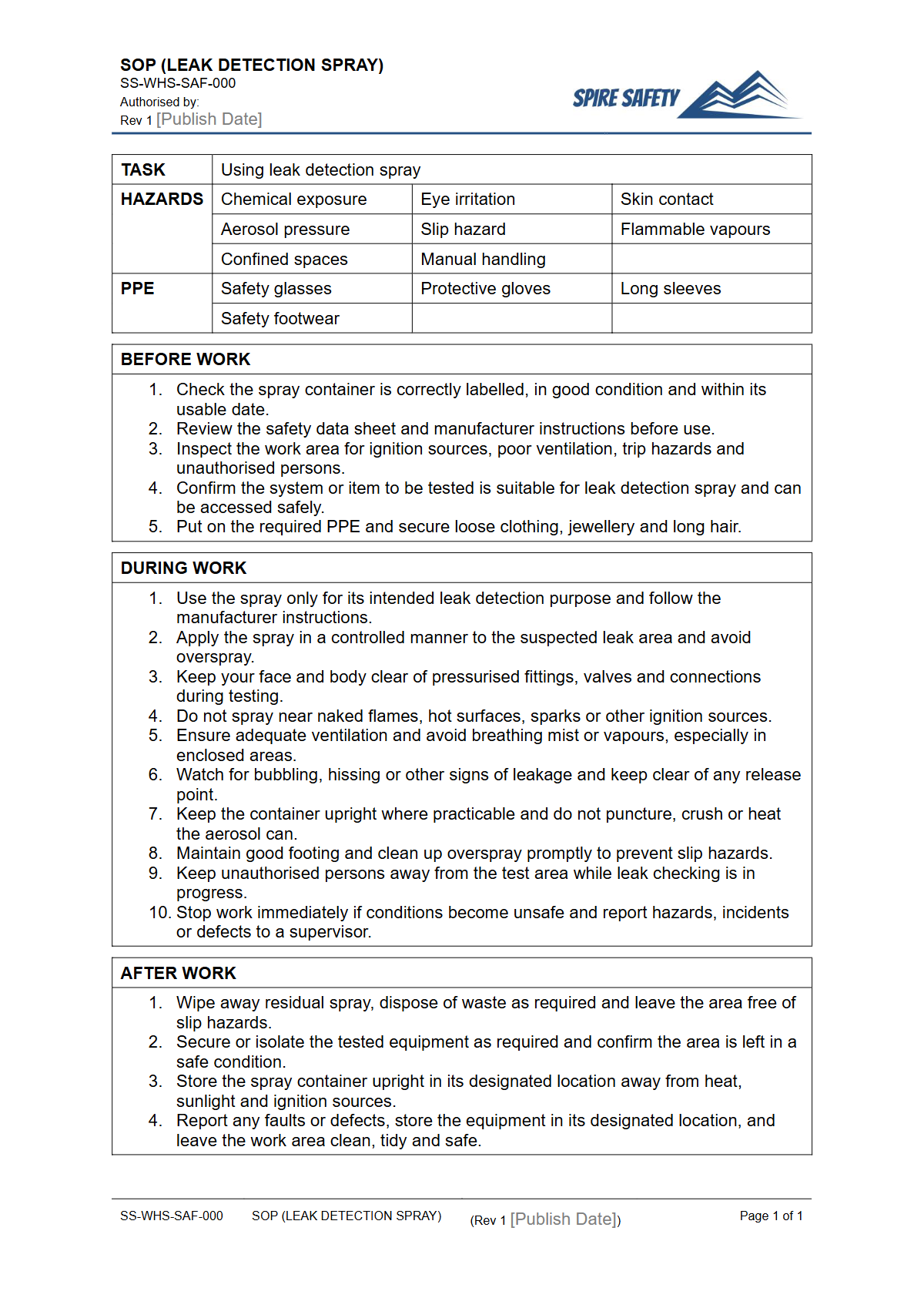
Our free Safe Operating Procedure (Leak Detection Spray) template provides a structured starting point for organisations to document the step-by-step process for safely identifying leaks in gas, air, or other pressurised pipework and equipment. Using this SOP helps standardise your process, ensuring that every worker follows a consistent, low-risk method.
The primary goal is to control hazards at the source, minimise risks like chemical exposure or fire, and provide clear guidance for employees.
A well-defined SOP is a critical component of a proactive safety culture. It moves beyond simple verbal instruction by formally outlining pre-operational checks, personal protective equipment (PPE) requirements, the correct application technique, and post-task clean-up.
This level of detail is vital for tasks that may seem simple but carry underlying risks. For instance, documenting procedures for pressurised equipment is just as important as having robust air compressor safe operating procedures to manage associated hazards effectively.
Implementing this SOP helps you meet your duty of care under Australian WHS legislation by providing a safe system of work.
Video walkthrough
How to use the Free Safe Operating Procedure (Leak Detection Spray) Template
This Safe Operating Procedure for leak detection spray is provided in both an easy-to-edit DOCX format and a print-ready PDF. To get the most value from this resource, it is essential to adapt it to your specific operational context.
Download the file and begin by adding your company branding and details. Then, conduct a thorough risk assessment of the leak detection task as it is performed in your workplace.
This involves identifying the specific types of systems being tested (e.g., natural gas, compressed air, refrigerants), the exact leak detection products used, and the environments where the work occurs.
Use the findings from your risk assessment to populate and refine each section of the template. Update the PPE requirements based on the Safety Data Sheet (SDS) for your chosen spray, add any site-specific emergency procedures, and detail waste disposal methods for used materials and residue.
It’s crucial to involve workers who actually perform the task in the review process, as their practical experience is invaluable for creating a procedure that is both safe and workable. Integrating documents like this into your organisation’s safety framework is a key function of comprehensive WHS management systems.
Important: This document is a template and must be customised to suit the specific equipment, chemicals, and environmental conditions of your workplace. We recommend a competent person reviews and customises the SOP before implementation.
When to use a Leak Detection Spray SOP
This SOP should be implemented and followed whenever an employee is required to locate leaks in pressurised systems using a chemical spray. This applies to a wide range of situations across many industries, including manufacturing, automotive repair, HVAC services, and construction.
Common scenarios include routine preventive maintenance checks on pneumatic machinery, commissioning new gas pipe installations, troubleshooting performance issues in refrigeration units, or verifying the integrity of a repair. Rather than being a one-off document, the SOP should be an integrated part of your regular maintenance and safety protocols.
Consistency in its application ensures that safety standards are maintained, regardless of who is performing the task.
Who should use this SOP
The primary users of this Safe Operating Procedure are the workers directly responsible for maintenance, repair, and diagnostics. This includes maintenance fitters, mechanics, plumbers, gasfitters, HVAC technicians, and plant operators.
They are the individuals who need to understand and follow the step-by-step instructions to perform their job safely. Beyond the direct user, supervisors and managers have a critical role.
They are responsible for training workers on the SOP, ensuring it is readily available at the point of work, and monitoring its correct implementation. For organisations needing assistance with developing and rolling out such procedures, engaging with expert WHS consulting services can provide valuable support and guidance, ensuring your safety documents are practical and effective.
Ultimately, a robust SOP contributes to a safer work environment for everyone. Its use demonstrates a commitment to operational excellence and risk management.
Periodically verifying that procedures are being followed correctly is a key part of the safety lifecycle, a process that can be formalised through WHS compliance auditing. This helps identify any gaps between the written procedure and actual work practices. While this SOP is a great start, it's one of many documents you may need. You can explore a wide range of other useful documents in our library of free WHS resources.
Common mistakes
Common mistakes to avoid
- Using a flammable spray on or near potential ignition sources, such as electrical sparks or hot surfaces.
- Failing to read the Safety Data Sheet (SDS) to confirm chemical compatibility and required PPE.
- Not cleaning the residue after testing, which can lead to corrosion on certain metals or create a slip hazard.
- Assuming one type of spray is suitable for all systems (e.g., using a standard spray on oxygen lines, which requires a specific, approved product).
Legal references
Legal considerations
The following legal requirements may be relevant to this type of work.
- Work Health and Safety Act (Harmonised) — Provides the primary duties for protecting workers and other people from work health and safety risks.
- Work Health and Safety Regulations (Harmonised) — Sets out requirements supporting the management of workplace hazards and risks.
The following codes may be relevant to this type of work.
- Managing WHS Risks Code of Practice — Provides practical guidance on identifying hazards, assessing risks and applying effective controls.
- Work Health and Safety Consultation, Cooperation and Coordination Code of Practice — Provides practical guidance on consulting workers and coordinating with other duty holders.
- Managing the Work Environment and Facilities Code of Practice — Provides practical guidance on safe work environments, workplace facilities and related controls.
Did you know
The Cost of a Leak
A small 1mm compressed air leak at 7 bar (100 psi) can cost a business over $1,000 per year in wasted energy, highlighting the financial and environmental importance of effective leak detection.
Beyond the Bubbles
Many modern leak detection sprays are fluorescent and glow brightly under UV light. This makes it significantly easier to pinpoint tiny or slow leaks in poorly lit or hard-to-reach areas.
FAQ
Frequently asked questions
01What hazards are associated with using leak detection spray?
02Is a Safe Operating Procedure a legal requirement for using leak detection spray?
03How often should we review our leak detection spray SOP?
04Can I use soapy water instead of a commercial leak detection spray?
Share this resource
Free Safe Operating Procedure (Leak Detection Spray) Template
Browse Categories
How To Use It
- 1Download and open in Word or PDF.
- 2Replace the placeholders with your business details.
- 3Get it reviewed by a WHS specialist before rollout.
Need it customised?
Our WHS consultants can adapt this template to your site, run a gap analysis, or audit what you already have in place.
Book a Free Consultation WHS consulting servicesor call 1300 156 382
Related templates
- Free Safe Operating Procedure (Leather Cutter) Template
- Free Safe Operating Procedure (Leather Skiver) Template
- Free Safe Operating Procedure (Level Transmitter Test) Template
- Free Safe Operating Procedure (Life Raft Handling) Template
- Free Safe Operating Procedure (Lifebuoy Inspection) Template
- Free Safe Operating Procedure (Lift Car Cleaning) Template