
Free Safe Operating Procedure (Lead Paint Removal) Template
Download our free Safe Operating Procedure for lead paint removal. This customisable DOCX & PDF template helps manage risks of lead-based paint.
Free Safe Operating Procedure (Lead Paint Removal) Template
DOCX • 126 KB + PDF
Updated Oct 2026
No signup required
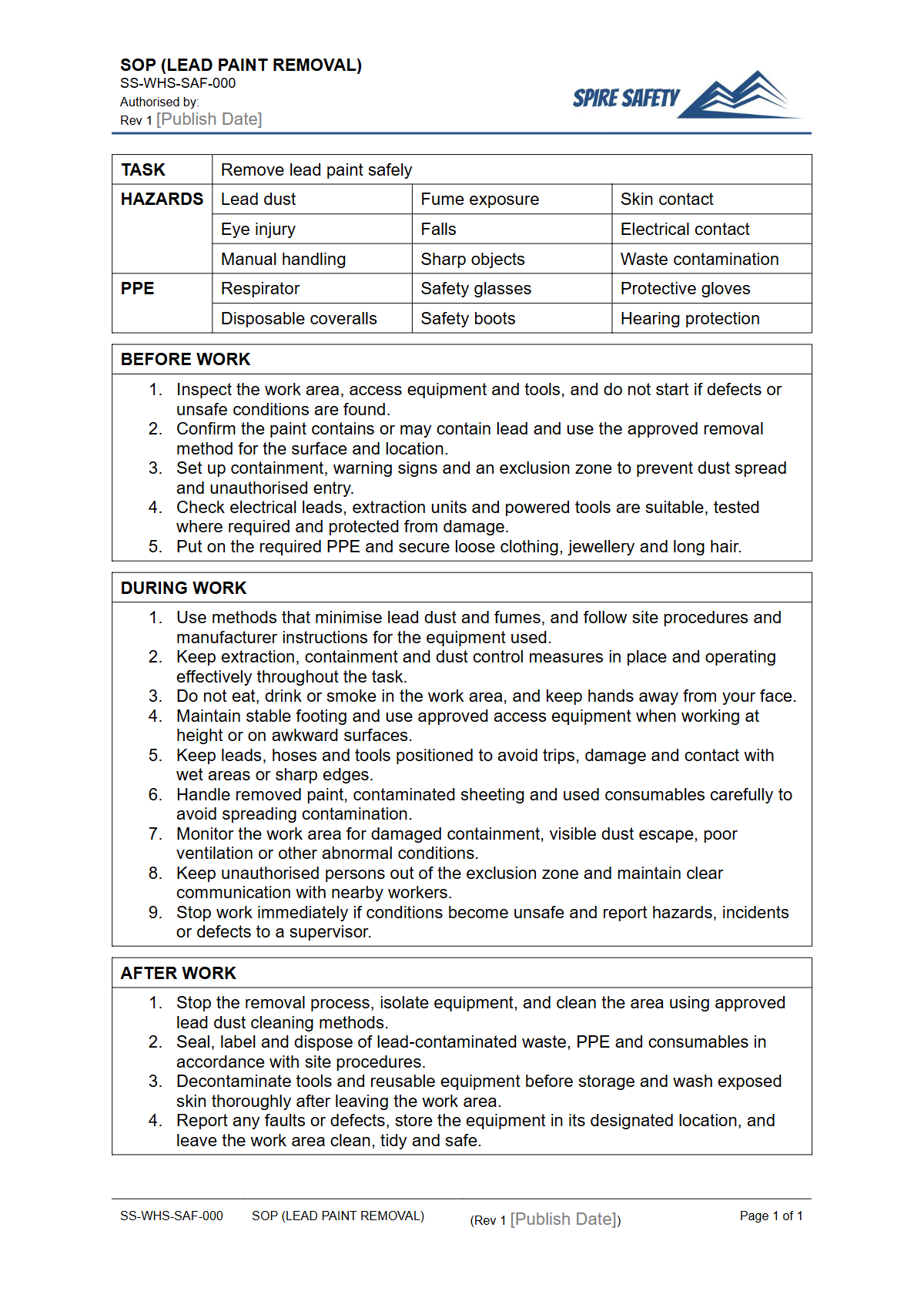
Purpose of the Free Safe Operating Procedure (Lead Paint Removal) Template
Working with lead-based paint poses significant health risks, primarily through the inhalation or ingestion of lead dust and fumes. This Free Safe Operating Procedure (Lead Paint Removal) Template provides a structured framework for managing these risks effectively.
Its purpose is to outline a step-by-step process for safely removing or disturbing lead paint, ensuring that all necessary precautions are taken to protect workers and others in the vicinity. By documenting hazards, risk controls, and emergency procedures, this SOP serves as a critical component of a compliant safety management system.
A well-defined Safe Operating Procedure (SOP) is more than a document; it's a vital tool for training, supervision, and risk management. It standardises your approach to high-risk tasks, ensuring consistency and helping to meet your legal obligations as a Person Conducting a Business or Undertaking (PCBU).
Integrating this procedure into your broader WHS management systems demonstrates a commitment to proactive safety culture and helps protect your business from the severe consequences of a workplace incident involving lead exposure.
Video walkthrough
How to Use the Free Safe Operating Procedure (Lead Paint Removal) Template
This document is provided as a starting point in both DOCX and PDF formats. It is essential to understand that it must be customised to reflect the specific circumstances of your workplace.
Download the file and carefully review each section, adapting the content to suit your unique tools, materials, environment, and personnel. Effective customisation requires consultation with the workers who will be performing the task, as they have direct experience with the operational realities and potential hazards.
To adapt the template:
- Identify the specific tools used for removal (e.g., chemical strippers, heat guns, HEPA-filtered sanders).
- Specify the type and location of the structure (e.g., residential interior, industrial exterior).
- Detail the required Personal Protective Equipment (PPE) based on your risk assessment.
- Outline site-specific procedures for containment, decontamination, and waste disposal.
If you need assistance, our WHS consulting services can help tailor documents to your precise needs.
When to Use This Safe Operating Procedure
This Safe Operating Procedure should be implemented whenever there is a risk of disturbing paint that is known or presumed to contain lead. In Australia, houses built before 1970 are highly likely to contain lead paint.
This SOP is critical for tasks such as scraping, sanding, blasting, burning, or cutting painted surfaces during renovation, restoration, or demolition projects. Any activity that can create dust or fumes from a lead-painted surface requires a formal safe work process. For tasks involving powered tools, this document should be used alongside equipment-specific procedures, such as our FREE Circular Saw SOP (Safe Operating Procedure) Template.
Who Should Use This Safe Operating Procedure
This SOP is intended for use by multiple roles within an organisation.
- PCBUs and Company Owners: Responsible for providing a safe work environment and ensuring that robust procedures like this SOP are developed, implemented, and maintained.
- Managers and Supervisors: Responsible for training workers on the SOP, ensuring it is followed on-site, and providing all necessary equipment and resources.
- Workers: Responsible for following the outlined procedures to protect their own health and safety and that of their colleagues.
Often, lead paint removal involves working at heights to access eaves or window frames; in these cases, this procedure should be cross-referenced with height-related documents like our FREE Step Ladder SOP (Safe Operating Procedure) Template to ensure all risks are managed concurrently.
Key Elements of Lead Paint Removal Safety
A comprehensive SOP for lead paint removal must address several critical safety areas. Firstly, containment is essential to prevent dust from spreading.
This involves using plastic sheeting to seal off the work area and covering floors, furniture, and vents. Secondly, dust suppression techniques, such as wet scraping or using chemical strippers instead of dry sanding, are vital for minimising airborne particles.
Thirdly, workers must be equipped with appropriate PPE, including a P2 or P3-rated respirator, disposable coveralls, gloves, and eye protection. In heavy industrial demolition settings where thermal tools are used, it's also important to consider procedures for other equipment, such as those found in a FREE Plasma Cutter SOP (Safe Operating Procedure) Template. Finally, the procedure must clearly define methods for decontamination of personnel and equipment and the proper disposal of contaminated waste in accordance with local environmental regulations.
Common mistakes
Common mistakes to avoid
- Using dry sanding, scraping, or abrasive blasting methods, which create large amounts of hazardous dust.
- Failing to properly contain the work area, allowing lead dust to contaminate the rest of the building and surrounding environment.
- Wearing inadequate or improperly fitted Personal Protective Equipment (PPE), especially respirators.
- Incorrect disposal of contaminated waste, clothing, and equipment, leading to wider environmental contamination.
Legal references
Legal considerations
The following legal requirements may be relevant to this type of work.
- Work Health and Safety Act (Harmonised) — Provides the primary duties for protecting workers and other people from work health and safety risks.
- Work Health and Safety Regulations (Harmonised) — Sets out requirements supporting the management of workplace hazards and risks.
The following codes may be relevant to this type of work.
- Managing WHS Risks Code of Practice — Provides practical guidance on identifying hazards, assessing risks and applying effective controls.
- Work Health and Safety Consultation, Cooperation and Coordination Code of Practice — Provides practical guidance on consulting workers and coordinating with other duty holders.
- Managing the Work Environment and Facilities Code of Practice — Provides practical guidance on safe work environments, workplace facilities and related controls.
Did you know
Lead in Paint History
In Australia, the recommended amount of lead in domestic paint was reduced to 1% in 1965, and then further reduced to 0.1% by 1997. However, any house built before 1970 should be assumed to contain lead-based paint.
No Safe Level
According to the World Health Organization (WHO), there is no known level of lead exposure that is considered safe. Even low levels of exposure can cause significant and sometimes irreversible health problems, particularly in children and pregnant women.
FAQ
Frequently asked questions
01What are the main health hazards of lead paint removal?
02What kind of respirator is needed for lead paint removal?
03How should I dispose of lead paint waste in Australia?
04Is a Safe Operating Procedure legally required for lead paint removal?
Share this resource
Free Safe Operating Procedure (Lead Paint Removal) Template
Browse Categories
How To Use It
- 1Download and open in Word or PDF.
- 2Replace the placeholders with your business details.
- 3Get it reviewed by a WHS specialist before rollout.
Need it customised?
Our WHS consultants can adapt this template to your site, run a gap analysis, or audit what you already have in place.
Book a Free Consultation WHS consulting servicesor call 1300 156 382
Related templates
- Free Safe Operating Procedure (Leaf Blower) Template
- Free Safe Operating Procedure (Leaf Collection) Template
- Free Safe Operating Procedure (Leaf Litter Removal) Template
- Free Safe Operating Procedure (Leak Detection Spray) Template
- Free Safe Operating Procedure (Leather Cutter) Template
- Free Safe Operating Procedure (Leather Skiver) Template