
Free Safe Operating Procedure (Lawn Top Dressing) Template
Download our free Safe Operating Procedure (Lawn Top Dressing) template. This customisable DOCX & PDF helps detail safety steps for landscaping tasks.
Free Safe Operating Procedure (Lawn Top Dressing) Template
DOCX • 126 KB + PDF
Updated Oct 2026
No signup required
Purpose of the Free Safe Operating Procedure (Lawn Top Dressing) Template
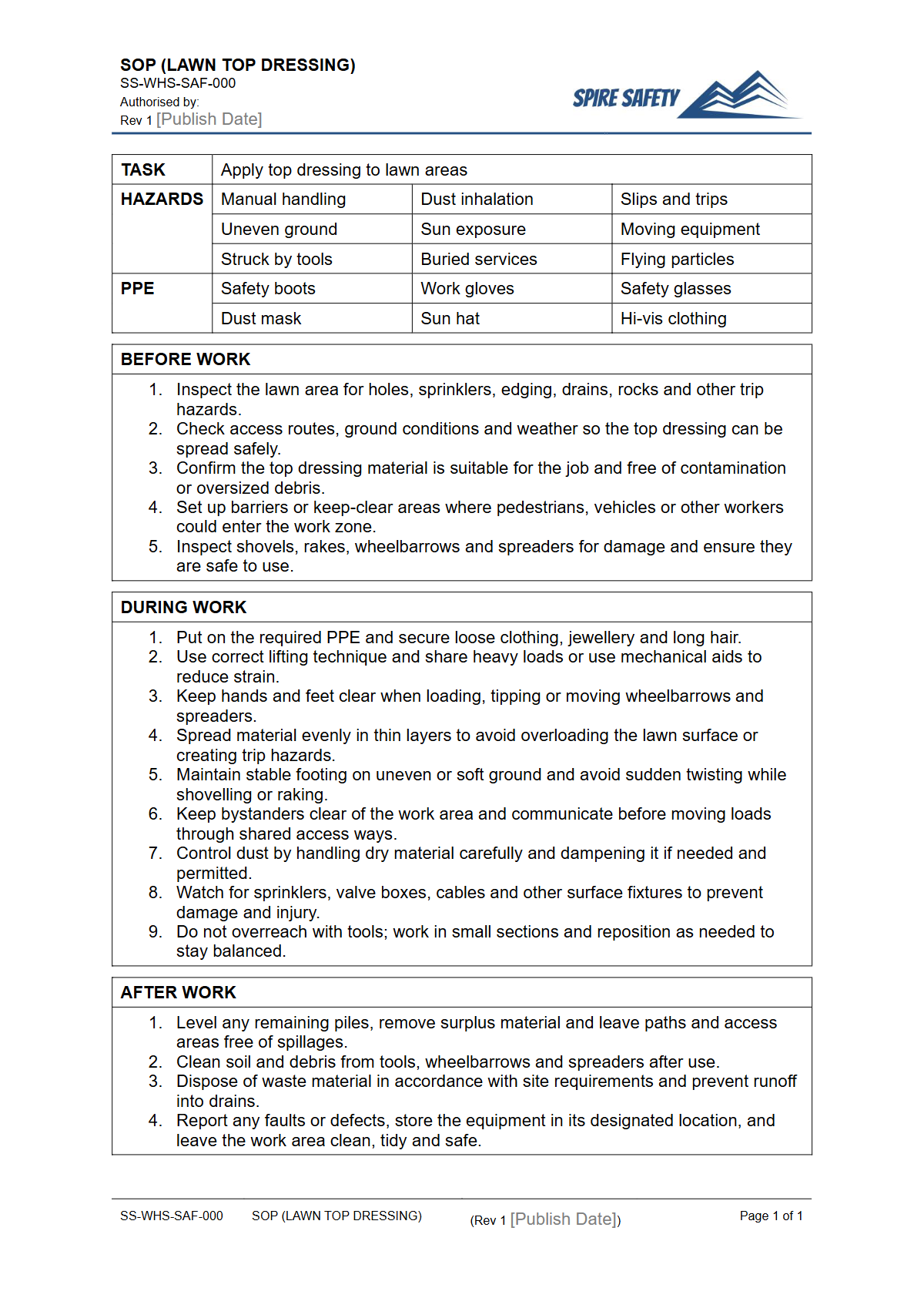
A Safe Operating Procedure (SOP) is a foundational document for any task involving risk. This Free Safe Operating Procedure (Lawn Top Dressing) Template provides a structured framework to help your business document the step-by-step process for safely applying top dressing to lawns and turf areas.
Its primary purpose is to identify and control hazards associated with the task, such as manual handling of heavy bags, operating machinery like spreaders or light vehicles, and exposure to dust and other airborne particles. By clearly outlining these steps, you create a consistent, safe method of work that reduces the likelihood of injuries and incidents.
Implementing task-specific SOPs like this one is a key part of developing and maintaining robust WHS management systems. It demonstrates a commitment to proactively managing workplace risks and provides a clear standard for worker training and supervision. A well-drafted procedure helps ensure everyone on the team understands the safest way to perform their duties, promoting a stronger safety culture across your organisation.
Video walkthrough
How to use the Free Safe Operating Procedure (Lawn Top Dressing) Template
Our template is designed as a starting point. Once downloaded, you must adapt it to reflect the specific context of your workplace.
This involves reviewing each section and adding details relevant to your equipment, materials (e.g., sand, soil, compost blends), site conditions, and company policies. The procedure should include pre-operational checks for machinery, step-by-step instructions for the task itself, and post-operational clean-up and storage requirements.
It is crucial to consult with the workers who actually perform the lawn top dressing tasks. Their direct experience is invaluable for identifying practical hazards and effective control measures that might otherwise be overlooked.
When detailing equipment usage, you may find it helpful to reference other specific procedures, such as a Free Trencher SOP Template if ground preparation is part of the broader project.
Important Note on Customisation
This document is a template and requires customisation to be effective. We recommend you thoroughly edit this Safe Operating Procedure to align with the unique hazards, equipment, and environment of your worksite.
You must identify and assess all potential risks and implement suitable control measures. Spire Safety accepts no liability for any loss or damage resulting from the use of this template.
When to use a Safe Operating Procedure
A Safe Operating Procedure for lawn top dressing should be a living document, used consistently throughout your operations. It is essential for inducting new employees or contractors, ensuring they are trained in your established safe work methods before they begin.
It should also be used for refresher training for existing staff to prevent complacency and reinforce safe behaviour. Furthermore, the SOP serves as a critical reference point during job planning and for pre-start meetings, allowing teams to quickly review risks and controls specific to the day's conditions, like wind or recent rainfall.
The procedure is also a vital tool following an incident or a near-miss. It should be reviewed as part of the investigation to determine if the documented process was followed and if it needs to be updated to prevent a recurrence.
For larger projects involving significant ground levelling, you might consult other documents like a FREE Grader SOP (Safe Operating Procedure) Template in conjunction with this one.
Who should use it
This SOP is intended for a range of personnel within a landscaping, horticulture, or groundskeeping business. Workers directly involved in top dressing activities should use it as their primary guide for performing the task safely.
Supervisors and team leaders are responsible for using the SOP as a tool for training, monitoring work, and enforcing safe practices on site. They must ensure that all workers understand and adhere to the documented procedures.
Work Health and Safety (WHS) officers and managers should oversee the development, review, and implementation of the SOP as part of the broader safety framework. During formal reviews or safety checks, the SOP serves as a benchmark for performance.
This documentation is often a key piece of evidence examined during a WHS compliance auditing process to verify that safe systems of work are in place and being followed. For a complete safety program, it's also wise to have procedures for emergencies, such as a Safe Operating Procedure for Defibrillator Operation.
Ultimately, a well-implemented SOP helps everyone from the business owner to the apprentice understand their safety responsibilities. You can find more templates and guides in our free WHS resources library to help build out your safety management system.
Common mistakes
Common mistakes to avoid
- Using the template as-is without customising it for specific site conditions and equipment.
- Failing to adequately train workers on the specific steps and hazards outlined in the final SOP.
- Neglecting to specify the correct Personal Protective Equipment (PPE), such as P2/N95 dust masks, gloves, and safety glasses.
- Forgetting to include emergency procedures, such as first aid response for eye contamination or manual handling injuries.
Legal references
Legal considerations
The following legal requirements may be relevant to this type of work.
- Work Health and Safety Act (Harmonised) — Provides the primary duties for protecting workers and other people from work health and safety risks.
- Work Health and Safety Regulations (Harmonised) — Sets out requirements supporting the management of workplace hazards and risks.
The following codes may be relevant to this type of work.
- Managing WHS Risks Code of Practice — Provides practical guidance on identifying hazards, assessing risks and applying effective controls.
- Work Health and Safety Consultation, Cooperation and Coordination Code of Practice — Provides practical guidance on consulting workers and coordinating with other duty holders.
- Managing the Work Environment and Facilities Code of Practice — Provides practical guidance on safe work environments, workplace facilities and related controls.
Did you know
Manual Handling Risk
A standard 25kg bag of top dressing mix or sand exceeds the recommended weight for frequent lifting according to Australian manual handling guidelines. Using mechanical aids or team lifts is a critical control measure.
Silica Dust
Many top dressing mixes contain sand, which can release respirable crystalline silica dust when dry. Inhaling this dust can lead to serious long-term lung diseases, making dust suppression and appropriate respiratory protection essential.
FAQ
Frequently asked questions
01What is a Safe Operating Procedure for lawn top dressing?
02Is this lawn top dressing SOP template suitable for all types of equipment?
03Who is responsible for writing and reviewing a lawn top dressing SOP?
04How often should an SOP for lawn top dressing be reviewed?
Share this resource
Free Safe Operating Procedure (Lawn Top Dressing) Template
Browse Categories
How To Use It
- 1Download and open in Word or PDF.
- 2Replace the placeholders with your business details.
- 3Get it reviewed by a WHS specialist before rollout.
Need it customised?
Our WHS consultants can adapt this template to your site, run a gap analysis, or audit what you already have in place.
Book a Free Consultation WHS consulting servicesor call 1300 156 382
Related templates
- Free Safe Operating Procedure (Leachate Area Check) Template
- Free Safe Operating Procedure (Leachate Spill Cleanup) Template
- Free Safe Operating Procedure (Lead Acid Battery Work) Template
- Free Safe Operating Procedure (Lead Paint Removal) Template
- Free Safe Operating Procedure (Leaf Blower) Template
- Free Safe Operating Procedure (Leaf Collection) Template