
Free Safe Operating Procedure (Leachate Spill Cleanup) Template
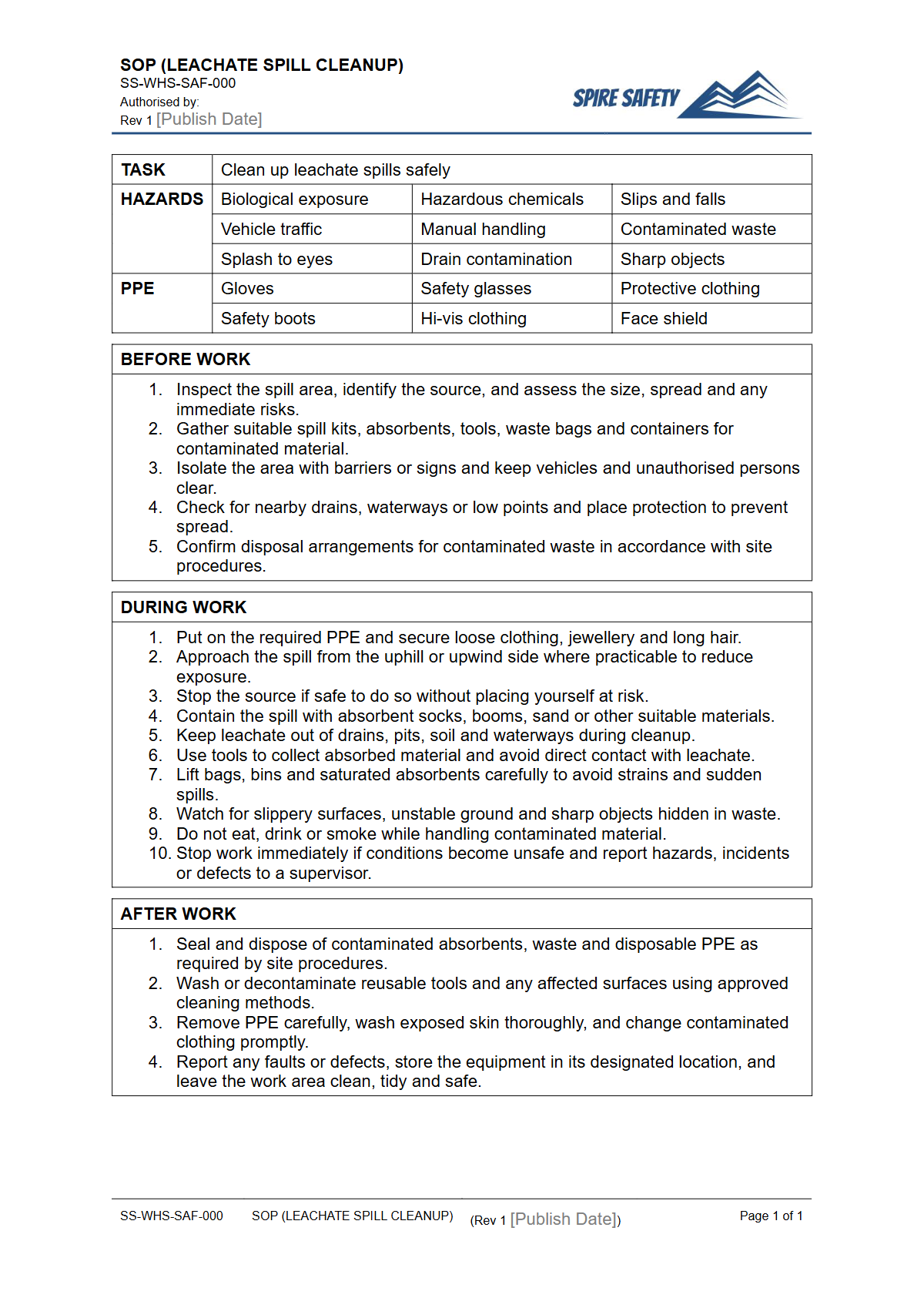
Download our free Safe Operating Procedure (Leachate Spill Cleanup) template. This customisable DOCX and PDF helps manage leachate spills safely. Download now.
Free Safe Operating Procedure (Leachate Spill Cleanup) Template
DOCX • 126 KB + PDF
Updated Oct 2026
No signup required
Purpose of the Free Safe Operating Procedure (Leachate Spill Cleanup) Template
This Free Safe Operating Procedure (Leachate Spill Cleanup) Template provides a structured framework for businesses to document a clear, step-by-step process for responding to leachate spills. Leachate, the liquid that drains from landfill and other contaminated sites, can contain a hazardous mix of chemicals, heavy metals, and pathogens, posing significant risks to workers and the environment.
This SOP template helps you control these risks by outlining the required personal protective equipment (PPE), containment methods, cleanup materials, and disposal protocols.
Developing a specific SOP for this task is a critical component of a robust safety management system. It formalises your organisation's approach to a high-risk activity, ensuring that responses are consistent, safe, and effective.
Integrating procedures like this into your overall framework is essential for demonstrating due diligence and systematically managing workplace hazards. Comprehensive WHS management systems provide the overarching structure into which specific documents like this SOP fit.
Leachate spills commonly occur in environments such as landfills, waste transfer stations, and industrial sites where waste is processed or stored. These sites often involve the use of heavy machinery for moving and compacting waste, which can sometimes lead to liner tears or containment failures.
Having clear procedures for all high-risk tasks on such sites is crucial, which is why operators often also maintain a free Dozer SOP template alongside spill response plans.
Video walkthrough
How to use the Free Safe Operating Procedure (Leachate Spill Cleanup) Template
This document is a starting point designed for adaptation. To make it effective, you must edit it to reflect the specific circumstances of your workplace.
Download the DOCX file and update the content to include site-specific details such as emergency contact numbers, the exact location of spill kits, the types of leachate you handle, and the specific PPE required for your team. You should also detail the correct procedure for disposing of contaminated materials according to local environmental regulations.
Important: This is a template, not a finished document. We are not WHS practitioners and cannot provide WHS advice.
You must have a competent person review and customise this document to ensure it is suitable for your specific workplace, equipment, and operational risks.
Once customised, the SOP should be used as a basis for training. All personnel who may be involved in cleanup operations must be trained on the procedure to ensure they understand their roles and can perform the task safely.
Regular refresher training and drills are recommended. For organisations needing assistance with the implementation, training, and review process, engaging specialist WHS consulting can provide expert guidance and support.
When to use it
This Safe Operating Procedure should be implemented and communicated to relevant staff before any work begins at a site where leachate spills are a foreseeable risk. It serves as both a proactive planning tool and a reactive guide during an incident.
The SOP should be readily accessible in areas where spills might occur and included in the site's overall emergency response plan. Having clear procedures for all potential emergencies is vital; for example, a spill incident could lead to a medical emergency, highlighting the need for documents like a Safe Operating Procedure for Defibrillator Operation as part of your preparedness.
Who should use it
This SOP is intended for several key roles within an organisation. It should be used directly by workers and operators responsible for executing the spill cleanup.
Supervisors and team leaders should use it to induct new workers, conduct pre-start briefings, and oversee cleanup activities to ensure the documented steps are followed. WHS managers and coordinators will use the template as a foundational document for risk assessments, training programs, and incident investigations related to hazardous substance spills.
Periodically verifying that the documented procedures are being followed correctly on the ground is a key part of maintaining a safe system of work. This process can be supported through internal checks or formal WHS compliance auditing services. Spire Safety offers a wide range of documents and checklists to help with these processes, all available in our free WHS resources library.
Common mistakes
Common mistakes to avoid
- Underestimating the chemical hazards present in the leachate by not consulting a risk assessment.
- Using incorrect or insufficient Personal Protective Equipment (PPE), leading to chemical exposure.
- Failing to properly contain the spill at its source, leading to wider environmental contamination.
- Improper disposal of contaminated cleanup materials and PPE, violating environmental regulations.
Legal references
Legal considerations
The following legal requirements may be relevant to this type of work.
- Work Health and Safety Act (Harmonised) — Provides the primary duties for protecting workers and other people from work health and safety risks.
- Work Health and Safety Regulations (Harmonised) — Sets out requirements supporting the management of workplace hazards and risks.
The following codes may be relevant to this type of work.
- Managing WHS Risks Code of Practice — Provides practical guidance on identifying hazards, assessing risks and applying effective controls.
- Work Health and Safety Consultation, Cooperation and Coordination Code of Practice — Provides practical guidance on consulting workers and coordinating with other duty holders.
- Managing the Work Environment and Facilities Code of Practice — Provides practical guidance on safe work environments, workplace facilities and related controls.
Did you know
Leachate Composition
Leachate's chemical makeup varies dramatically depending on the landfill's age and waste type, ranging from acidic to alkaline and containing heavy metals, organic compounds, and pathogens.
Landfill Gas
The same decomposition process that creates leachate also produces landfill gas, primarily methane. This gas is a potent greenhouse gas and can pose significant fire and explosion risks if not managed.
FAQ
Frequently asked questions
01What is leachate and why is it hazardous?
02What PPE is typically required for leachate spill cleanup?
03Does this SOP template cover incident reporting requirements?
04Can I use this template for other chemical spills?
Share this resource
Free Safe Operating Procedure (Leachate Spill Cleanup) Template
Browse Categories
How To Use It
- 1Download and open in Word or PDF.
- 2Replace the placeholders with your business details.
- 3Get it reviewed by a WHS specialist before rollout.
Need it customised?
Our WHS consultants can adapt this template to your site, run a gap analysis, or audit what you already have in place.
Book a Free Consultation WHS consulting servicesor call 1300 156 382
Related templates
- Free Safe Operating Procedure (Lead Acid Battery Work) Template
- Free Safe Operating Procedure (Lead Paint Removal) Template
- Free Safe Operating Procedure (Leaf Blower) Template
- Free Safe Operating Procedure (Leaf Collection) Template
- Free Safe Operating Procedure (Leaf Litter Removal) Template
- Free Safe Operating Procedure (Leak Detection Spray) Template