
Free Safe Operating Procedure (Lawn Fertilising) Template
Download our free Safe Operating Procedure (Lawn Fertilising) Template. This customisable DOCX & PDF helps document safe work practices for groundskeeping.
Free Safe Operating Procedure (Lawn Fertilising) Template
DOCX • 126 KB + PDF
Updated Oct 2026
No signup required
Purpose of the Free Safe Operating Procedure (Lawn Fertilising) Template
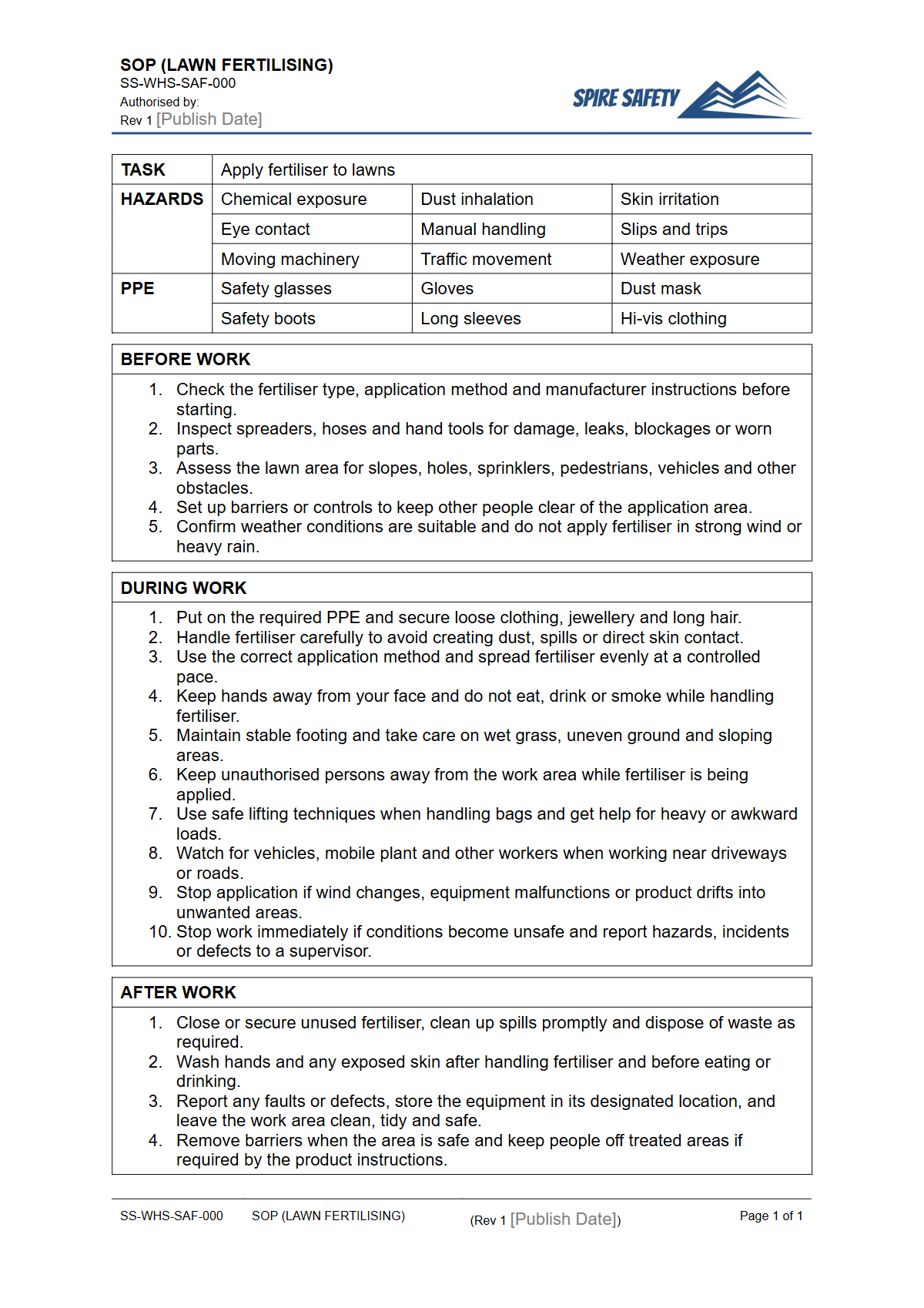
Our Free Safe Operating Procedure (Lawn Fertilising) Template provides a comprehensive starting point for landscaping, horticulture, and groundskeeping businesses. This downloadable DOCX and PDF resource is designed to help you formally document the step-by-step process for fertilising lawns safely.
The primary purpose of this Safe Operating Procedure for Lawn Fertilising is to provide clear, unambiguous instructions that standardise how the task is performed, minimising risks to workers. Lawn fertilising involves significant hazards, including skin contact or inhalation of chemicals, musculoskeletal disorders from lifting heavy bags, and operational risks from mechanical spreaders.
A documented SOP is a fundamental tool for hazard control and forms a critical part of your overall WHS management system. By outlining required PPE, pre-start checks, safe application techniques, and clean-up procedures, it helps you meet your WHS duties and demonstrate due diligence.
Video walkthrough
How to use the Free Safe Operating Procedure (Lawn Fertilising) Template
Download the template and adapt it to your specific operational context. It is designed to be customised to align with your risk assessments and the practical realities of your workplace.
Important: This document is a template and not a finished Safe Operating Procedure. We have provided a structured starting point, but you must consult with your team and add site-specific details.
This includes identifying the exact fertilisers used (referencing their Safety Data Sheets), the types of spreaders in operation (e.g., broadcast, drop, handheld), unique site conditions (slopes, public areas, waterways), and your company's specific emergency procedures. A documented process for responding to incidents, including having equipment and trained personnel as outlined in a defibrillator operation SOP, is a key part of a robust safety plan.
When to use it
A lawn fertilising SOP should be developed and implemented before any worker undertakes the task. It is a vital document for worker inductions and for providing task-specific training.
It should also be used as a reference for periodic refresher training or when work practices change, such as the introduction of a new chemical or piece of equipment. For instance, while this SOP covers fertilising, introducing other agricultural machinery would require separate documentation, such as our free grain drill SOP. Supervisors can also use the finalised SOP as a checklist to conduct observations and verify that correct procedures are being followed on-site.
Who should use it
This template is intended for any PCBU (Person Conducting a Business or Undertaking) in the landscaping, grounds maintenance, sports turf management, or agricultural sectors. This includes business owners, managers, and WHS officers responsible for creating and implementing safety systems.
Supervisors should use the completed SOP to train and oversee workers effectively. Most importantly, operators and groundskeepers who perform the fertilising tasks must be trained in the SOP's contents and use it as their guide for safe work.
Similar principles apply to other specialised tasks, which may require a dedicated Trencher SOP for excavation work. For tasks involving even minor work at heights, like loading equipment, a step ladder SOP is also essential.
A well-drafted and properly implemented SOP is a cornerstone of a safe work environment, protecting your workers and your business. For businesses seeking expert guidance on developing and embedding these documents into their daily operations, our WHS consulting services can provide tailored support. Feel free to explore our complete collection of document templates in the Spire Safety free WHS resources library.
Common mistakes
Common mistakes to avoid
- Failing to customise the template with specific details of the fertilisers used, referencing their Safety Data Sheets (SDS).
- Neglecting to specify the correct Personal Protective Equipment (PPE), such as gloves, eye protection, and respiratory protection.
- Not training workers on the SOP's contents or verifying their understanding before they perform the task.
- Using generic instructions that don't address unique site hazards like steep slopes, public access areas, or proximity to waterways.
Legal references
Legal considerations
The following legal requirements may be relevant to this type of work.
- Work Health and Safety Act (Harmonised) — Provides the primary duties for protecting workers and other people from work health and safety risks.
- Work Health and Safety Regulations (Harmonised) — Sets out requirements supporting the management of workplace hazards and risks.
The following codes may be relevant to this type of work.
- Managing WHS Risks Code of Practice — Provides practical guidance on identifying hazards, assessing risks and applying effective controls.
- Work Health and Safety Consultation, Cooperation and Coordination Code of Practice — Provides practical guidance on consulting workers and coordinating with other duty holders.
- Managing the Work Environment and Facilities Code of Practice — Provides practical guidance on safe work environments, workplace facilities and related controls.
Did you know
Hazard Classification
Many common fertilisers contain ammonium nitrate, which is classified as a hazardous chemical and may also be a security sensitive ammonium nitrate (SSAN), requiring specific storage and handling controls under WHS regulations.
Environmental Impact
Incorrect fertiliser application can lead to nutrient runoff into stormwater systems. This pollution is a significant contributor to algal blooms in local creeks, rivers, and coastal waterways, harming aquatic ecosystems.
FAQ
Frequently asked questions
01Is a Safe Operating Procedure legally required for lawn fertilising in Australia?
02What key information should be included in a lawn fertilising SOP?
03How often should I review my lawn fertilising SOP?
04Can I use this template for both commercial and residential lawn care?
Share this resource
Free Safe Operating Procedure (Lawn Fertilising) Template
Browse Categories
How To Use It
- 1Download and open in Word or PDF.
- 2Replace the placeholders with your business details.
- 3Get it reviewed by a WHS specialist before rollout.
Need it customised?
Our WHS consultants can adapt this template to your site, run a gap analysis, or audit what you already have in place.
Book a Free Consultation WHS consulting servicesor call 1300 156 382
Related templates
- Free Safe Operating Procedure (Lawn Hand Edging) Template
- Free Safe Operating Procedure (Lawn Overseeding) Template
- Free Safe Operating Procedure (Lawn Repair) Template
- Free Safe Operating Procedure (Lawn Top Dressing) Template
- Free Safe Operating Procedure (Leachate Area Check) Template
- Free Safe Operating Procedure (Leachate Spill Cleanup) Template