
Free Safe Operating Procedure (Lawn Hand Edging) Template
Download our free Safe Operating Procedure (SOP) for lawn hand edging.
Free Safe Operating Procedure (Lawn Hand Edging) Template
DOCX • 126 KB + PDF
Updated Oct 2026
No signup required
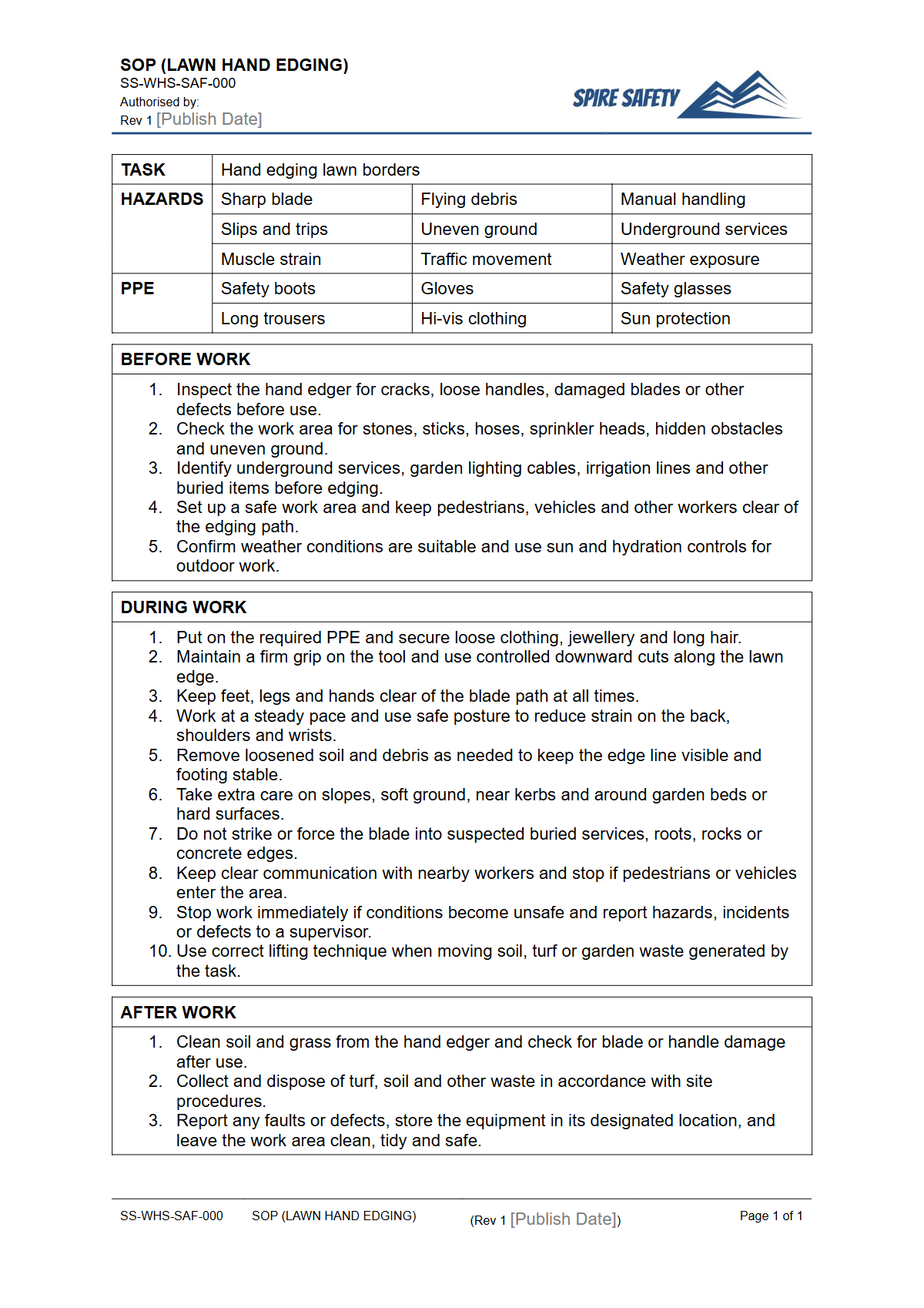
Purpose of the Free Safe Operating Procedure (Lawn Hand Edging) Template
This Free Safe Operating Procedure (Lawn Hand Edging) Template provides a structured framework for documenting the safe and correct method for edging lawns using manual tools. Creating a formal SOP helps standardise your process, ensuring every worker, from new hires to experienced groundskeepers, understands the required safety measures.
It details the step-by-step process, identifies potential hazards like sharp blades, musculoskeletal strain, and environmental risks, and outlines the control measures necessary to mitigate them. Implementing clear SOPs is a critical component of effective WHS management systems, demonstrating your organisation's commitment to proactive risk management.
Video walkthrough
How to use the Free Safe Operating Procedure (Lawn Hand Edging) Template
To get started, download the template in your preferred format. The DOCX file is fully editable, allowing you to add your company logo and tailor the content to your specific needs.
The PDF version is ready for immediate printing and use in the field. This document provides a solid foundation, but it must be adapted to reflect the realities of your workplace.
Important: This is a template, not a finished document. We have designed it as a starting point.
You must customise it to suit the specific tools (e.g., half-moon edger, spade), ground conditions, and personnel at your site. A site-specific risk assessment should be conducted to ensure all relevant hazards are identified and controlled before this procedure is finalised and implemented.
For other manual tasks involving powered tools, you might find our FREE Circular Saw SOP (Safe Operating Procedure) Template useful as a reference.
When to use it
A Safe Operating Procedure for lawn hand edging should be used consistently as part of your daily work routine. It is an essential tool for inducting and training new employees, ensuring they learn the correct, safe method from day one.
It also serves as a valuable resource for pre-start meetings or toolbox talks, allowing teams to quickly review safety protocols before commencing work. Having the SOP readily available in work vehicles or storage sheds provides a quick reference point for workers if they are unsure about any step of the process.
For tasks involving larger landscaping equipment, a procedure like our FREE Trencher SOP Template is equally critical.
Who should use it
This SOP is designed for any Person Conducting a Business or Undertaking (PCBU) whose workers perform groundskeeping or landscaping duties. This includes landscaping companies, local councils, schools, horticultural businesses, and facilities management services.
Supervisors and managers should use the SOP to train staff and monitor safe work practices. Workers must use it to guide their actions, ensuring they adhere to the established safety standards and minimise their risk of injury.
If you need assistance integrating SOPs into your broader safety framework, our WHS consulting team can provide expert guidance.
Key Elements of a Lawn Edging SOP
A comprehensive SOP for this task goes beyond just the action itself. Our template guides you through several critical stages to ensure a holistic approach to safety.
Pre-Operational Checks
Before any work begins, a series of checks is vital. This includes inspecting the tool for defects such as a loose handle, a dull or chipped blade, or splintering.
The work area must also be inspected for hazards like sprinkler heads, buried cables, rocks, uneven surfaces, or public access ways. This structured approach to equipment safety is fundamental for all tools, as outlined in procedures like our FREE Step Ladder SOP Template.
Operational Sequence
The procedure should detail the correct sequence of actions for performing the task safely. This includes specifying the proper stance and grip to minimise ergonomic strain, the correct application of force, and maintaining awareness of surroundings, particularly when working near paths or other people.
It should also define controls for environmental factors like sun exposure and hydration.
Post-Operational Tasks
Safety doesn't end when the edging is complete. The SOP outlines post-task requirements, including cleaning the tool to remove soil and debris, checking it again for any damage sustained during use, and storing it securely to prevent unauthorised access or accidental injury.
It also includes instructions for managing any green waste generated during the task. For more document templates to support your safety processes, browse our complete free WHS resources library.
Common mistakes
Common mistakes to avoid
- Using a dull or damaged tool, which requires more force and increases the risk of slipping.
- Failing to inspect the work area for hidden hazards like rocks, sprinkler heads, or uneven ground.
- Adopting poor posture (e.g., excessive bending or twisting), leading to back and shoulder strain over time.
- Neglecting to wear appropriate Personal Protective Equipment (PPE), especially safety glasses and sturdy footwear.
Legal references
Legal considerations
The following legal requirements may be relevant to this type of work.
- Work Health and Safety Act (Harmonised) — Provides the primary duties for protecting workers and other people from work health and safety risks.
- Work Health and Safety Regulations (Harmonised) — Sets out requirements supporting the management of workplace hazards and risks.
The following codes may be relevant to this type of work.
- Managing WHS Risks Code of Practice — Provides practical guidance on identifying hazards, assessing risks and applying effective controls.
- Work Health and Safety Consultation, Cooperation and Coordination Code of Practice — Provides practical guidance on consulting workers and coordinating with other duty holders.
- Managing the Work Environment and Facilities Code of Practice — Provides practical guidance on safe work environments, workplace facilities and related controls.
Did you know
Manual Labour Injuries
According to Safe Work Australia, musculoskeletal disorders, often resulting from hazardous manual tasks like gardening and landscaping, are the most common mechanism for serious workers' compensation claims.
FAQ
Frequently asked questions
01What is a Safe Operating Procedure for lawn hand edging?
02Why is an SOP necessary for a simple task like hand edging?
03Who is responsible for creating and implementing this SOP?
04How often should the lawn hand edging SOP be reviewed?
Share this resource
Free Safe Operating Procedure (Lawn Hand Edging) Template
Browse Categories
How To Use It
- 1Download and open in Word or PDF.
- 2Replace the placeholders with your business details.
- 3Get it reviewed by a WHS specialist before rollout.
Need it customised?
Our WHS consultants can adapt this template to your site, run a gap analysis, or audit what you already have in place.
Book a Free Consultation WHS consulting servicesor call 1300 156 382
Related templates
- Free Safe Operating Procedure (Lawn Overseeding) Template
- Free Safe Operating Procedure (Lawn Repair) Template
- Free Safe Operating Procedure (Lawn Top Dressing) Template
- Free Safe Operating Procedure (Leachate Area Check) Template
- Free Safe Operating Procedure (Leachate Spill Cleanup) Template
- Free Safe Operating Procedure (Lead Acid Battery Work) Template