
Free Safe Operating Procedure (Lawn Aeration) Template
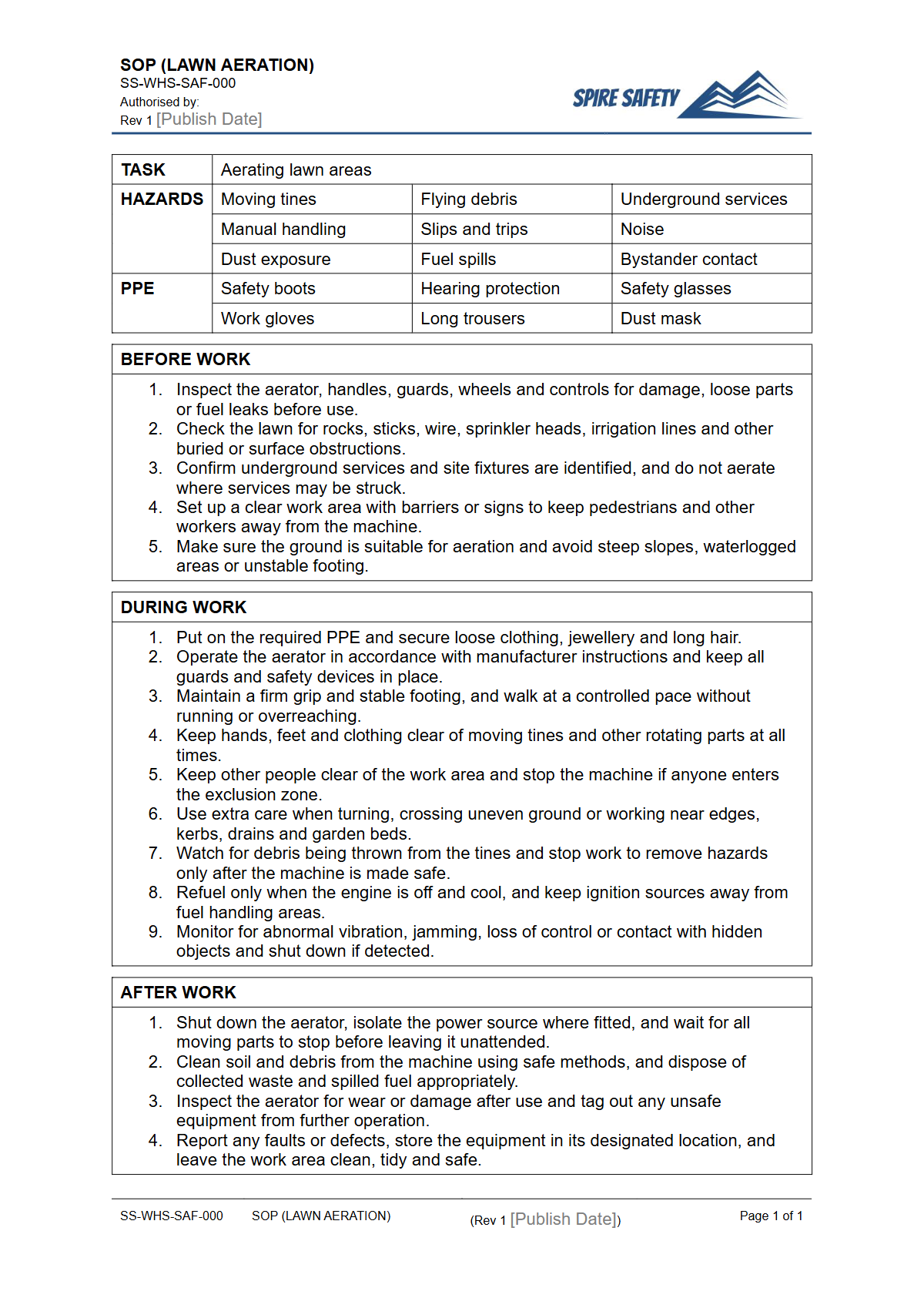
Download our free Safe Operating Procedure (Lawn Aeration) Template. This customisable DOCX & PDF helps you outline safe work methods for lawn aeration tasks.
Free Safe Operating Procedure (Lawn Aeration) Template
DOCX • 126 KB + PDF
Updated Oct 2026
No signup required
Purpose of the Free Safe Operating Procedure (Lawn Aeration) Template
Operating a lawn aerator, whether a walk-behind or ride-on model, introduces significant workplace hazards. This includes risks from rotating tines, projectiles, noise, and manual handling.
Our Free Safe Operating Procedure (Lawn Aeration) Template provides a structured framework to help your organisation document the safest way to perform this task. A well-drafted SOP is a critical tool for hazard identification and risk control, forming a key component of your overall safety management system.
It standardises the process, ensuring every worker follows the same safety-checked steps, every time.
By clearly defining the approved method for lawn aeration, you create a valuable resource for worker training and competency assessment. It formalises expectations around pre-start checks, operational safety, and shutdown procedures.
Implementing clear, documented procedures is fundamental to building robust WHS management systems that protect your workers and support your due diligence obligations.
Video walkthrough
How to use the Free Safe Operating Procedure (Lawn Aeration) Template
This resource is available for immediate download in both DOCX and PDF formats. The DOCX version is fully editable, allowing you to tailor it to your specific operational needs.
The SOP is pre-filled with common hazards and controls relevant to lawn aeration, but it must be adapted to your unique context. Similar to our FREE Trencher SOP Template, this document provides a solid foundation for you to build upon.
Important: This document is a template only. We have provided a structured starting point, but you must customise it to reflect the specific lawn aerator models, work environments, and control measures unique to your workplace.
Review and amend every section to ensure it aligns with your risk assessments and operational realities before implementation.
Customisation Steps:
- Plant & Equipment: Replace generic placeholder text with the specific make and model of the aerator(s) used on your site.
- Site-Specific Hazards: Add any hazards unique to your work areas, such as steep slopes, concealed irrigation systems, or proximity to public spaces.
- Control Measures: Adjust the recommended personal protective equipment (PPE) and safety controls to match your site's risk assessment findings.
- Emergency Procedures: Detail your specific emergency contacts and procedures for responding to an incident involving the equipment.
- Consultation: Involve your workers and supervisors in the drafting and review process. Their hands-on experience is invaluable for creating a practical and effective procedure.
When to use a Lawn Aeration SOP
A Safe Operating Procedure for lawn aeration should be a central part of your daily and long-term safety planning. It is used before any aeration task begins to guide pre-operational checks and ensure the area is clear of hazards.
It's an essential document for new worker inductions and for verifying the competency of existing staff. It should also be readily available in the work area for reference.
The SOP serves as a benchmark for supervisors conducting safety observations and for incident investigations to determine if procedures were followed.
This document should be reviewed periodically or whenever there is a change in equipment, processes, or following an incident. Keeping procedures up-to-date is as important as creating them.
For tasks in and around maintenance areas, you might also require procedures like a step ladder SOP template to manage other common risks.
Who should use this Safe Operating Procedure
This SOP template is designed for use by a range of personnel within organisations that perform groundskeeping and landscaping tasks. This includes landscaping companies, turf management businesses, local councils, schools, and golf courses.
- Workers and Operators: Use the final, customised SOP as a step-by-step guide to perform their work safely.
- Supervisors and Team Leaders: Use it to train staff, monitor work practices, and ensure safety standards are being met on-site.
- WHS Managers and Advisors: Use this template as a starting point for developing formal, site-specific procedures as part of the organisation's safety framework. Documents like this are often reviewed during a WHS compliance auditing process to verify that risks are being systematically managed.
The principles outlined are relevant to various ground-engaging equipment. If your work involves agriculture, you might find similar resources like our FREE Grain Drill SOP (Safe Operating Procedure) Template useful. For a wider selection of procedural documents, you can browse our complete free WHS resources library.
Common mistakes
Common mistakes to avoid
- Failing to inspect the area for foreign objects (rocks, sprinklers, debris) before starting.
- Operating the aerator on steep slopes or uneven ground, increasing rollover risk.
- Neglecting to wear appropriate PPE, especially steel-capped boots and hearing protection.
- Attempting to clear blockages or perform maintenance on the tines while the engine is running.
Legal references
Legal considerations
The following legal requirements may be relevant to this type of work.
- Work Health and Safety Act (Harmonised) — Provides the primary duties for protecting workers and other people from work health and safety risks.
- Work Health and Safety Regulations (Harmonised) — Sets out requirements supporting the management of workplace hazards and risks.
The following codes may be relevant to this type of work.
- Managing WHS Risks Code of Practice — Provides practical guidance on identifying hazards, assessing risks and applying effective controls.
- Work Health and Safety Consultation, Cooperation and Coordination Code of Practice — Provides practical guidance on consulting workers and coordinating with other duty holders.
- Managing the Work Environment and Facilities Code of Practice — Provides practical guidance on safe work environments, workplace facilities and related controls.
Did you know
Core vs. Spike
The two main types of lawn aerators are 'spike aerators', which poke holes in the soil, and 'core' or 'plug' aerators, which physically remove small plugs of turf and soil for more effective compaction relief.
Healthy Roots
Lawn aeration can significantly reduce soil compaction, allowing water, air, and nutrients to reach the grass roots more effectively, which promotes healthier and more resilient turf growth.
FAQ
Frequently asked questions
01What hazards are associated with lawn aeration?
02Is a Safe Operating Procedure a legal requirement in Australia?
03What should be included in pre-start checks for a lawn aerator?
04How often should lawn aeration SOPs be reviewed?
Share this resource
Free Safe Operating Procedure (Lawn Aeration) Template
Browse Categories
How To Use It
- 1Download and open in Word or PDF.
- 2Replace the placeholders with your business details.
- 3Get it reviewed by a WHS specialist before rollout.
Need it customised?
Our WHS consultants can adapt this template to your site, run a gap analysis, or audit what you already have in place.
Book a Free Consultation WHS consulting servicesor call 1300 156 382
Related templates
- Free Safe Operating Procedure (Lawn Fertilising) Template
- Free Safe Operating Procedure (Lawn Hand Edging) Template
- Free Safe Operating Procedure (Lawn Overseeding) Template
- Free Safe Operating Procedure (Lawn Repair) Template
- Free Safe Operating Procedure (Lawn Top Dressing) Template
- Free Safe Operating Procedure (Leachate Area Check) Template