
Free Safe Operating Procedure (Lavatory Service Cart) Template
Download our Free Safe Operating Procedure (Lavatory Service Cart) Template. Customise this DOCX & PDF to manage risks and outline safe work steps.
Free Safe Operating Procedure (Lavatory Service Cart) Template
DOCX • 126 KB + PDF
Updated Oct 2026
No signup required
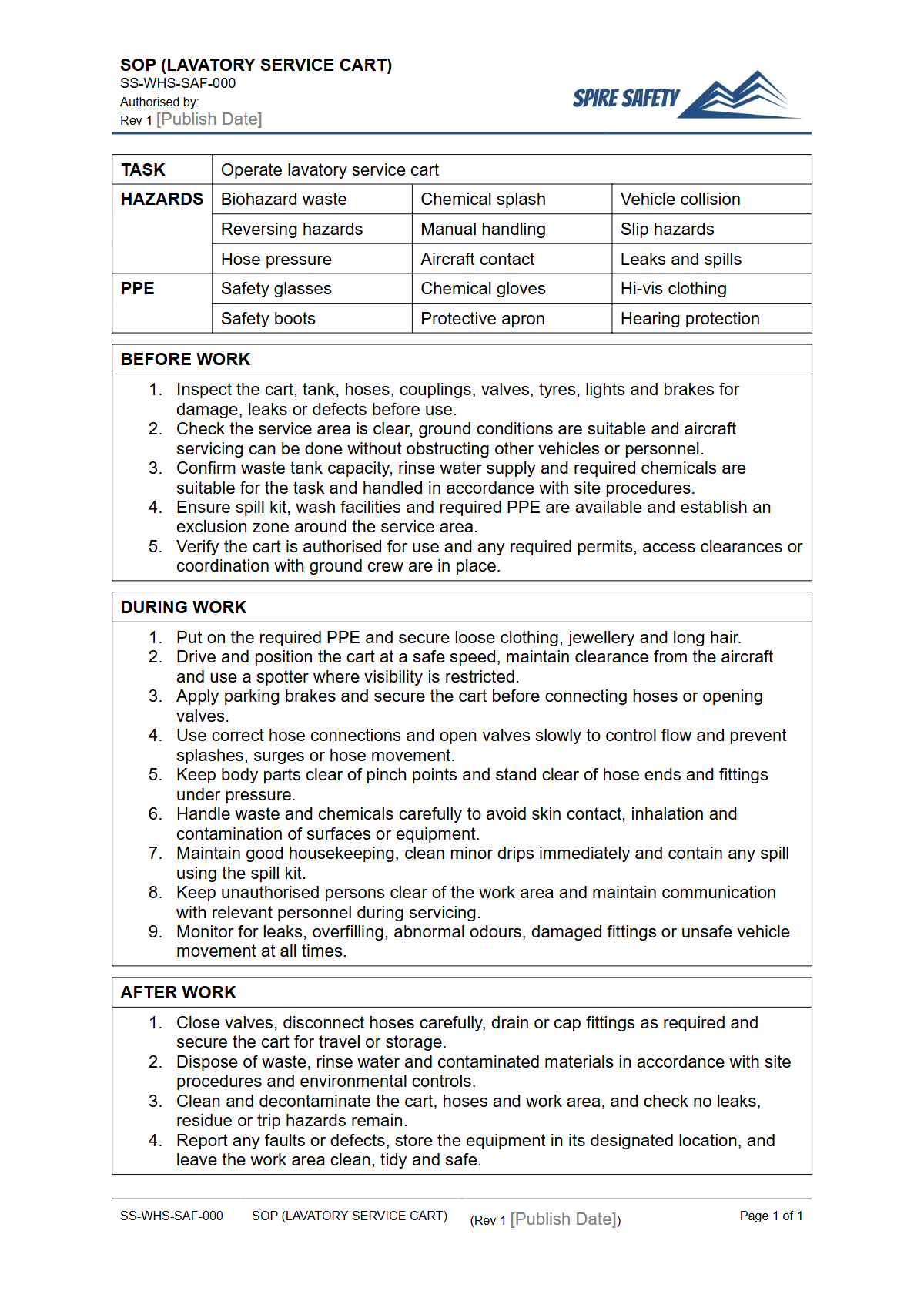
Purpose of the Free Safe Operating Procedure (Lavatory Service Cart) Template
Operating ground support equipment like a lavatory service cart involves specific risks that must be managed to ensure worker safety and prevent environmental contamination. This Free Safe Operating Procedure (Lavatory Service Cart) Template provides a structured framework for documenting the required steps for pre-operational checks, safe operation, and post-operational duties.
It helps organisations control hazards associated with vehicle movement, manual handling, chemical exposure from disinfectants, and biological exposure from waste materials. Implementing a clear SOP is a critical component of all robust WHS management systems, forming part of your safe system of work.
Video walkthrough
How to use the Free Safe Operating Procedure (Lavatory Service Cart) Template
This document is a template that must be customised for your specific workplace. After downloading the DOCX or PDF file, you should consult with operators and supervisors to add details relevant to your site.
This includes the specific make and model of your lavatory service carts, the types of aircraft serviced, site-specific traffic management rules, and the exact chemicals used for flushing and disinfection. It's also vital to include your site's emergency procedures and contact information. Effective SOPs are practical documents used daily, not just paperwork filed away; their effectiveness is often scrutinised during WHS compliance auditing.
Important: This is a template only. Before use, you must customise it to reflect the specific equipment, chemicals, and procedures at your workplace.
We are not responsible for any incidents that may occur from using this document.
The SOP should be used as a basis for worker training, induction, and competency assessments. Consider pairing it with other procedural documents for similar mobile equipment, such as our free Telehandler SOP template, to ensure consistency in your approach to operational safety.
Regularly review and update the SOP to reflect any changes in equipment, procedures, or regulations.
When to use a Safe Operating Procedure
A Safe Operating Procedure for a lavatory service cart should be developed and implemented before any worker is permitted to operate the equipment. It is a key reference document that should be readily accessible in the work area.
Use this SOP during initial operator training, for periodic refresher training, and as a guide for supervisors conducting safety observations. The procedure should also be reviewed as part of any incident investigation involving the equipment to identify potential gaps or areas for improvement.
It serves a similar function to documents for fixed plant, like our free Air Compressor SOP template, by providing clear, unambiguous instructions.
Who should use this Safe Operating Procedure
This SOP is intended for several groups within an organisation. Primarily, it is for the trained and authorised operators of the lavatory service cart who must follow the outlined steps to perform their duties safely.
Supervisors and team leaders should use it to oversee operations, enforce safe work practices, and conduct pre-start checks or safety inspections. WHS managers and personnel can use it to fulfil their due diligence obligations by ensuring formalised procedures are in place for high-risk tasks.
It is also an essential tool for trainers responsible for developing and delivering competency-based training programs. Preparing for emergencies is also a key part of any procedure; you may find value in reviewing our Safe Operating Procedure for Defibrillator Operation to strengthen your site's overall preparedness.
This document is one of many templates designed to assist Australian businesses in managing their safety obligations. You can explore a wide range of similar documents in our comprehensive free WHS resources library, covering various plant, equipment, and high-risk work tasks.
Common mistakes
Common mistakes to avoid
- Failing to properly check hose connections, leading to leaks and spills of waste or chemical concentrate.
- Using inadequate or damaged Personal Protective Equipment (PPE), particularly gloves and eye protection.
- Neglecting to use wheel chocks on the service cart or ensure the aircraft is properly secured before approaching.
- Poor communication with the flight crew or other ground personnel, creating collision or interference risks.
Legal references
Legal considerations
The following legal requirements may be relevant to this type of work.
- Work Health and Safety Act (Harmonised) — Provides the primary duties for protecting workers and other people from work health and safety risks.
- Work Health and Safety Regulations (Harmonised) — Sets out requirements supporting the management of workplace hazards and risks.
The following codes may be relevant to this type of work.
- Managing WHS Risks Code of Practice — Provides practical guidance on identifying hazards, assessing risks and applying effective controls.
- Work Health and Safety Consultation, Cooperation and Coordination Code of Practice — Provides practical guidance on consulting workers and coordinating with other duty holders.
- Managing the Work Environment and Facilities Code of Practice — Provides practical guidance on safe work environments, workplace facilities and related controls.
Did you know
Turnaround Times
Efficient ground handling, including lavatory servicing, is critical for airline operations. A typical turnaround for a narrow-body aircraft like a Boeing 737 can be as short as 30-40 minutes.
Blue Juice
The blue disinfectant fluid used in aircraft lavatories is a carefully formulated biocide and deodorant. Its composition is designed to be effective at high altitudes and varying temperatures.
FAQ
Frequently asked questions
01What are the main hazards when operating a lavatory service cart?
02What PPE is required for servicing aircraft lavatories?
03How often should an SOP for a lavatory service cart be reviewed?
04Can this template be used for any model of lavatory service cart?
Share this resource
Free Safe Operating Procedure (Lavatory Service Cart) Template
Browse Categories
How To Use It
- 1Download and open in Word or PDF.
- 2Replace the placeholders with your business details.
- 3Get it reviewed by a WHS specialist before rollout.
Need it customised?
Our WHS consultants can adapt this template to your site, run a gap analysis, or audit what you already have in place.
Book a Free Consultation WHS consulting servicesor call 1300 156 382
Related templates
- Free Safe Operating Procedure (Lawn Aeration) Template
- Free Safe Operating Procedure (Lawn Fertilising) Template
- Free Safe Operating Procedure (Lawn Hand Edging) Template
- Free Safe Operating Procedure (Lawn Overseeding) Template
- Free Safe Operating Procedure (Lawn Repair) Template
- Free Safe Operating Procedure (Lawn Top Dressing) Template