
Free Safe Operating Procedure (Laundry Sorting) Template
Download our free Safe Operating Procedure (Laundry Sorting) template. This customisable DOCX & PDF is a structured starting point for Australian businesses.
Free Safe Operating Procedure (Laundry Sorting) Template
DOCX • 126 KB + PDF
Updated Oct 2026
No signup required
Purpose of the Free Safe Operating Procedure (Laundry Sorting) Template
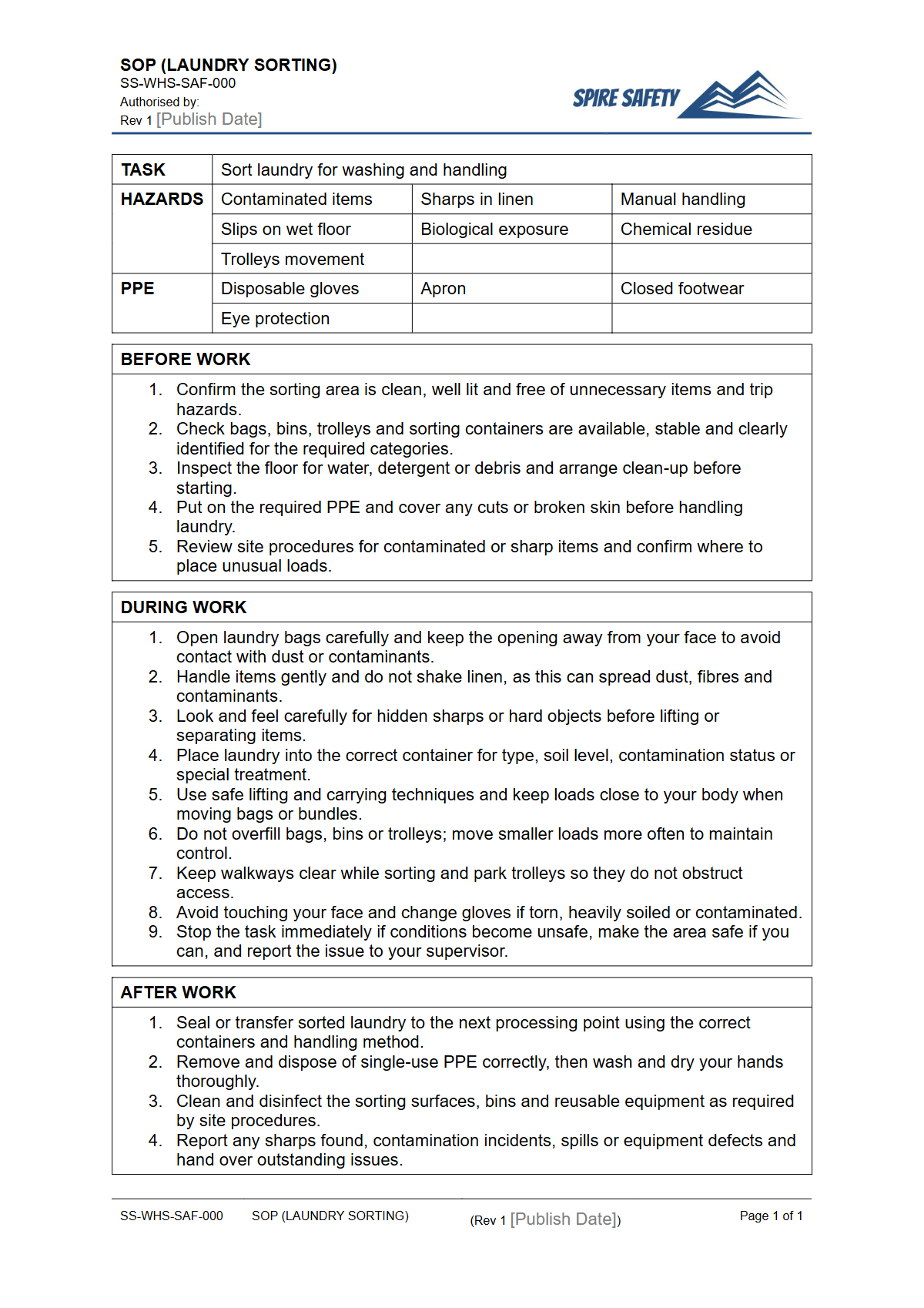
This Free Safe Operating Procedure (Laundry Sorting) Template provides a structured framework for documenting the safe handling and sorting of linen in commercial or institutional settings. It is designed to help businesses outline key steps, identify potential hazards, and implement control measures to minimise risks.
Using this SOP can assist in fulfilling your duty of care by formalising procedures for tasks that involve manual handling, potential exposure to biological hazards, and interaction with laundry chemicals. It serves as a critical tool for worker training and ensures a consistent, safety-focused approach is applied by all team members.
Video walkthrough
How to use the Free Safe Operating Procedure (Laundry Sorting) Template
This template is provided in both DOCX and PDF formats for your convenience. To effectively use this Safe Operating Procedure, download the DOCX file and adapt it to the specific conditions of your workplace.
This involves adding your company branding, identifying the specific types of laundry handled (e.g., from healthcare, hospitality, or industrial sites), and listing the exact equipment and chemicals used. Consultation with workers who perform the task is essential to ensure the procedure is practical and reflects on-the-ground reality.
Important: We have created this template as a guide. You must customise it to reflect the specific hazards, equipment, and procedures in your workplace.
A generic procedure is not sufficient to manage your unique health and safety risks.
When to use a Laundry Sorting SOP
A Safe Operating Procedure for laundry sorting should be a core document within your safety management system. It is used during the induction and training of new employees to establish safe work habits from day one.
It also serves as a valuable refresher for existing staff and a reference point for pre-task risk assessments. The SOP is particularly important in environments like hotels, hospitals, aged care facilities, and large-scale commercial laundries where staff turnover can be high and the risks associated with soiled linen are significant.
It also provides a clear benchmark for performance during safety observations or incident investigations.
Who should use it
This template is designed for use by Persons Conducting a Business or Undertaking (PCBUs), managers, supervisors, and health and safety representatives. Managers and PCBUs can use it to ensure they are providing a safe system of work.
Supervisors rely on it to train, monitor, and instruct workers correctly. Workers should use the finalised SOP as their guide to performing laundry sorting tasks safely, understanding the hazards and the controls they must apply.
Integrating this procedure into your broader framework helps build robust WHS management systems and a positive safety culture.
Key Hazards in Laundry Sorting
Sorting laundry may seem like a simple task, but it carries several significant WHS risks that must be managed. A thorough risk assessment is the first step in identifying these hazards in your specific context.
Hazardous Manual Tasks
This is one of the most common risks, involving lifting heavy laundry bags, repetitive bending and reaching into deep bins, pushing and pulling heavy trolleys, and prolonged standing. These actions can lead to musculoskeletal disorders (MSDs).
If you need assistance with ergonomic assessments, engaging with expert WHS consulting services can provide valuable insights.
Biological and Chemical Hazards
Soiled linen, especially from healthcare or accommodation settings, can be contaminated with bacteria, viruses, fungi, and bodily fluids. There is also a risk of exposure to detergents, disinfectants, and stain-removal chemicals, which can cause skin irritation, allergies, or respiratory issues.
Proper PPE is essential for mitigation.
Sharps and Foreign Objects
A critical hazard is the potential for sharps like needles, syringes, broken glass, or other sharp items to be hidden in laundry. A puncture wound or cut from a contaminated sharp can lead to serious infection or disease.
Your emergency plan should include a clear response for sharps injuries and access to first aid, which may involve referencing your safe operating procedure for defibrillator operation for cardiac arrest scenarios.
Slips, Trips, and Falls
Wet floors from leaking machines or spills, along with laundry bags or carts obstructing walkways, create a significant risk of slips, trips, and falls. Good housekeeping practices are vital. At times, staff may need to access linen stored on high shelving, which requires a safe method of access, as outlined in documents like a step ladder SOP.
Reviewing and Improving Your Laundry Sorting Procedures
An SOP is not a 'set and forget' document. It should be reviewed regularly—typically annually, or whenever there is a change in equipment, chemicals, processes, or following an incident.
This continuous improvement cycle ensures the procedure remains effective and relevant. Conducting regular WHS compliance auditing can help verify that the procedures documented in the SOP are being consistently followed in practice. For more templates and safety guides, explore our complete free WHS resources library.
Common mistakes
Common mistakes to avoid
- Using a generic template without customising it for site-specific equipment, chemicals, and hazards.
- Failing to consult with and properly train workers on the finalised SOP.
- Neglecting to include a clear, specific procedure for identifying and safely handling sharps found in laundry.
- Not enforcing the use of the required Personal Protective Equipment (PPE) specified in the procedure.
Legal references
Legal considerations
The following legal requirements may be relevant to this type of work.
- Work Health and Safety Act (Harmonised) — Provides the primary duties for protecting workers and other people from work health and safety risks.
- Work Health and Safety Regulations (Harmonised) — Sets out requirements supporting the management of workplace hazards and risks.
The following codes may be relevant to this type of work.
- Managing WHS Risks Code of Practice — Provides practical guidance on identifying hazards, assessing risks and applying effective controls.
- Work Health and Safety Consultation, Cooperation and Coordination Code of Practice — Provides practical guidance on consulting workers and coordinating with other duty holders.
- Managing the Work Environment and Facilities Code of Practice — Provides practical guidance on safe work environments, workplace facilities and related controls.
Did you know
Manual Handling Risk
According to Safe Work Australia, manual handling injuries account for a significant portion of all serious workers' compensation claims, with the healthcare and social assistance industry being one of the most affected.
Hidden Dangers
A study on hotel laundry found that items like television remotes and bedspreads can harbour high levels of bacteria, highlighting the unseen biological risks workers face when handling used linen.
FAQ
Frequently asked questions
01What is a Safe Operating Procedure for laundry sorting?
02How often should we review our laundry sorting SOP?
03Who is responsible for writing a Laundry Sorting SOP?
04What PPE is generally required for sorting laundry?
Share this resource
Free Safe Operating Procedure (Laundry Sorting) Template
Browse Categories
How To Use It
- 1Download and open in Word or PDF.
- 2Replace the placeholders with your business details.
- 3Get it reviewed by a WHS specialist before rollout.
Need it customised?
Our WHS consultants can adapt this template to your site, run a gap analysis, or audit what you already have in place.
Book a Free Consultation WHS consulting servicesor call 1300 156 382
Related templates
- Free Safe Operating Procedure (Laundry Stain Treatment) Template
- Free Safe Operating Procedure (Laundry Trolley Clean) Template
- Free Safe Operating Procedure (Laundry Washer) Template
- Free Safe Operating Procedure (Lavatory Service Cart) Template
- Free Safe Operating Procedure (Lawn Aeration) Template
- Free Safe Operating Procedure (Lawn Fertilising) Template