
Free Safe Operating Procedure (Laundry Trolley Clean) Template
Download our free Safe Operating Procedure (Laundry Trolley Clean) template.
Free Safe Operating Procedure (Laundry Trolley Clean) Template
DOCX • 126 KB + PDF
Updated Oct 2026
No signup required
Purpose of the Free Safe Operating Procedure (Laundry Trolley Clean) Template
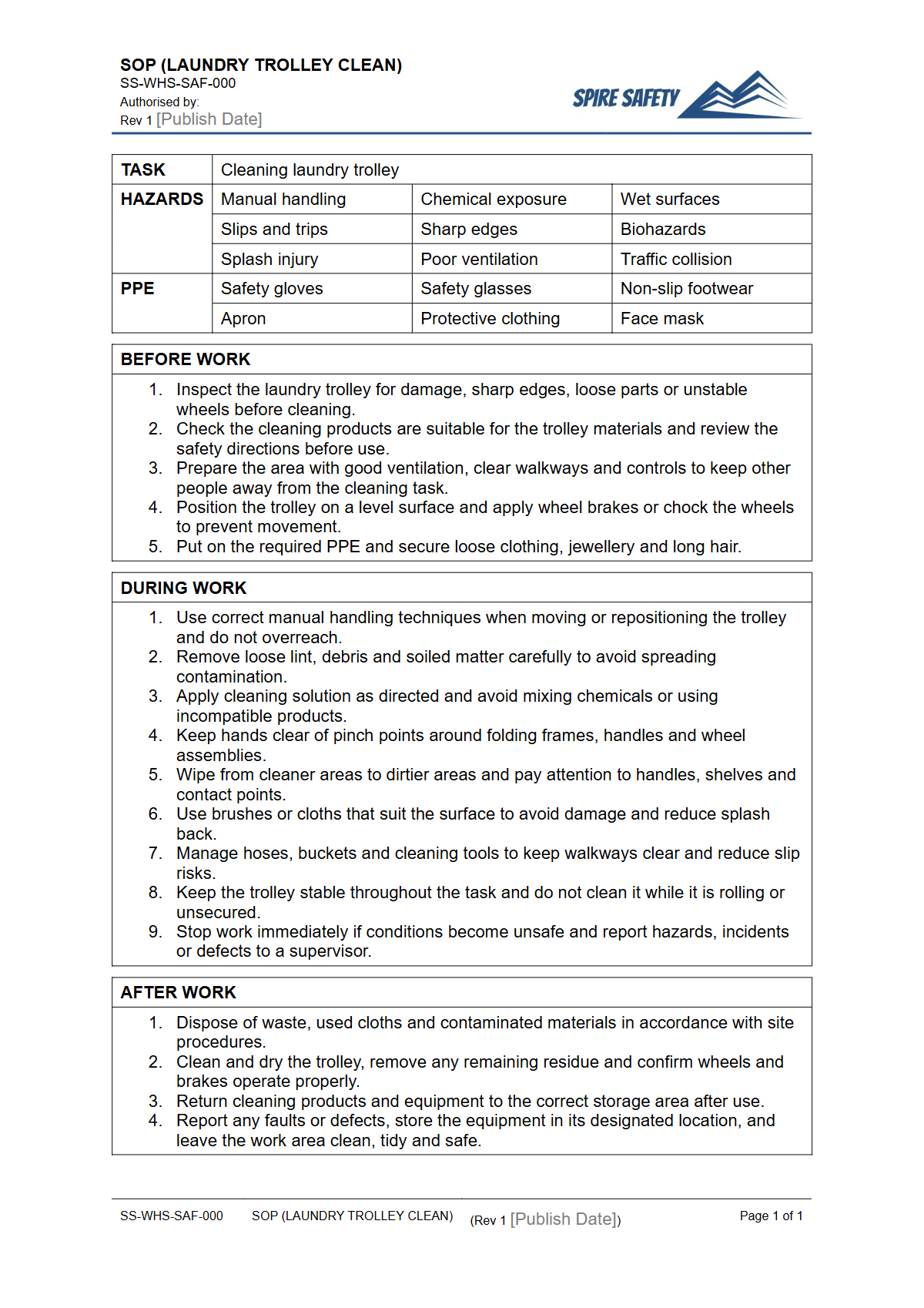
This Free Safe Operating Procedure (Laundry Trolley Clean) Template provides a comprehensive framework for workers to follow, ensuring laundry trolleys are cleaned safely and effectively. Proper cleaning is critical in environments like healthcare, aged care, hospitality, and commercial laundries to prevent cross-contamination and maintain hygiene standards.
This SOP helps Persons Conducting a Business or Undertaking (PCBUs) fulfil their duty of care by establishing a documented safe system of work.
Using this template helps control common risks associated with the task, including manual handling injuries from moving heavy or awkward trolleys, exposure to hazardous cleaning chemicals, contact with biological hazards, and the creation of slip and trip hazards. Documenting these steps is a fundamental part of an effective WHS management system, providing clarity for workers and evidence of risk management processes.
What is a Safe Operating Procedure?
A Safe Operating Procedure (SOP) is a written document that provides step-by-step instructions on how to safely perform a specific task or operate machinery. It outlines potential hazards and the control measures required to eliminate or minimise the risk of injury or illness.
An SOP is a key administrative control used in workplaces across Australia.
Video walkthrough
How to use the Free Safe Operating Procedure (Laundry Trolley Clean) Template
This resource is available for download as a DOCX file for easy customisation and as a PDF for convenient printing and distribution. To make it your own, simply add your company logo and specific details relevant to your site, such as the exact types of trolleys used, the approved cleaning agents, and the location of safety equipment like spill kits and first aid stations.
Important: This document is a template only. We provide it as a starting point, aligned with Australian WHS principles.
You must review, edit, and customise this SOP to suit the unique conditions of your workplace. This includes consulting with your workers and incorporating their feedback to ensure the procedure is practical and effective.
If you need assistance with tailoring safety documents, our expert WHS consulting services can provide tailored support.
When to use this Safe Operating Procedure
An SOP for cleaning laundry trolleys should be a core part of your workplace safety and training program. It should be used:
- As a primary training document before a worker performs the task for the first time.
- During induction for new employees who will be involved in laundry or cleaning operations.
- For regular refresher training to reinforce safe work habits.
- As a reference tool for supervisors to monitor and correct work practices.
- As part of an investigation following an incident or near-miss to review and improve procedures.
Consistent application and review of SOPs are often checked during formal WHS compliance auditing to verify that safe systems of work are being implemented correctly.
Who should use this Safe Operating Procedure
This SOP is designed for use by a range of personnel within an organisation to ensure a consistent approach to safety. The primary users are:
- Workers: Cleaners, laundry attendants, orderlies, and maintenance staff who are directly responsible for cleaning the trolleys.
- Supervisors and Managers: Individuals overseeing laundry or facilities management who are responsible for ensuring procedures are followed and workers are adequately trained.
- WHS Representatives: Safety officers and committee members who use the document for risk assessments, training development, and workplace inspections.
Documented procedures are vital for all workplace tasks, not just those involving heavy machinery. A clear process for cleaning a trolley is just as important as having our Safe Operating Procedure for defibrillator operation available in an emergency.
Key elements of a robust Safe Operating Procedure
A well-drafted SOP should be clear, concise, and easy for any worker to understand. This template provides a structured format that covers the essential components, including the required Personal Protective Equipment (PPE), a logical sequence of steps, and emergency response actions.
Other examples, like our free step ladder SOP, follow a similar structure to ensure consistency across different tasks.
Essential sections include:
- Pre-operational Checks: Inspecting the trolley for damage and ensuring the work area is clear.
- Task Breakdown: A step-by-step guide from preparation to cleaning and final inspection.
- Hazard Identification: Listing potential hazards (e.g., chemical splash, ergonomic strain) and their controls.
- Required PPE: Specifying gloves, eye protection, and any other necessary gear.
- Emergency Procedures: Instructions for chemical spills, first aid, or other incidents.
By customising this document, you create a tool that not only guides behaviour but also strengthens your overall safety culture. For more templates and safety guides, explore our extensive library of free WHS resources.
Common mistakes
Common mistakes to avoid
- Using incorrect or unauthorised cleaning chemicals, leading to surface damage or ineffective cleaning.
- Failing to wear the specified Personal Protective Equipment (PPE), such as gloves and eye protection.
- Neglecting to inspect the trolley for damage (e.g., sharp edges, faulty wheels) before or after cleaning.
- Leaving the trolley or surrounding floor wet, creating a serious slip hazard for others.
Legal references
Legal considerations
The following legal requirements may be relevant to this type of work.
- Work Health and Safety Act (Harmonised) — Provides the primary duties for protecting workers and other people from work health and safety risks.
- Work Health and Safety Regulations (Harmonised) — Sets out requirements supporting the management of workplace hazards and risks.
The following codes may be relevant to this type of work.
- Managing WHS Risks Code of Practice — Provides practical guidance on identifying hazards, assessing risks and applying effective controls.
- Work Health and Safety Consultation, Cooperation and Coordination Code of Practice — Provides practical guidance on consulting workers and coordinating with other duty holders.
- Managing the Work Environment and Facilities Code of Practice — Provides practical guidance on safe work environments, workplace facilities and related controls.
Did you know
Cross-Contamination Risk
In healthcare settings, inadequately cleaned laundry trolleys can become a vector for transmitting infections. A documented cleaning procedure is a simple but critical infection control measure.
Manual Tasks
According to Safe Work Australia, manual handling injuries are the most common type of workplace injury in the country. A good SOP will include instructions on safe pushing, pulling, and manoeuvring of equipment like trolleys.
FAQ
Frequently asked questions
01What is a Safe Operating Procedure for cleaning a laundry trolley?
02Why is an SOP important for a simple task like cleaning a trolley?
03What hazards are associated with cleaning laundry trolleys?
04Does this template cover chemical handling for cleaning?
Share this resource
Free Safe Operating Procedure (Laundry Trolley Clean) Template
Browse Categories
How To Use It
- 1Download and open in Word or PDF.
- 2Replace the placeholders with your business details.
- 3Get it reviewed by a WHS specialist before rollout.
Need it customised?
Our WHS consultants can adapt this template to your site, run a gap analysis, or audit what you already have in place.
Book a Free Consultation WHS consulting servicesor call 1300 156 382
Related templates
- Free Safe Operating Procedure (Laundry Washer) Template
- Free Safe Operating Procedure (Lavatory Service Cart) Template
- Free Safe Operating Procedure (Lawn Aeration) Template
- Free Safe Operating Procedure (Lawn Fertilising) Template
- Free Safe Operating Procedure (Lawn Hand Edging) Template
- Free Safe Operating Procedure (Lawn Overseeding) Template